
Family Therapy Worksheets for Assessment, Repair, and Practice

Outline
Authored by Dr. Elena Vasquez, licensed psychologist (PsyD), play-therapy and child-and-family-therapy trained, with a family-systems lens across home, school, and clinic.
Families rarely arrive asking for a form. They arrive with a story about one person, and they want that story confirmed. Family therapy worksheets give the clinician a way to slow that collapse: name the job in the system, put more than one perspective on paper, and keep the referred member from becoming the only person the hour is allowed to see.
Licensed therapists and supervised family-therapy trainees choose a family-system form after the presenting concern is already in view. Keep the broader worksheet rules from the therapy worksheets clinical guide when you still need them. For individual work, match a worksheet to the presenting concern and modality. The twelve formats are session sheets you adapt in the room. They are not a downloadable family pack.
Educational content for licensed therapists, not clinical or legal advice. Worksheet selection sits inside formulation, consent, and risk review. What follows is family-systems choreography, not a protocol, custody opinion, or crisis procedure.
This is not a consumer relationship printable
A consumer page tells a household to sit down and get along. Family therapy worksheets belong in a licensed session, not in a printable gallery aimed at a better week at home. The therapist chooses the form, says what it is for, names who will write or speak, and decides whether the paper even belongs in a shared room.
The difference shows up in three places:
- Whose problem the page is allowed to name. Family-systems work treats the referred person as part of a pattern, not as the cause of the hour. Minuchin’s structural frame still holds here: the therapist watches proximity, coalition, and the identified-patient slot, then asks the paper to show the pattern instead of prosecuting the person.
- Who is allowed to refuse. A child, a quiet partner, or a member who cannot read the language on the page can pass. Completion is not engagement.
- What the paper must not become. A worksheet is not proof for a custody file, a school meeting, or one adult’s case against another. If that is how the family will use it, the form stays in the drawer.
If the hour still needs orientation, consent, and several accounts of the concern before anyone writes, start with the family therapy intake form. If the missing map is three-generation structure rather than a present-tense task, use the family therapy genogram template. When several households share one facilitated hour rather than a single-family worksheet, use family group therapy activities.
Choose by family-system job, session stage, and developmental fit
Choose family therapy worksheets by the job in the system, not by the prettiest printable. Early sessions often need a shared problem-definition line or a multiple-perspectives map so the referred member is not the only author. Mid-work often needs a cycle map, a communication sequence, or a repair plan. Later work can hold a routine experiment or a session review. When the next hour needs home or school observation of one named behavior rather than a multi-perspective session format, use behavior worksheets. For measurable ADHD SMART goals across home, school, and clinic, use the ADHD treatment plan goals PDF. When the identified client is an adult outpatient chart that needs the SMART split, not a home-school reporter field, use the treatment plan goals and objectives for ADHD PDF. Developmental fit cuts across all of that. A form that asks a seven-year-old for a written request is already the wrong form.
Scroll the table sideways to view every column
| Family-system job | Format | Who contributes | Stop cue |
|---|---|---|---|
| Several preferred changes without a single culprit | Shared problem-definition sheet | Each member writes or dictates a private line | Only the referred child is asked to fill it |
| Sequence of moves instead of character labels | Circular interaction-cycle map | Therapist scribes; members correct | "They always" language takes over the page |
| Times the pattern did not run the house | Strengths and exceptions map | Anyone who can name a real exception | The page becomes a gratitude lecture |
| Spoken versus assumed household jobs | Roles and expectations map | Each member names own role and one they assign | The form audits one parent or one teen |
| Same event, several accounts | Multiple-perspectives map | Each member; therapist holds the page | Used to catch someone in a lie |
| Talk turns, interruptions, translators | Communication-sequence observer | Therapist or a member who is not speaking | Scorecard of who is rude |
| Protest turned into a specific ask | Needs-to-request translator | One member at a time | Joint request practice where control or fear is present |
| Early cues before the fight is a fight | Escalation cues and pause plan | Each member names own cues | Used to police one person's anger |
| Small repair after a rupture | Repair-attempt planner | The person who will try the repair | The injured person is coached to forgive on paper |
| One household transition as a trial | Routine and transition experiment | People who actually run that transition | Becomes a parenting lecture to the child |
| What the adult holds versus what the young person practices | Caregiver-young-person scaffolding plan | Caregiver and young person | Child asked for adult insight, or teen used as co-therapist |
| Close the hour without a new identified patient | Family session review sheet | Each member plus the therapist's next step | Used as a report card |
Carr’s review of family therapy and systemic interventions for child-focused problems is evidence that the relational frame matters. It is not evidence for any particular sheet. The paper follows the formulation. It does not create it.
Keep the page from becoming evidence against one member
Households already know how to use documents. They bring report cards, texts, and screenshots. A worksheet that only the referred person completes will join that pile.
Keep the page even-handed:
- Give every participating member the same prompt, or say out loud why one person is writing and the others are witnessing.
- Offer a pass. A blank line can be clinical data. It is not noncompliance.
- Scribe when literacy, language, motor access, or shame would turn handwriting into a test.
- Separate observation from verdict. “After dinner, the teenager goes quiet and a parent raises their voice” is a sequence. “The teenager is defiant and the parent is explosive” is a case.
- Do not send a completed sheet into a shared family chat, a school portal, or a lawyer’s inbox.
When two or more people in a relationship are in the room, AAMFT Standard 1.2 requires informed consent for the service you are actually providing, and Standard 2.1 requires you to disclose confidentiality limits. APA Standard 10.02 requires psychologists to clarify at the outset which individuals are clients and the relationship with each person. If the family did not agree that this sheet could be seen by every adult in the room, do not pass it around.
Twelve formats for clinician-led family sessions
Treat the twelve family therapy worksheets as formats, not files. Each format lists a job, the minimum fields, an introduction line that does not assign blame, a developmental adaptation, a stop cue, and how the sheet returns to treatment. Use one. Switching mid-session because the first sheet felt incomplete usually means the job was never named.
1. Shared problem-definition and preferred-change sheet
Job. Externalize several pictures of the problem and several preferred changes before the family votes.
Who. Each member writes or dictates. The therapist does not merge the lines in the room.
Minimum fields. What I see as the problem. What I want more of. One move I will not ask anyone to make today.
Introduce. “Everyone answers the same three lines. We are collecting pictures, not picking a winner.”
Developmental adaptation. A child draws the house as it is and the house as they wish it. A teen may keep the “what I will not ask” line private for now.
Stop. The referred child is the only person handed a pen.
Return. Read the gaps as a hypothesis about coalitions and hope. Do not tally votes.
2. Circular interaction-cycle map
Job. Replace character labels with a sequence of moves.
Who. The therapist scribes. Members correct the sequence.
Minimum fields. Who did what first. The next move. The next. How it usually ends. One time it ended differently.
Introduce. “We are drawing a loop, not a villain.”
Developmental adaptation. Use toys, arrows, or a walk-around of the room for younger children. Keep language behavioral.
Stop. The page fills with “because they always.”
Return. Pick one link in the cycle to interrupt next time, not the whole personality of the person at that link.
3. Family strengths and exceptions map
Job. Locate times the pattern did not run the household.
Who. Anyone who can name a real exception, including a child who remembers a quieter morning.
Minimum fields. When the problem was smaller. Who did what instead. What else was happening that day.
Introduce. “We are looking for a time the pattern lost, not for a reason to drop the concern.”
Developmental adaptation. Ask the child for a concrete scene: breakfast, pickup, bedtime. Avoid abstract “what is going well.”
Stop. The page becomes a lecture on gratitude that silences the complaint that brought them in.
Return. Thicken one exception. Do not paper over risk.
4. Roles and expectations map
Job. Make spoken and assumed household jobs visible.
Who. Each member names their own role and one role they think another person holds.
Minimum fields. The job I think I have. The job I think you have. The job nobody claimed. What happens when that job is missed.
Introduce. “We are mapping jobs, including unofficial ones. This is not a performance review.”
Developmental adaptation. A child may name who helps with homework, who leaves, and who comforts. Do not ask them to evaluate a parent’s character.
Stop. The form is used to audit one parent or one teenager.
Return. Renegotiate one role. Leave the rest for later.
5. Multiple-perspectives map
Job. Hold several accounts of the same event without a verdict.
Who. Each member. The therapist holds the page so no one edits another person’s line.
Minimum fields. What I saw. What I thought it meant. What I needed. What I still do not know.
Introduce. “If these lines disagree, that is information. It is not a lie detector.”
Developmental adaptation. Younger children may tell the story with figures. Teens may need a private pass on the “what it meant” line if adults will weaponize it.
Stop. Anyone uses the page to catch someone in a contradiction.
Return. Name the distance between accounts as the next clinical object.
6. Communication-sequence observer
Job. Track talk turns, interruptions, and who translates for whom.
Who. The therapist, or a member who is not the current speaker.
Minimum fields. Who spoke. Who interrupted. Who explained the child to the room. Who went quiet. What the quiet person might have been holding.
Introduce. “We are watching the sequence of the talk, not grading manners.”
Developmental adaptation. For a child, mark whose body turned toward whom. Do not ask the child to referee the adults.
Stop. The page becomes a scorecard of who is rude.
Return. Replay one sequence slower. Do not assign a week of “use your words” homework that only the child will be graded on.
7. Needs-to-request translator
Job. Convert protest into a specific request without requiring the other person to agree.
Who. One member at a time. Optional swap later.
Minimum fields. The protest in its current form. The need underneath. A request small enough to say in one sentence. What I will do if the answer is no.
Introduce. “A request is not a verdict on the other person. They can still say no.”
Developmental adaptation. A child may point to a need card. A teen may write the request before saying it. Do not force a child to negotiate adult conflict.
Stop. Intimate-partner violence, coercive control, or any joint request practice that could raise risk. USPSTF recommends screening women of reproductive age, including pregnant and postpartum women, for intimate partner violence, and referring those who screen positive to ongoing support. A shared request sheet is the wrong tool in that context.
Return. Rehearse one request in the room. Do not assign a home confrontation.
8. Escalation cues and pause plan
Job. Catch early body and interaction cues before the fight is already a fight.
Who. Each member names their own cues. The family agrees on one pause signal.
Minimum fields. My early cue. A cue I notice in someone else, offered as observation. A pause signal. How we return to the talk.
Introduce. “We are building a pause, not a punishment.”
Developmental adaptation. A child can choose a physical signal. Keep return-to-talk in adult hands when the conflict is between caregivers.
Stop. The page is used to police one person’s anger.
Return. Try one pause signal. Review whether anyone was later punished for using it.
9. Repair-attempt planner
Job. Plan a small repair after a rupture. Not a confession script.
Who. The person who will try the repair. Others are not required to accept it on the page.
Minimum fields. The rupture in behavioral terms. What I can own. The repair I can actually offer. What I will not demand in return.
Introduce. “Repair is an offer. The other person does not have to sign.”
Developmental adaptation. A child may offer a concrete repair (sit nearby, redo a task). Do not script an apology the child does not mean.
Stop. The injured person is coached to forgive on paper.
Return. Whether a repair was offered, and how it landed, becomes next session’s data.
10. Routine and transition experiment
Job. Treat one household transition as a testable change.
Who. The people who actually run that morning, pickup, bedtime, or handoff.
Minimum fields. The transition. What usually happens. One small change for one trial. How we will know it ran. What we will not add yet.
Introduce. “This is one experiment for one transition. It is not a new family constitution.”
Developmental adaptation. The child’s job stays child-sized. Do not make the young person responsible for an adult’s regulation.
Stop. The page becomes a parenting lecture delivered through the child.
Return. Review one trial day. Keep, shrink, or drop the change.
11. Caregiver-young-person scaffolding plan
Job. Separate what the adult holds from what the young person is ready to practice.
Who. Caregiver and young person, with the therapist protecting developmental fit.
Minimum fields. The task. What the adult still holds. What the young person will try. Signals that the scaffold needs to return. School or other setting, if it is part of the task.
Introduce. “We are deciding who holds which piece, not who is failing.”
Developmental adaptation. This is the format. If the young person is asked to parent a sibling, soothe an adult, or produce adult insight, stop.
Stop. The teen is used as a co-therapist, or the child is adultomorphized into a small clinician.
Return. Keep one scaffold, fade one, and leave school-home translation explicit.
12. Family session review and next-step sheet
Job. Close the hour without installing a new identified patient.
Who. Each member names one noticing. The therapist names one next experiment.
Minimum fields. One thing I noticed. One thing I do not want used against me later. One small next step. Any safety or access issue that still needs a private channel.
Introduce. “We are closing the hour. We are not issuing grades.”
Developmental adaptation. A child can name a feeling or a wish in one word. Do not require a summary speech.
Stop. The page is used as a report card, especially on the referred child.
Return. Open the next session from this sheet.
Adapt the form when a child or adolescent is in the room
A young client is not a miniature adult who happens to sit lower in the chair. Play, drawing, pointing, and short dictated lines are not lesser versions of “real” worksheets. They are the developmentally honest form of the same job.
Keep three rules in view:
- Do not adultomorphize. A child can show a cycle with figures. They cannot hold the marriage.
- Do not parentify. A teen may have a sharp read of the house. That does not make them the co-therapist, translator, or regulator of the adults.
- Protect a private channel. Some lines stay with the therapist until it is safe to bring them into the family conversation. Consent and confidentiality limits belong in the room before anyone writes.
If the useful next map is still “who belongs in this system,” that is genogram work. If the useful next map is “what this hour is for,” that is a session worksheet.
Introduce, use, and debrief one form
Keep the loop small enough to finish inside the hour.
Scroll the visual sideways to view the full diagram
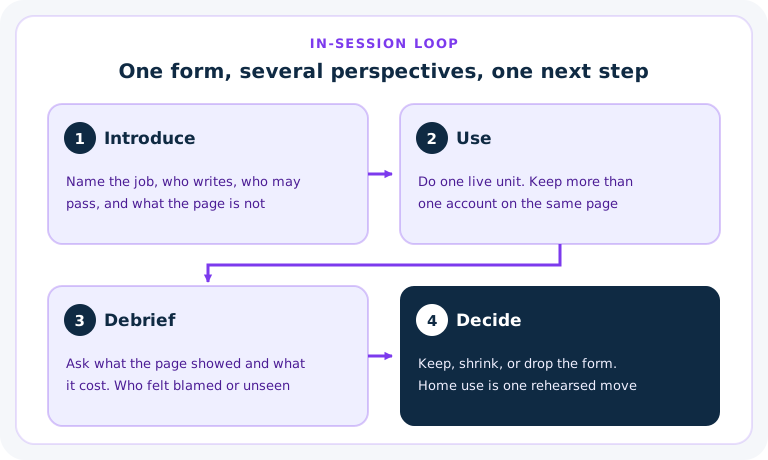
Introduce. Name the job in one sentence. Name who writes, who watches, and who may pass. Say what the page is not: a test, a diagnosis, or proof.
Use. Do one unit live. One preferred-change line from each person. One cycle. One request. One pause signal. You want data from the hour you are already in.
Debrief. Ask what the page showed and what it cost. Who felt blamed. Who felt unseen. Where the form got in the way.
Decide what returns. Keep the same format, shrink the fields, or drop the paper. If anything goes home, send one continuation of the rehearsed move, not a packet. Between-session use is optional. The primary use is in the room.
When not to use a worksheet
Hold family therapy worksheets, or never take them out, when:
- Acute risk. Suicidality, homicidality, or a child who is not safe in the household needs assessment and a safety plan, not a communication sheet.
- Coercive control or intimate-partner violence. Joint worksheets, shared request practice, and repair scripts can increase danger. Screen. Separate. Do not use the family hour to coach a request the frightened partner cannot safely make.
- Unsafe joint disclosure. If a secret, an identity, or an abuse report cannot be spoken in front of another member, do not put it on a shared page.
- High activation. If someone is outside a workable range, the paper is too slow. Stabilize first.
- Contested records and legal context. Do not create a worksheet that one adult will carry into custody litigation. If that is the likely path, stop and document the clinical hour without a family form.
- Literacy, language, disability, or access barriers. A page the member cannot use is not neutral. Scribe, translate, enlarge, or drop it.
- The form replacing relational work. If you are hiding behind the clipboard because the room is hot, put the clipboard down.
These are clinical holds, not a moral ranking of families who “are not ready for worksheets.”
Adjacent tools these formats do not replace
These twelve formats do not replace intake paperwork, genogram symbols, individual communication drills, or worksheet ethics. Use intake when the hour still needs orientation, consent, and several accounts of the concern. Use a genogram when the missing map is three-generation structure. When the hour needs bodies in the room rather than another written map, run a family sculpting sequence: setup, sculpt, reactions, a hoped-for re-sculpt, and a debrief. Use an individual communication drill when the work is one person’s sequence. Use a family-system task when the next hour needs more than one perspective on the same pattern.
The downloadable sampler is a broader mental-health set: a behavioral experiment, an activity log, a window-of-tolerance check-in, and a trigger log. It is useful in individual work, but it is not a family-systems set and does not contain the twelve formats above, so name that difference when you hand it to a family.
Use the broader mental health worksheets sampler. It holds four individual session sheets and does not contain these twelve family formats, so name that difference when you hand it to a family.
Get the Mental Health Worksheets Sampler
Four printable individual-work sheets — behavioral experiment, activity log, window-of-tolerance check-in, and trigger log. Sent to your inbox.
- Behavioral experiment sheet for testing one prediction
- Activity log for pacing and energy across a week
- Window-of-tolerance check-in for arousal range
- Trigger log for mapping one cue-urge-response chain
Free. We'll email the PDF link right away and add you to the therapist toolkit, sent every two weeks. Unsubscribe any time.
Where should we send the link?
We'll email the PDF link right away. You'll also get the therapist toolkit every two weeks. Unsubscribe any time.
✓ Check your inbox
We've sent you the PDF
The download link is on its way to your inbox, usually within a minute or two. The email will come from Emosapien (hello@team.emosapien.com); check your spam folder if you don't see it.
You're also on the therapist toolkit list, sent every two weeks. Unsubscribe any time from the email footer.
Where Emosapien fits
A family hour still has to return one system job to the chart: the cycle you mapped, the repair that landed or did not, the pause signal, or the next experiment. Emosapien drafts a SOAP, BIRP, or GIRP note from that hour so you can record the intervention and the response without pasting the family’s private writing into the chart.
The therapist stays with the household and the consent boundary. Emosapien organizes the family-system job, each member’s response, and the next-session cue so the next hour starts from the pattern that stayed visible, not from a reconstructed worksheet.
Start your journey with Emosapien and keep chosen family-session work connected to the treatment plan.
References
- Minuchin, S. (1974). Families and Family Therapy. Harvard University Press.
- American Association for Marriage and Family Therapy. AAMFT code of ethics on Standard 1.2 informed consent, and Standard 2.1 confidentiality limits.
- American Psychological Association. Ethical principles of psychologists and code of conduct on Standard 10.02, therapy involving couples or families.
- U.S. Preventive Services Task Force. Screening for intimate partner violence, elder abuse, and abuse of vulnerable adults.
- Carr, A. (2019). Family therapy and systemic interventions for child-focused problems: the current evidence base. Journal of Family Therapy, 41(2), 153-213.
Family therapy worksheets earn a place when the next family hour is clearer because more than one perspective stayed visible. Keep the job small, the consent explicit, and the referred person in view without making them the entire page.