
How to Facilitate a Group Therapy Session: Clinician Guide

Outline
A therapy group can change direction in one exchange. One member answers every question, another disappears behind a polite smile, and a third begins offering advice to steady the room. The plan may still be sound. The facilitator’s job is to notice what the group now needs.
This guide is for licensed mental-health clinicians learning how to facilitate a group therapy session. Facilitation means managing the conditions for therapeutic group work, not delivering a perfect script. Observe, orient, invite, link, regulate, decide, and close. Those seven moves help you respond without forcing disclosure or abandoning the clinical purpose.
The group therapy resource hub covers the wider cluster. This guide stays with live facilitator judgment and the thread carried across sessions.
Use this educational resource alongside your training, supervision, informed-consent process, accessibility planning, setting policy, and crisis procedures. No article or planning pack can determine what is safe for a particular group.
Prepare the conditions before members arrive
Live judgment gets easier when the room already has a working container. Before the first chair fills, settle the decisions that will otherwise compete for attention during the hour.
Name the group’s purpose and population. Decide whether membership is open or closed, how new members are oriented, and what continuity the setting can realistically offer. Review informed consent, confidentiality limits, local policy, and the route for individual risk follow-up. Plan for language, sensory, movement, literacy, and neurodivergent access rather than asking members to request every adjustment publicly.
Then choose one primary topic and one backup. The group therapy topics guide helps with theme selection by population, goal, and stage. The full group therapy session structure guide holds the opening, working, processing, and closing agenda. Here, the plan matters because it gives you something deliberate to adapt when the room changes. When the working hour is an open discussion rather than an activity or a check-in, use mental health questions for discussion.
Clarify co-facilitator roles when two clinicians are present. Who watches time and access? Who follows a member out? Who stays with the group? A vague agreement can become a visible split at the moment members most need steadiness.
Establish a working contract through behavior
A long rules speech rarely creates safety. Members learn the contract by watching what you repeat, protect, and repair.
Scroll the table sideways to view every column
| Contract element | What it does | Facilitator action | Member choice |
|---|---|---|---|
| Stated norm | Gives the room shared language | Explain that responses begin with reflection before advice | A member can decline to respond |
| Modeled process | Shows how members can work together | Ask one member what they heard another person say | A member can name resonance without disclosing a similar story |
| Enforced boundary | Interrupts behavior that harms the container | Stop cross-talk, intimidation, or pressure to disclose | A member retains the choice to pass or step out under setting policy |
| Retained choice | Makes consent visible during the hour | Offer spoken, written, paired, or pass options where clinically appropriate | A member chooses the available form and depth of participation |
Confidentiality also needs accurate language. State its limits and the expectations members agree to follow without promising privacy that no facilitator can fully guarantee among peers. The Association for Specialists in Group Work’s best practice guidelines tie group preparation to purpose, informed practice, and the needs of the population.
The contract becomes credible when you use it under pressure. If advice-giving begins, return to reflection. If a member is put on the spot, reopen choice. If you miss an exclusionary moment, name the miss and repair it rather than defending the plan.
Different types of group therapy change how you run the hour
The types of therapy groups you facilitate change the job of the hour more than the topic does. A psychoeducational circle, a skills group, a process group, and a support group can share a population and still need different invitations, different depth, and a different reason to leave the plan.
SAMHSA’s TIP 41: Substance Abuse Treatment: Group Therapy names five models used in substance-use treatment: psychoeducational, skills development, cognitive-behavioral or problem-solving, support, and interpersonal process. When the flyer only says therapy group, name the type before you run the hour. Association for Specialists in Group Work best practice guidelines keep the work tied to purpose. Type is that purpose made visible.
- Psychoeducational. Hold one teaching point long enough for members to use it. Keep the lecture short, then move into practice and meaning-making. Do not open here-and-now character work because a story appeared. If the hour needs a teach-practice-process-transfer arc, use psychoeducational groups.
- Skills. Demonstrate one behavior, then let members try it with a pass. The hour succeeds when someone can repeat the move, not when everyone has processed the week. If advice-giving starts, return to rehearsal.
- Support. Protect peer connection and practical coping. Stay with what members can use this week. Interrupt rescue and pile-on. Leave developmental pattern work for a process contract the members actually have.
- Process. Follow here-and-now relating: who speaks, who disappears, who advises, and what the group does with difference. Content is secondary. Do not fill silence with a worksheet because the silence made you uneasy.
- Similar formats. Cognitive-behavioral and problem-solving groups sit between skills and process. You still teach a model, then you track how members use it with one another. Hybrid rooms fail when you switch type mid-hour without saying so.
Name the type in the first minutes, then keep it. If the room needs a different type, say that you are changing the job, and why.
Once the type is named, return to running the hour. Observe, orient, invite, link, regulate, decide, and close still apply. The type tells you which of those moves you lean on, and which ones you hold back.
How to facilitate a group therapy session in seven moves
The live loop is not a seven-step script. You may move from observe to regulate, return to orient, then close. Its value is that it keeps your response connected to what is happening now and what must continue afterward.
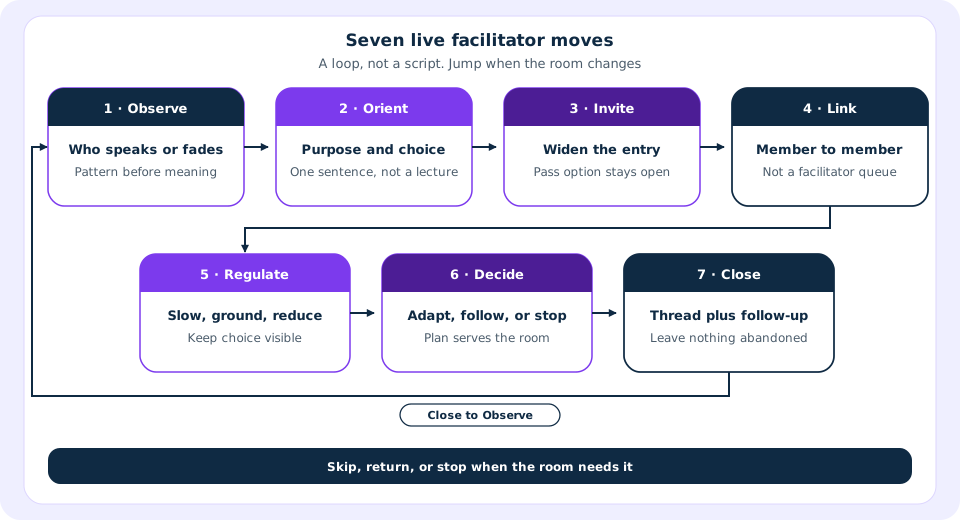
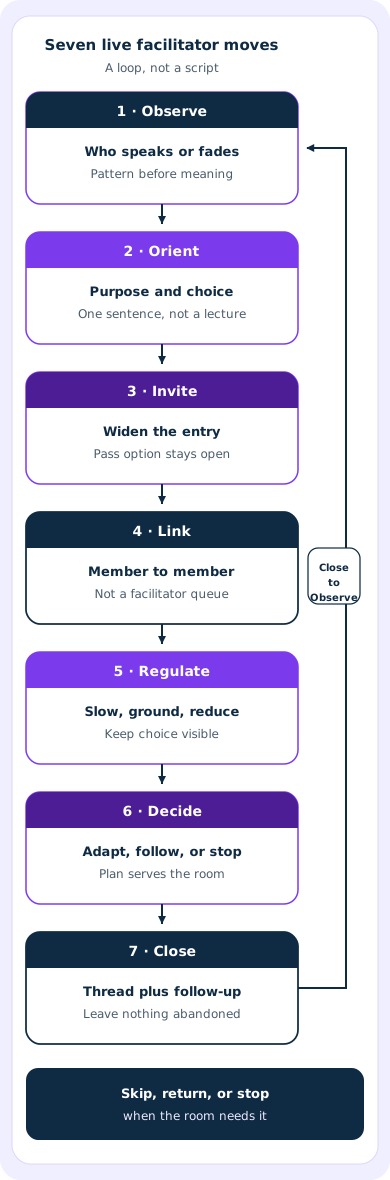
Seven live moves keep the response tied to the room now. The loop returns from Close to Observe. Skip, return, or stop when the group needs it.
- Observe. Track who speaks, who disappears, who rescues, who advises, who performs competence, and who becomes activated. Notice patterns before assigning meaning.
- Orient. Return the room to its purpose, contract, shared task, or available choices. Orientation can be one sentence, not another lecture.
- Invite. Widen participation with a specific opening that does not make disclosure compulsory. Offer a pass and a later entry point.
- Link. Connect two contributions so members respond to one another instead of waiting for the facilitator’s next interview question.
- Regulate. Slow the pace, name observable process, ground, reduce the task, take a pause, or narrow the depth when the room cannot keep going as planned.
- Decide. Continue the plan, adapt it, follow the emergent process, move something to individual follow-up, or stop under the setting’s safety procedure.
- Close. Name the shared thread, preserve differences in member response, identify follow-up, and state what can carry into the next session.
A member’s silence today is one observation. Silence across several sessions, after invitations in different forms and careful access checks, becomes a participation pattern worth exploring. Continuity protects you from turning one moment into a conclusion.
Free PDF: Group Facilitation Pack
A printable facilitator pack for group therapy topics: population-goal-stage checks, topic selector menu, and primary-plus-backup planner.
- Population, goal, and stage decision checklist before you pick a topic
- 12 group therapy topics across forming, anxiety, depression, relationship, process, and ending lanes
- Primary topic plus backup planner for activated or shut-down rooms
- After-group note stems for intervention, response, risk, and next step
Free. We'll email the PDF link right away and add you to the therapist toolkit, sent every two weeks. Unsubscribe any time.
Where should we send the link?
We'll email the PDF link right away. You'll also get the therapist toolkit every two weeks. Unsubscribe any time.
✓ Check your inbox
We've sent you the PDF
The download link is on its way to your inbox, usually within a minute or two. The email will come from Emosapien (hello@team.emosapien.com); check your spam folder if you don't see it.
You're also on the therapist toolkit list, sent every two weeks. Unsubscribe any time from the email footer.
Facilitate participation without forcing equality
Equal airtime is not the same as meaningful participation. Some members need more time to formulate a response. Some speak easily while staying emotionally distant. Others participate through careful listening before they risk a first contribution.
Scroll the table sideways to view every column
| Room state | Notice without assuming | One possible move | Follow-up threshold |
|---|---|---|---|
| One member speaks often | Airspace narrows after their contributions | Acknowledge the point, then invite two voices that have not entered | Explore privately if the pattern persists or reflects unmet support needs |
| The room goes silent | Silence follows a prompt, exchange, or shift in tone | Wait, name the silence, and offer clarification, writing, pairs, or a pass | Follow up when silence may reflect exclusion, access barriers, rupture, or risk |
| Two members dominate each other | Their exchange pulls attention from the circle | Slow them down and ask what each wants the group to understand | Pause if the exchange becomes intimidating or cannot stay bounded |
| A member repeatedly passes | The member declines several forms of invitation | Keep the pass available and offer a lower-pressure entry later | Check privately for access, consent, safety, or fit without presuming resistance |
| Advice replaces reflection | Responses move quickly to fixing | Ask members to reflect impact or resonance before offering ideas | Revisit the contract if unsolicited advice continues to close down disclosure |
| Side conversations emerge | Attention splits and some members lose access | Name the split and bring the content back to the circle | Address hearing, language, confusion, exclusion, or alliance patterns as relevant |
| Everyone looks to the facilitator | Member contributions stop at your chair | Link two comments and ask members to respond to each other | Use supervision if the group remains dependent despite repeated linking |
| One story takes over | Questions turn the hour into individual therapy with witnesses | Summarize the thread and ask how it lives elsewhere in the room | Move member-specific depth or risk assessment to individual follow-up |
A public correction can make the room quieter without making it safer. Use the least shaming move that protects the group, then see whether it worked.
Link members instead of interviewing them in sequence
Serial questioning gives the facilitator plenty to do and the group little reason to need one another. Linking changes the direction of attention.
Facilitator-to-member questioning sounds like, “What happened next?” Member-to-member resonance sounds like, “Jordan, what did you hear in Casey’s description that connects with your experience?” Reflection without advice sounds like, “Before we offer solutions, what impact did that have on you as you listened?”
A process observation stays close to what anyone could see: “Three people looked down when anger entered the conversation.” It does not diagnose the room or publicly confront one member’s presumed motive. Follow with choice: “Would it be useful to stay with what happened between us, or do we need to slow this down first?”
These phrases are examples, not mandates. Language that sounds attuned in one group may sound controlling, culturally discordant, or too exposing in another. The facilitator listens for the response to the invitation, not just whether the words were delivered correctly.
Decide when the process should change the plan
A plan provides direction. It should not become a reason to ignore the group in front of you. If you need a task that fits the adjusted clinical job, use the group therapy activities selector rather than filling time with a second exercise.
Scroll the table sideways to view every column
| Signal | Stay with the plan when | Adapt or follow process when | Pause or stop when |
|---|---|---|---|
| Participation | The task remains accessible and members enter at different depths | The task reveals a pattern the group can examine with choice | A member is coerced, scapegoated, or acutely destabilized |
| Conflict | Difference stays direct, bounded, and tied to group purpose | A rupture must be named before the task can continue | Threat, intimidation, or acute risk exceeds the room's capacity |
| Silence | Members appear to be thinking, regulating, or choosing | Confusion, exclusion, shame, or an unspoken rupture needs checking | Continuing would force disclosure or bypass a safety concern |
| Activation | A member remains oriented and retains meaningful choice | Pace, depth, or task complexity needs scaling down | The setting's crisis or risk procedure must replace group work |
The American Group Psychotherapy Association’s practice guidelines emphasize attention to group development, therapeutic factors, member selection, and the clinician’s responsibilities. A decision table supports that judgment. It cannot make the judgment for you.
Work with rupture without promising immediate repair
Rupture may appear as open conflict, a joke that lands badly, repeated interruption, a member withdrawing after feedback, or the facilitator missing a cultural or relational cue. Start with what was observable. Slow the exchange and protect members from humiliation or a pile-on.
Return to impact, choice, and purpose. You might say, “The pace increased, Morgan was interrupted twice, and the room became quieter. I want to slow us down. Morgan, do you want to say what the interruption was like, pass, or speak with me after group?”
Not every rupture belongs in public process. A member may not consent to continue in the room. Acute risk, trauma activation, or a concern about another member can require individual assessment and setting-specific action. Repair can begin with the facilitator acknowledging impact and preserving a route back, even when resolution cannot happen before the session ends.
Documentation keeps the shared intervention separate from each member’s response. Record what you did with the group, then note who withdrew, who re-engaged, who needed follow-up, and what remains clinically relevant for the next contact.
Close without abandoning open material
Signal the transition before the final minute. A careful close does not pretend everything is resolved. It tells members what is complete for today, what remains open, and where that open material can go. When leftover heat needs a shared landing task rather than a checkout speech, use group therapy closing activities. When the group itself is ending, not just today’s hour, use group therapy termination activities so goodbye work is planned across sessions instead of squeezed into the last minutes.
Summarize the shared thread without flattening different experiences. Invite one member-owned next step or support. Identify risk assessment, consultation, or follow-up that cannot stay inside the group. Name the thread that may return next time, while avoiding a promise that membership, attendance, or circumstances cannot support.
Do not open new depth to avoid the discomfort of ending. When a member brings significant material late, acknowledge it, assess what must happen now, and agree on the next safe point of contact under your setting’s procedure.
After the room empties, start a therapist-reviewed draft that separates the shared intervention from member-specific responses. It does not replace your clinical review, signature, risk process, or chart of record.
Two rooms, two facilitation decisions
A quiet outpatient group when the activity does not land
Leah brings a values-sorting activity to a mixed outpatient group. After the instructions, two members study the cards, one says “I don’t know,” and the room goes still.
She observes low entry rather than labeling resistance. She avoids assuming the members lack insight or motivation. Leah orients the group to the purpose, then offers three ways in: choose one card privately, discuss a pair in twos, or pass and listen. When one member says the categories feel too abstract, she links that response to another member’s earlier difficulty naming goals.
The decision point is whether to keep teaching, scale down, or follow the live difficulty with choice and future language. Leah scales down. At close, members name one value in their own words. She follows up privately about the repeated pass and carries the language-access issue into the next plan.
This is how to facilitate a group therapy session without mistaking completion of the activity for participation in the work.
Advice-giving turns one member into the room’s focus
After Devon describes a conflict at home, three members offer solutions in quick succession. Devon leans back, stops answering, and looks toward the door.
The facilitator observes the advice sequence and Devon’s withdrawal without claiming to know why it happened. They interrupt the fixing, orient the group to reflection before advice, and ask Devon whether they want to name the impact, listen while others reflect, pass, or speak after group. The facilitator then invites members to say what they felt while listening, without turning Devon’s situation into a case conference.
The decision point is whether the group can repair the interaction without demanding more from Devon. When Devon chooses to pass, the facilitator protects that choice and closes the public exchange. The session ends with a reminder about reflection and consent. Individual follow-up checks impact and safety, while the next session returns to how the group responds when helplessness appears.
Use the Group Facilitation Pack as a planning aid
The Group Facilitation Pack helps you prepare the conditions for responsive work. It includes population, goal, and stage checks; a primary-topic and backup-topic planner; guardrail and pass-option reminders; a 12-topic selector; after-group note stems; and a client session-preparation sheet.
Use the pack before the room fills and again after members leave. It does not contain every move in this guide, replace group-work training, or determine when a situation requires supervision or crisis action.
When you are deciding how to facilitate a group therapy session, bring one purpose, one primary plan, one backup, and a clear follow-up route. The room will still change. You will be readier to change with it without losing the thread.
Free PDF: Group Facilitation Pack
A printable facilitator pack for group therapy topics: population-goal-stage checks, topic selector menu, and primary-plus-backup planner.
- Population, goal, and stage decision checklist before you pick a topic
- 12 group therapy topics across forming, anxiety, depression, relationship, process, and ending lanes
- Primary topic plus backup planner for activated or shut-down rooms
- After-group note stems for intervention, response, risk, and next step
Free. We'll email the PDF link right away and add you to the therapist toolkit, sent every two weeks. Unsubscribe any time.
Where should we send the link?
We'll email the PDF link right away. You'll also get the therapist toolkit every two weeks. Unsubscribe any time.
✓ Check your inbox
We've sent you the PDF
The download link is on its way to your inbox, usually within a minute or two. The email will come from Emosapien (hello@team.emosapien.com); check your spam folder if you don't see it.
You're also on the therapist toolkit list, sent every two weeks. Unsubscribe any time from the email footer.