
3 Impulse Control Worksheets for Therapists: Free PDF

Outline
Authored by Dr. Hannah Lin, counseling psychologist trained in CBT, ACT, and IFS, with over a decade of clinical practice across anxiety and complex trauma.
Impulse control worksheets earn their place when they slow one cue-to-action sequence enough for the client to notice an earlier choice point. They are not character tests, classroom obedience charts, or proof that someone “has” or “lacks” willpower.
Searchers often type self control worksheets when they want a printable structure. Clinically safer language keeps the focus on one observable behavior, the conditions that make the pull stronger, and a rehearsed response that fits the client’s formulation and arousal level.
Download the impulse control worksheets
The pack is three therapist-guided pages for session use and a planned return, not a blank homework dump.
- Trigger-to-Urge Map: vulnerability, trigger, early signal, urge, action, and consequence for one target behavior.
- Pause-and-Choice Plan: earliest reliable signal, realistic pause, low- and high-urge responses, friction or support, if-then rehearsal, and a stop rule.
- Review-and-Repair Log: several episode rows without pass/fail scoring, plus what to adjust next session.
Download the impulse control worksheets (PDF)
Use the field skeletons later on this page when you want the prompts in the chart before you print. The PDF is the version designed to leave the room and come back next session.
This resource sits among therapy worksheets for clinical practice. The tools support formulation and rehearsal. They do not measure worth, motivation, or diagnosis.
Educational content for licensed therapists, not clinical or legal advice. Adapt every technique to the client’s presentation, risk level, developmental stage, and readiness. This does not replace supervision, risk assessment, crisis protocol, medication review, or coordinated care. When there is risk of harm to the client or others, standard safety work takes precedence and the worksheet is paused.
What impulse control work is targeting
Scroll the visual sideways to view the full diagram
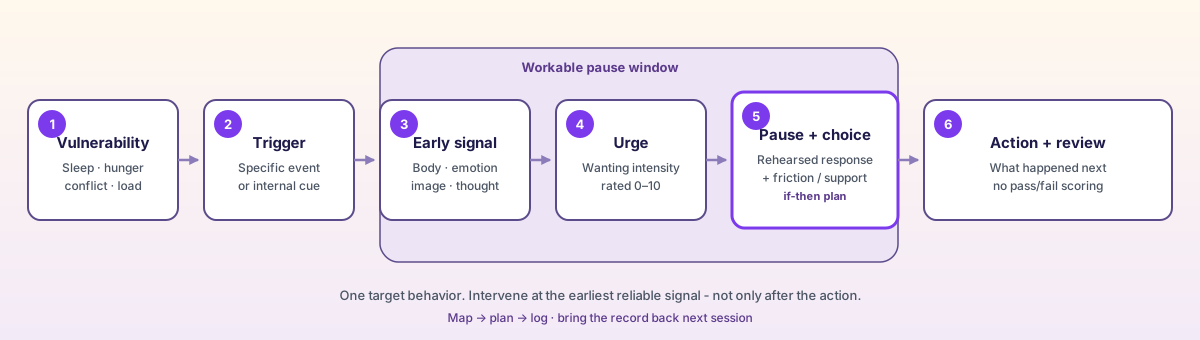
Separate four layers that clients often collapse into one word.
| Layer | What it is | Why the split matters |
|---|---|---|
| Impulse | Fast pull toward an action | Names the pull without judging the person |
| Urge | Felt intensity of wanting to act (0-10) | Lets you track wanting even when action does not follow |
| Action | What the person did next | Keeps the record behavioral |
| Consequence | Immediate relief or cost, and later effect | Supports functional review instead of punishment |
The workable intervention point may sit at the vulnerability context, the external or internal trigger, a body cue, the urge peak, the environment, or the first moments of the action. Not every impulsive pattern shares the same mechanism. Hunger-plus-conflict messaging is not the same chain as substance craving, trauma-linked reactivity, or a manic escalation.
Make the target behavior specific enough to observe. “Acting without thinking” is too broad. “Sending several reactive messages after conflict” is workable. One behavior at a time keeps the map honest.
Worksheet 1: trigger-to-urge map
Build the first page around sequence, not confession.
| Step | What to capture | Clinical purpose |
|---|---|---|
| Vulnerability context | Sleep, hunger, conflict, substance use, overstimulation, or another relevant state | Shows why the same trigger lands differently on different days |
| Trigger | The specific event or internal cue | Keeps the form behavioral and observable |
| Early signal | First body sensation, emotion, image, or thought | Identifies the earliest realistic intervention point |
| Urge | Action the client felt pulled toward and intensity from 0 to 10 | Separates wanting to act from acting |
| Action | What happened next | Records behavior without moral judgment |
| Consequence | Immediate relief or cost and later effect | Supports functional review rather than punishment |
Every row carries distinct information. Do not add a repeated notes field that says the same thing on all three pages.
Cue identification can start earlier with trigger mapping before the urge when the client still cannot name a high-frequency cue. Once the cue is visible, this map tracks what happens after it.
Worksheet 2: pause-and-choice plan
The second page is rehearsal, not a list of thirty coping ideas.
Capture:
- the earliest signal the client can reliably notice;
- a realistic pause length for the real setting;
- one low-urge response and one high-urge response;
- environmental friction when clinically appropriate (moving a device, leaving a room, delaying access);
- a support person or professional resource where appropriate;
- an if-then statement tied to the actual cue;
- a clear stop rule for moments when a worksheet is not enough.
Link the chosen response to formulation, ability, environment, and current arousal. A calm cognitive reframe is the wrong ask at an 8/10 urge. A body-led interrupt may be the right first move, with appraisal work later. For selecting a rehearsed response at the pause point, pair this page with coping skills for the pause point. When the next move is shared in-room rehearsal rather than an individual pause-plan sheet, use coping skills group activities. When the next move is a short spark-urge-action write rather than a pause-plan sheet, assign journaling for anger.
Urge surfing can sit inside the high-urge column when the client can observe a wave without needing a long written plan. DBT-informed distress-tolerance and mindfulness chains often feed this kind of pause work; see Linehan in References for the skills-manual source. When the pause needs a four-quadrant act-versus-tolerate grid rather than a cue map, use the four-quadrant urge grid. Keep claims inside what that source supports, and treat urge surfing as one technique, not the title of the pack.
Worksheet 3: review-and-repair log
The third page holds several attempts without pass/fail scoring.
Each row should capture date and situation, peak urge intensity, whether a pause was attempted, response chosen, immediate outcome, later outcome, what helped or blocked the pause, what to rehearse or change next, and a next-session review point.
An action after an unsuccessful pause is still useful data. Avoid columns labeled success, failure, good choice, or bad choice. Those words teach the client to edit the record.
How to use the pack in session
Keep the sequence tight so the forms support conversation rather than replace it.
- Agree on one target behavior in the client’s words.
- Reconstruct one recent low- or moderate-risk example together before any solo homework.
- Find the earliest signal, not only the final action.
- Choose and rehearse one alternative response that fits arousal and setting.
- Decide which fields can realistically be completed in the moment versus later the same day.
- Set the return-to-session plan so the log is reviewed, not filed away.
- Adjust the form if reading, writing, memory, attention, or sensory load makes it inaccessible.
Do not send the pack home unintroduced. The clinical value is the rehearsal and review loop, not the blank paper. Impulse control worksheets fail most often when they are treated as a take-home quiz instead of a coached sequence.
Adaptations without scope drift
Adults. Use one behavior and a full cue-to-consequence sequence. Keep language concrete.
Adolescents. Shorten the form, use plain words and a smaller intensity scale, and preserve the young person’s own account. Do not convert the page into a caregiver compliance chart.
ADHD or executive-function difficulties. Reduce writing load and add environmental support. Do not use the worksheet to diagnose ADHD or imply that impulse control is simply effort.
Substance-use urges. Urge surfing and relapse-prevention supports may fit when they align with the existing treatment plan. Withdrawal, overdose risk, and medical priority still lead.
Trauma-related reactivity or dissociation. Use grounding and stabilization first when sequence reconstruction would flood or disconnect the client.
High-risk impulses. Self-harm, harm to others, acute mania, psychosis, intoxication, withdrawal, or immediate safeguarding concerns require your risk and crisis protocol. The worksheet is paused.
Worked example: reactive messaging after conflict
Client (adult, interpersonal reactivity): “I blow up over text. I know I should stop, but by the time I notice, the thread is already a mess.”
Target behavior: sending more than one reactive message within ten minutes after a conflict text.
- Vulnerability context: short sleep, skipped lunch, unresolved argument from the morning.
- Trigger: partner’s short reply (“k.”) after the client asked for a plan.
- Early signal: heat in the face, thought “they’re dismissing me,” urge to send a multi-message defense.
- Urge intensity: 7/10.
- Original action and short-term function: three rapid texts; brief sense of being heard by oneself; later shame and a longer fight.
Pause-and-choice plan rehearsed in session:
- Earliest reliable signal: heat in the face plus the first draft of a long reply.
- Pause length: five minutes before any second message.
- Low-urge response: lock phone, one glass of water, write one sentence in notes app instead of sending.
- High-urge response: body-led cool-down (cold water on wrists), then a single delayed message template: “I want to answer this well. Can we talk at 7?”
- Environmental friction: move the conversation app off the home screen during high-conflict weeks.
- If-then: If I feel face-heat after a short reply, then I set a five-minute timer before any second text.
- Stop rule: if urge stays above 8 after two body skills, or if content turns to threats or self-harm language, stop the worksheet path and use the client’s safety or support plan.
Next-session review: first ten minutes. Markers of useful movement: fewer rapid multi-message bursts, earlier noticing of face-heat, or clearer language about what the short reply meant. Not “became a calm person.”
Common misuses
Treating self-control as a moral trait. The work is one sequence, not a verdict on character.
Choosing several target behaviors at once. Multiple targets produce vague maps and unusable plans.
Completing the form only as a retrospective confession. Memory work has a place early on, but the skill is earlier noticing.
Assigning a written worksheet when arousal is too high for writing. Match the tool to state. Body-led interruption first; writing later.
Teaching no alternative response before asking for a pause. A pause without a rehearsed next move often collapses into the original action.
Relying on willpower while ignoring environment and support. Friction and people are clinical tools, not cheats.
Using the worksheet as evidence for a parent, partner, school, court, or employer. The record belongs to treatment, not to a case against the client.
Failing to review the completed record. An unread log is not an intervention.
Using the worksheet instead of risk assessment or coordinated care. Forms do not replace safety work.
When impulse control worksheets get misused this way, the repair is usually simpler than a new form: one behavior, one rehearsed response, and a real review slot next session.
Copy-ready field skeletons
Use these structures live beside the printable PDF, or as teaching scaffolds while you walk a trainee through the sequence.
Documentation handoff
Keep the chart lean. The note should carry the clinical thread without photocopying the form.
Do not state that the client lacks self-control. Do not assign a diagnosis from the worksheet. Name the behavior, the intervention, the response, and the review point so the next clinician (including future you) can continue the work.
Where Emosapien fits
Impulse-control work produces a thin but high-value thread: the target behavior, the cue and urge, the rehearsed pause, the environmental support, and the review condition. That thread is easy to lose when notes stay generic and homework never returns.
Emosapien’s Scribe Agent drafts clinician-reviewed progress notes from session context so the sequence, intervention, client response, and next review point can stay connected. The Engagement Agent supports between-session guided check-ins and modality-aligned homework so the pause plan has a place to live between hours. The therapist still owns formulation, risk decisions, and what belongs in the chart. Emosapien does not score impulse control, diagnose a condition, select a skill on its own, or replace clinical judgment.
References
- Linehan, M. M. DBT Skills Training Manual (2nd ed.). Guilford Press. Publisher page.