
Insurance Billing for Therapists: Practice Workflow

Outline
The session went well. The note is signed. Three weeks later the claim is still unpaid, the client got a confusing explanation of benefits, and nobody can say whether the denial is a front-desk data error or a documentation gap. That gap is an operations failure, not a coding puzzle.
Insurance billing for therapists is the practice system that moves a covered session from eligibility check to deposited payment without losing the client relationship. For US outpatient therapy practices, the loop runs eligibility and benefits, intake data, authorizations, claim creation, clearinghouse submission, remittance posting, denials, reconciliation, and client communication. Code selection stays with clinician judgment and the CPT codes for therapists hub. The end-to-end ops path stays here. When the question is who does that work, in-house, a biller, or a service, use the behavioral health billing services comparison.
Free PDF: Insurance Billing Preflight and Denial-Handoff Worksheet
A printable two-page therapy insurance billing worksheet: claim lifecycle map, eligibility and pre-submit checks, denial classification, and weekly AR stand-up.
- Six-stage claim lifecycle map for therapy practices
- Eligibility, authorization, intake, and pre-submit checklists
- Denial ticket with owner, class, due dates, and root-cause fields
- Fifteen-minute weekly billing stand-up close sheet
Free. We'll email the PDF link right away and add you to the therapist toolkit, sent every two weeks. Unsubscribe any time.
Where should we send the link?
We'll email the PDF link right away. You'll also get the therapist toolkit every two weeks. Unsubscribe any time.
✓ Check your inbox
We've sent you the PDF
The download link is on its way to your inbox, usually within a minute or two. The email will come from Emosapien (hello@team.emosapien.com); check your spam folder if you don't see it.
You're also on the therapist toolkit list, sent every two weeks. Unsubscribe any time from the email footer.
Educational resource for licensed US mental-health clinicians and the billing staff who support them. Payer contracts, CPT descriptors, CMS guidance, and state rules change. Verify current requirements before submitting claims. This is not legal, coding, or reimbursement advice.
What insurance billing for therapists actually includes
Insurance billing for therapists is a chain of handoffs. Break any link and cash stalls even when the clinical work was solid.
Scroll the table sideways to view every column
| Stage | Ops job | Failure mode if skipped |
|---|---|---|
| Eligibility and benefits | Confirm active coverage, mental-health benefits, deductible, copay or coinsurance, and visit limits | Surprise balances and denials for inactive plans |
| Intake data | Capture member ID, payer, subscriber relationship, referring provider when required, and consent to bill | Claims rejected for incomplete subscriber data |
| Authorization | Check prior-auth and continued-stay rules before the session that needs them | Medical-necessity denials that were avoidable |
| Service documentation | Signed note that supports the billed service and diagnosis | Claim denied or payment recouped during an audit |
| Claim creation | Map service to claim fields with clinician-reviewed codes | Upcoding, undercoding, or wrong place of service |
| Clearinghouse | Submit 837P cleanly and fix rejections the same day | Silent stalls in a pending queue |
| Remittance | Post 835/ERA payments, adjustments, and patient responsibility | Unposted payments and wrong client statements |
| Denials | Classify, correct, appeal, or write off with an owner and deadline | Aging AR and staff burnout |
| Client communication | Explain estimates, EOBs, and balances in plain language | Lost trust and unpaid patient shares |
Software selection can help or hurt this chain. An EHR shortlist is the buying lens. That shortlist only pays off if the software can run eligibility through denial handoffs.
Claim lifecycle map
Treat every covered encounter as a ticket with a known path. The downloadable worksheet mirrors this map so a solo owner or a billing lead can run the same checklist.
Scroll the visual sideways to view the full diagram
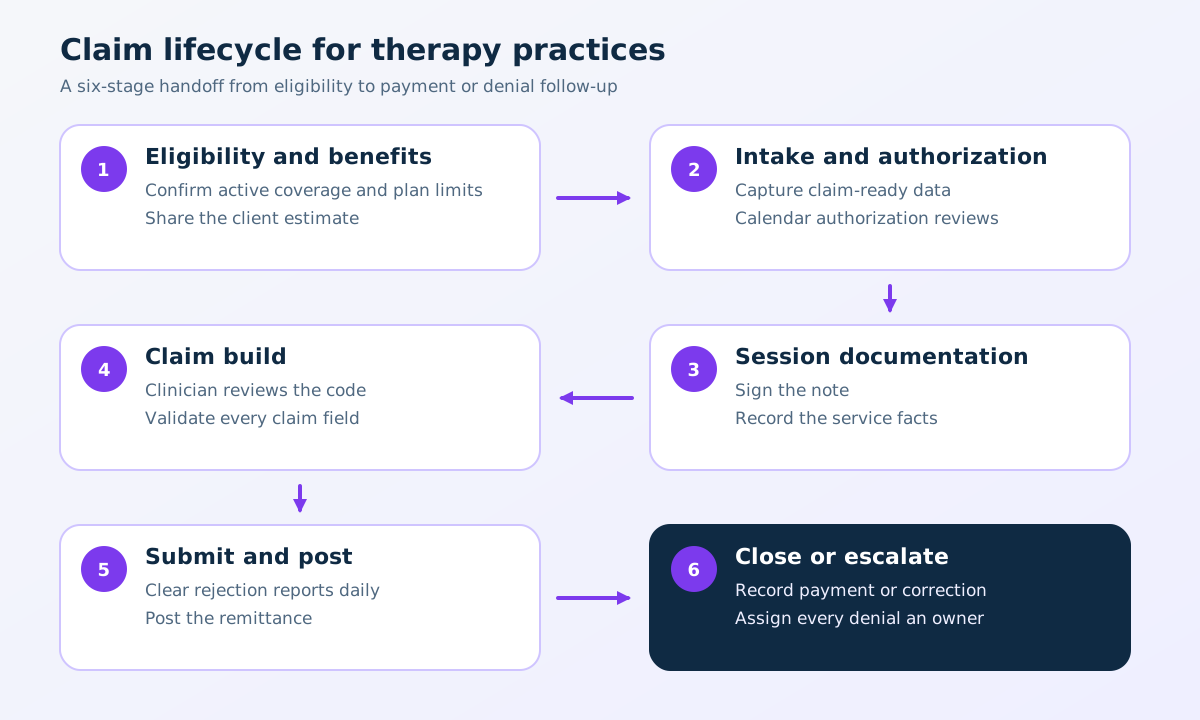
- Pre-session. Verify eligibility. Capture benefits. Flag prior auth. Confirm the client understands the estimate and your financial policy.
- Session day. Deliver the service. Complete the note. Record time, modality, participants, and clinical focus the claim will need later.
- Claim build. Clinician or trained biller selects the service family using your CPT references. Diagnosis and procedure must fit the note.
- Submit. Push through the clearinghouse. Work rejection reports daily, not weekly.
- Post. Apply ERA payments and contractual adjustments. Create the patient balance only from posted data when you can.
- Close or escalate. Paid clean, corrected and resubmitted, appealed, transferred to patient responsibility per policy, or written off with a reason code.
If one person holds the whole path in their head, the practice has a key-person risk. Write the map. Name the owner for each stage.
How mental health billing differs when you are billing for behavioral health services
Behavioral health billing uses the same eligibility-to-payment path you mapped above, with three differences a medical claim does not carry. Those differences sit on top of insurance billing for therapists, not beside it.
You verify mental-health benefits as their own class. For group health plans, 45 CFR 146.136 requires that financial requirements (copays, deductibles, coinsurance) and quantitative treatment limitations (visit limits and similar numeric limits) on mental health or substance use disorder benefits be no more restrictive than the predominant requirements or limitations applied to substantially all medical/surgical benefits in the classification. Nonquantitative limits such as prior authorization have a separate parity test under the same regulation. CMS’s MHPAEA fact sheet states those rules and notes that the statute does not require a plan to cover mental-health benefits at all. Read the client’s mental-health outpatient line on the portal, not only the medical office-visit copay, before you schedule the first covered session.
You put claim-ready facts in the progress note and you keep process notes off the claim. 45 CFR 164.501 defines psychotherapy notes as notes recorded by a mental health professional documenting or analyzing the contents of conversation during a private, group, joint, or family counseling session, and that are separated from the rest of the individual’s medical record. The same definition excludes medication monitoring, counseling session start and stop times, modalities and frequencies of treatment, test results, and summaries of diagnosis, functional status, treatment plan, symptoms, prognosis, and progress to date. Under that definition, those excluded items are not psychotherapy notes; they can live in the ordinary medical record. What a given payer asks for on a records request still depends on that request.
You need the client’s written authorization before you use or disclose psychotherapy notes for payment. 45 CFR 164.508 lists the exceptions, and routine claims are not among them. Do not attach process notes to the claim or to a routine records packet.
You may still use ordinary protected health information for payment. 45 CFR 164.506 permits a covered entity to use or disclose protected health information for treatment, payment, and health care operations as that section describes. That is your path for ordinary claim and remittance data. It is not the path for psychotherapy notes. For a payment disclosure, make reasonable efforts to limit PHI to the minimum necessary to accomplish its stated purpose; do not automatically send the entire chart merely because a payer requests all notes (45 CFR 164.502).
If the client pays the session in full and asks you not to bill the plan, record that request before you create a claim. You must agree to that restriction on disclosure to the health plan for payment or health care operations when the individual has paid out of pocket in full, unless the disclosure is otherwise required by law (45 CFR 164.522).
From eligibility to payment, run the six-stage lifecycle with those differences applied:
- Pre-session. Verify mental-health outpatient coverage, deductible, copay or coinsurance, visit limits, your network status, and prior-auth flags. Store the verification date and reference number. Give a written estimate labeled as an estimate.
- Session day. Deliver the service. Sign a progress note that carries time, modality, diagnosis, intervention, response, and plan. Keep conversation analysis in a separate store if you keep psychotherapy notes.
- Claim build. Map documented time and participants to the CPT family on your CPT path. Put the diagnosis the note supports on the claim. Leave process notes off the claim.
- Submit. Send the professional claim through the clearinghouse (CMS electronic billing). Work rejections the same day.
- Post. Apply the ERA. Build the patient share from posted amounts.
- Close or escalate. Paid clean, corrected and resubmitted, appealed, transferred to patient responsibility per policy, or written off with a reason.
That is insurance billing for therapists on a behavioral health claim: same six stages, different privacy and benefit checks.
Eligibility and benefits before the first session
Front-load the work that prevents bad claims.
Verify before you schedule the first covered session when you can. Capture:
- Payer name and plan type
- Member ID and group number
- Subscriber name and relationship to the client
- Effective and termination dates when available
- Mental-health outpatient coverage status
- Deductible remaining, copay, coinsurance
- Visit limits and whether sessions already used count against them
- In-network versus out-of-network status for this clinician
- Prior-authorization or referral flags
- Verification date, method, and reference number
A portal screenshot is not a process. Store the fields the claim and the client conversation need. Re-check when the plan year rolls, when the client reports a new card, or when a batch of similar claims starts failing.
Benefits language clients understand. “Your plan shows a $40 copay after deductible” beats “we will bill insurance.” Put the estimate in writing at intake and label it an estimate. Final patient responsibility often waits on the remittance.
Intake data the claim actually needs
Billing fails when clinical intake and billing intake never meet.
Minimum claim-ready intake fields for most commercial and Medicare outpatient therapy claims:
- Legal name matching the insurance card
- Date of birth
- Address and preferred contact
- Member ID, payer, and subscriber relationship
- Guarantor and payment method for patient share
- Consent to treat and consent to bill insurance
- Assignment of benefits when your policy uses it
- Referring or ordering provider fields if the plan requires them
- Telehealth location details when sessions are remote
Keep PHI access minimum-necessary for whoever runs claims. A biller needs claim fields and enough clinical context to work denials. They do not need unrestricted psychotherapy-note access. Pair this ops page with the wider compliance resource hub when you are designing access and retention around billing exports.
Authorization and continued-stay checks
Prior authorization is a calendar problem as much as a paperwork problem.
- Identify which payers and services need auth before session one or before session N.
- Submit with the clinical elements the payer asks for, not a vague “client needs therapy.”
- Log auth number, units or visits approved, start and end dates, and the next review date.
- Alert the clinician before the last approved unit is used.
- Do not deliver a non-covered session on the assumption that auth will catch up. Shift a session to self-pay only when your payer contract and applicable law allow it, you give required pre-service disclosure, the client consents in writing, and your financial policy documents the path. Consent alone is not enough if the contract or law blocks balance billing or non-covered charges.
When the payer asks for a clinical letter with that request, write a letter of medical necessity for therapy from the signed plan and note. Do not invent symptoms the chart does not contain.
Prior auth assumes the clinician is already contracted. If paneling is still open, start with insurance credentialing for therapists and return once the effective date is on file. The profile those plans read is what CAQH is, not the participation agreement. The ordered steps from NPI through that effective date sit on how to get credentialed with insurance. If a vendor will file those applications, compare credentialing services for therapists before you sign a retainer.
If your practice treats substance-use records under stricter federal confidentiality rules, billing and redisclosure workflows need a separate pass. Do not treat every behavioral-health claim as interchangeable when Part 2 or mixed-record rules apply. Keep that review on the 42 CFR Part 2 therapy guide while commercial claim ops stay the focus here.
Claim creation without turning ops into a coding desk
This is the boundary that keeps roles clean.
Operations owns: clean demographics, eligibility proof, auth numbers, timely filing, claim status, ERA posting, denial queues, client statements.
Clinician judgment owns: service delivered, medical necessity language in the note, and the CPT or E/M family that matches the encounter.
Route code-family decisions to the CPT codes for therapists hub and its linked code guides. Timed individual psychotherapy, family codes, group codes, telehealth modifiers, and crisis codes each have their own documentation traps. When the room holds more than one person, use the hub’s family and couples code path instead of inventing a code from memory or an auto-suggest. Whether that plan will pay for a two-adult hour is a separate check: whether a payer covers couples therapy.
A denied claim is not a professional-liability event. Before you bind or renew, compare professional liability insurance for therapists on form, limits, board defense, and tail. Claim types, board versus civil tracks, and what a claim needs to succeed sit on therapist malpractice.
Pre-submit checks that save a week of denial work:
- Diagnosis on the claim is supported in the chart
- Procedure matches session type, time, and participants
- Place of service and telehealth modifiers match how the session ran
- Rendering and billing NPIs are correct for the contracted clinician
- Auth number is present when required
- Frequency and units match the note and the auth
Medicare mental-health video and audio-only claims do not use the same place-of-service and modifier packaging as a commercial video row. Check the current CMS instructions on the Medicare telehealth for mental health guide before that row leaves the queue. A covered telehealth claim is not the same fact as a covered video hour on the malpractice policy. The location and emergency questions for that policy are on the telehealth liability insurance checklist.
Clearinghouse, rejections, and silent stalls
A claim that never reaches the payer is stuck in the pipeline, not pending payment.
Run a daily rejection report. Common clearinghouse or payer front-end rejects in therapy practices:
- Invalid member ID format
- Subscriber and patient relationship mismatch
- Missing taxonomy or NPI pairing issues
- Payer ID routing errors
- Duplicate claim detection after a rushed resubmit
Give rejections a same-day or next-business-day SLA. Weekly batching turns a five-minute fix into a timely-filing crisis.
Remittance posting and patient responsibility
The ERA (electronic remittance advice, often the 835) is the source of truth for what the plan paid, adjusted, and left to the client.
Posting discipline:
- Post payments and contractual adjustments before sending a final patient statement when your system allows it.
- Map common adjustment reason codes so staff do not invent explanations.
- Separate contractual write-offs from hardship write-offs and from “we forgot to bill correctly” write-offs.
- Reconcile deposits to posted ERAs weekly so money in the bank matches the ledger.
Client statements should show service date, what was billed, what insurance paid, adjustments, and the patient share in ordinary language. If your portal only shows opaque codes, add a plain-language sentence in the message templates.
Denials: classify, assign, close
Denials are a queue with owners, not a shared inbox of dread.
Classify first.
Scroll the table sideways to view every column
| Denial class | Typical fix owner | Default move |
|---|---|---|
| Eligibility or registration | Front desk / biller | Correct data, resubmit |
| Authorization | Biller + clinician | Obtain auth if still allowed; self-pay only if contract and law permit, with pre-service disclosure, written consent, and a documented financial policy |
| Coding or bundling | Clinician-reviewed biller | Correct code family using CPT references; resubmit or adjust |
| Medical necessity / documentation | Clinician | Review the existing chart; appeal with what is already documented; add only a dated, clearly labeled addendum when policy allows; never alter or backdate the original signed note |
| Timely filing | Billing lead | Appeal only if filing proof exists; otherwise process loss and prevent recurrence |
| COB / other payer | Biller | Update primary vs secondary order and resubmit |
Denial handoff rules that keep cash moving:
- Owner named within one business day of posting
- Classification within two business days
- Clean data corrections resubmitted immediately
- Appeals calendared with the payer deadline, not “when we get to it”
- Root cause logged if the same denial repeats three times in a month
The worksheet includes a one-page denial handoff block so the person who sees the ERA is not automatically the person who must write the appeal letter.
When the denial class is medical necessity, answer it with a medical necessity appeal letter built from the existing chart. Add a dated addendum only when policy allows. Do not backdate the original note.
A school or employer that asks only whether you diagnosed the client, or whether they are under your care, needs a therapy diagnosis letter. That letter is not an appeal.
Reconciliation and the weekly billing stand-up
Solo or group, run a short weekly review:
- Claims submitted last week versus rejections still open
- ERAs unposted older than three business days
- Denials older than seven days without an owner update
- Auths expiring in the next two weeks
- Client balances older than 30 days and the communication step already taken
- One process fix (template, checklist field, training) for the top repeat denial
This is practice operations. It is how independent clinics stay independent when payer mix grows.
Client communication that protects the relationship
Insurance language is hostile by default. Your practice does not have to be.
- Share the estimate before care when benefits are known
- Tell clients when a claim is delayed for reasons that change their balance
- Never surprise them with a large balance months later if the ERA has been sitting unposted
- Offer a written financial policy at intake: collection timing, a superbill template for OON, and what happens when a plan denies
- Keep clinical detail out of billing emails; minimum necessary still applies. The claim path itself belongs on the HIPAA-compliant billing workflow, not in a personal inbox.
The clinician’s own professional policy is not a line on the claim. If the quote is the ACA member program, compare the discount and the direct policy on the ACA liability insurance guide before you describe coverage to a client.
Front-of-house tools and CRMs can track the inquiry and payment conversation, but the claim ledger still needs a system of record. Pair relationship follow-up with the billing loop rather than replacing it.
How Emosapien fits beside the billing stack
Emosapien supports session documentation and continuity for mental-health clinicians without turning the note into a generic medical-scribe dump. It does not replace a clearinghouse, payer portal, or claims scrubber.
Where it helps the billing path:
- Structured progress notes that clinicians review and sign before anything becomes the record
- Treatment-plan continuity that supports medical-necessity narrative over time
- Therapy-shaped formats (SOAP, DAP, BIRP, GIRP) so time, intervention, and response are easier to find when a denial asks for documentation support
Where it does not replace your ops stack:
- Eligibility checks and payer portals
- 837P submission and ERA posting
- Fee schedules and contract negotiation
Keep the EHR or practice-management system as the claims home. Use documentation support so the chart is ready when billing asks for evidence. If you want to test that documentation layer, start a free trial.
Download the preflight and denial-handoff worksheet
The worksheet is a printable version of the lifecycle and denial handoff: claim lifecycle checkpoints, insurance billing preflight fields, and a denial-handoff block with owner, class, due date, and root-cause notes. Use it in solo weekly review or as the biller-to-clinician handoff sheet in a group practice. It is educational, not a payer form.
Free PDF: Insurance Billing Preflight and Denial-Handoff Worksheet
A printable two-page therapy insurance billing worksheet: claim lifecycle map, eligibility and pre-submit checks, denial classification, and weekly AR stand-up.
- Six-stage claim lifecycle map for therapy practices
- Eligibility, authorization, intake, and pre-submit checklists
- Denial ticket with owner, class, due dates, and root-cause fields
- Fifteen-minute weekly billing stand-up close sheet
Free. We'll email the PDF link right away and add you to the therapist toolkit, sent every two weeks. Unsubscribe any time.
Where should we send the link?
We'll email the PDF link right away. You'll also get the therapist toolkit every two weeks. Unsubscribe any time.
✓ Check your inbox
We've sent you the PDF
The download link is on its way to your inbox, usually within a minute or two. The email will come from Emosapien (hello@team.emosapien.com); check your spam folder if you don't see it.
You're also on the therapist toolkit list, sent every two weeks. Unsubscribe any time from the email footer.
Closing checklist
- Eligibility and benefits verified before first covered session when possible
- Intake captures every field the claim and the client estimate need
- Prior-auth calendar has an owner and a next-review date
- Code selection is clinician-reviewed against CPT references, not auto-suggest alone
- Clearinghouse rejections are worked daily
- ERAs post before final patient statements when the system allows
- Every denial has a named owner within one business day
- Weekly stand-up reviews aging AR and one repeat-denial fix
- Clients hear estimates early and balances in plain language
That is insurance billing for therapists as an operating system: fewer silent stalls, cleaner handoffs, and a cash cycle that does not depend on one heroic inbox.
References
- American Medical Association. CPT overview and resources.
- Centers for Medicare & Medicaid Services. Medicare Physician Fee Schedule lookup.
- Centers for Medicare & Medicaid Services. Electronic billing and EDI transactions.
- Centers for Medicare & Medicaid Services. Remittance advice information.
- Centers for Medicare & Medicaid Services. The Mental Health Parity and Addiction Equity Act of 2008 (MHPAEA).
- 45 CFR 146.136. Parity in mental health and substance use disorder benefits.
- 45 CFR 164.501. Definitions, including psychotherapy notes.
- 45 CFR 164.502. Uses and disclosures of protected health information, including minimum necessary.
- 45 CFR 164.506. Uses and disclosures to carry out treatment, payment, or health care operations.
- 45 CFR 164.508. Uses and disclosures for which an authorization is required.
- 45 CFR 164.522. Rights to request privacy protection for protected health information.
- U.S. Department of Health and Human Services. HIPAA for professionals.