
Mental Health Activity Sheets for Clinician-Led Sessions

Outline
Authored by Dr. Hannah Lin, counseling psychologist trained in CBT, ACT, and IFS, with over a decade of clinical practice in anxiety and complex trauma.
An activity sheet earns a place in the hour when it makes one clinical job visible enough to rehearse. Mental health activity sheets give the clinician a short structure for introducing a move, rehearsing it once, and deciding what the trial showed.
Use therapy worksheets when you are choosing the wider worksheet family. Use mental health worksheets by presenting concern when you need to match presentation, modality, and safety guardrails. For take-home strengths, three good things, meaning, or best-possible-self exercises, use positive psychology worksheets. If enjoyment is data for the next individual hour rather than an in-room sheet, assign fun journal prompts for adults. Use the four sheets here for in-session rehearsal: choose one, keep it from feeling like a test, and stop when the page starts running the hour.
Educational content for licensed therapists, not clinical or legal advice. Sheet selection sits inside formulation. Use these steps as session choreography, not a protocol or crisis guidance.
Choose the sheet by the job in the room
Start with the job, not the form name. If the presentation is anxiety with a testable prediction, a behavioral experiment belongs in the room. If the loop is withdrawal and low reward, an activity log belongs. If the client is leaving their range, a window-of-tolerance check-in belongs. If a personal cue-urge-response chain is the next useful map, a trigger log belongs. The sheet follows that judgment. It does not create it.
| Clinical task | Sheet | What the clinician observes | Stop or adjust cue |
|---|---|---|---|
| Test a feared prediction with live data | Behavioral experiment | Prediction versus actual outcome, and any safety behavior that leaked in | The client treats the page as an exam they can fail |
| Restore contact with reward or mastery | Behavioral activation activity log | Withdrawal versus one small completed action, and mood around that action | The log becomes a productivity or shame inventory |
| Pace trauma-aware work before content deepens | Window-of-tolerance check-in | In-range cues versus early hyperarousal or hypoarousal | The map is used to push narrative or exposure |
| Map a personal cue-urge-response chain | Trigger log | The sequence from cue to urge to response, without moralizing | The log expands into a recovery curriculum |
Use the sheet in a four-step session loop
Keep the loop small enough to finish inside the hour.
Scroll the visual sideways to view the full diagram
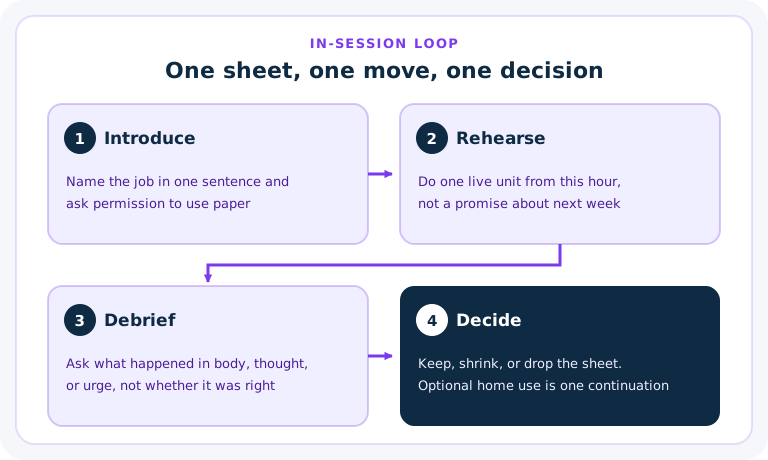
Introduce. Name the job in one sentence. “This page helps us test a prediction,” or “This page helps us notice when you leave your range.” Say what the sheet is not: a test, a diagnosis, or proof of effort. Ask permission to use paper in the room.
Rehearse. Do one unit live. One prediction. One logged action from today. One check-in of current state. One recent cue. You want data from the hour you are already in, not a promise about next week.
Debrief. Ask what happened, not whether they did it right. What did they notice in the body, the thought, or the urge? What surprised them? Where did the page get in the way?
Decide what carries forward. Keep the same move, shrink it, or drop the sheet. If anything goes home, send one continuation of the rehearsed move. Do not send a packet. Between-session practice is optional and secondary. The primary use is in the room.
Four mental health activity sheets for session use
Use one sheet in the hour. Switching mid-session because the first page felt incomplete usually means the job was never named.
Behavioral experiment for anxiety
Fit. The client can state a prediction (“If I leave the safety behavior, X will happen”) and can tolerate a small, planned test. Behavioral experiments test that prediction in experience and update formulation; they do not guarantee disconfirmation, and they are not a better argument on paper. Bennett-Levy’s handbook on behavioral experiments in cognitive therapy is the clinical frame; the printable is only a place to write the prediction and the result.
Example. A client predicts that saying one sentence of a worry out loud will “make it real” and spike anxiety past 8/10 for the rest of the day. You write the prediction, run one spoken sentence, then record peak anxiety and whether the feared duration arrived. The sheet holds the comparison. The intervention is the test.
Caution. If they fill in the prediction after they know the outcome, you no longer have an experiment. Pause and return to conversation, or shrink the test until the prediction can be written first.
Behavioral activation activity log for depression
Fit. Low mood is being maintained by narrowed activity, not only by a thought that needs debate. Activity monitoring and a small scheduled action are the workhorse. A behavioral activation worksheet can hold that monitoring in the hour when formulation points there. Dimidjian and colleagues’ randomized trial supports behavioral activation for adults with major depression. It does not test this worksheet or a rule that activity monitoring must precede cognitive restructuring.
Example. A client says nothing counts unless it is productive. You log one ten-minute walk from this morning, with mood before and after, and you leave mastery blank on purpose. The question is contact with activity, not a score.
Caution. If the log starts ranking the day, drop the ratings. A page that confirms worthlessness is not activation.
Window-of-tolerance check-in for trauma-aware work
Fit. The next clinical task is pacing, not insight. The client can still think, relate, and choose inside a range, and they leave that range into agitation or shutdown. The window-of-tolerance worksheet is a map of state. It is not a trauma-processing protocol. Corrigan’s review of the window-of-tolerance model is a useful reminder that autonomic shift can outrun language.
Example. Mid-session, the client’s voice flattens as you move toward a body cue. You stop the content, mark early hypoarousal on the check-in, and use the stop rule you already wrote: pause the prompt, feel feet on the floor, no narrative. The sheet times the work. It does not open it.
Caution. Do not use the map to justify more exposure. If they are outside range, the page goes down.
Trigger log for recovery planning
Fit. The useful next map is an individual cue-urge-response chain: what showed up, what the urge did, what they did next. This is one sheet for one person in one session. It is not a group curriculum and not a twelve-step worksheet set.
Example. A client names Friday evening plus an empty apartment as the cue, a four out of ten urge, and scrolling until they missed a meal as the response. You record that chain once. Next session you review whether any link is usable, not whether they produced a week of logs.
Caution. If the page turns into confession, moral inventory, or a program plan, close it. Tracking a cycle is not the same as running recovery programming.
Presenting-concern sampler. The broader mental health worksheets sampler holds one sheet per presenting concern: a behavioral experiment, an activity log, a window-of-tolerance check-in, and a trigger log. It is not the four in-session sheets above.
Get the Mental Health Worksheets Sampler
One printable sheet per presenting concern — behavioral experiment, activity log, window-of-tolerance check-in, and trigger log. Sent to your inbox.
- Behavioral experiment sheet for testing one prediction
- Activity log for pacing and energy across a week
- Window-of-tolerance check-in for arousal range
- Trigger log for mapping one cue-urge-response chain
Free. We'll email the PDF link right away and add you to the therapist toolkit, sent every two weeks. Unsubscribe any time.
Where should we send the link?
We'll email the PDF link right away. You'll also get the therapist toolkit every two weeks. Unsubscribe any time.
✓ Check your inbox
We've sent you the PDF
The download link is on its way to your inbox, usually within a minute or two. The email will come from Emosapien (hello@team.emosapien.com); check your spam folder if you don't see it.
You're also on the therapist toolkit list, sent every two weeks. Unsubscribe any time from the email footer.
When to pause or adapt the sheet
Pause when the page costs more than it gives.
Literacy and language: if reading or writing is the load, switch to spoken answers, a drawn mark, or a shorter field list. Mental health activity sheets stay optional when the page itself is the barrier. Do not confuse incomplete boxes with incomplete work.
Cognitive load: one column is enough when attention, medication fog, or exhaustion is in the room. A dense grid can masquerade as thoroughness.
Perfectionism and evaluative threat: some clients hear a blank line as a test. If handwriting gets smaller and more careful, or they apologize for the page, name that pattern and offer a pass.
Dissociation and activation: if they leave range, the sheet is too slow. Ground, stop, and return to state before any further prompt.
Accessibility: motor, visual, and sensory access are clinical constraints. Enlarge, scribe, or drop paper.
Informed consent: if the sheet will hold trauma detail, urge maps, or other material the client would not otherwise externalize, say how it will be stored and who can see it before they write.
Document the intervention, not the client’s private worksheet
The progress note records what you did and how the client responded. Name the intervention (“behavioral experiment on speaking one worry sentence”), the response, and the next step. Do not paste the client’s private writing into the note unless there is a specific clinical reason.
The working page does not replace the progress note or the complete record of care. Completion is not the outcome. If the hour produced a clear observation and a smaller next move, the sheet did its job even if fields remain blank.
Where Emosapien fits
After you name the job, rehearse one of these mental health activity sheets, and decide what carries forward, Emosapien drafts a SOAP, BIRP, or GIRP note from that hour. You review the named intervention, the client’s response, and the next step before anything enters the chart.
The therapist stays with formulation and the stop rule. Emosapien organizes the named intervention, the observed response, and the next step in the clinician-reviewed note so the next hour starts from what the trial showed.
Start free with Emosapien and keep the rehearsed move tied to the note you sign.
References
- Bennett-Levy, J., Butler, G., Fennell, M., Hackmann, A., Mueller, M., and Westbrook, D. (Eds.). (2004). Oxford guide to behavioral experiments in cognitive therapy. Oxford University Press.
- Dimidjian, S., Hollon, S. D., Dobson, K. S., Schmaling, K. B., Kohlenberg, R. J., Addis, M. E., … Jacobson, N. S. (2006). Randomized trial of behavioral activation, cognitive therapy, and antidepressant medication in the acute treatment of adults with major depression. Journal of Consulting and Clinical Psychology, 74(4), 658-670.
- Corrigan, F. M., Fisher, J. J., and Nutt, D. J. (2011). Autonomic dysregulation and the Window of Tolerance model of the effects of complex emotional trauma. Journal of Psychopharmacology, 25(1), 17-25.