
Mindfulness Group Activities You Can Run This Hour

Outline
Authored by Dr. Hannah Lin, counseling psychologist trained in CBT, ACT, and IFS, with over a decade of clinical practice across anxiety and complex trauma.
Someone asks the room to close their eyes and “just breathe.” Two members go still. One starts performing calm. One leaves without a pass. The hour became a wellness ritual, and nobody can say what was rehearsed.
Mindfulness group activities are in-room attention rehearsals a licensed therapist can run this hour: timed, eyes-open by default, with a pass option and a stop rule. They are not a meditation class. They are not a take-home worksheet.
The pack holds ten cards across three jobs: observe and describe, low-risk grounding, and brief present-moment contact.
Educational resource for licensed mental-health clinicians facilitating mixed adult groups. Card selection sits inside formulation, consent, and risk review. This is not a treatment, not a crisis service, and not a substitute for the agreed safety plan.
Mindfulness group activities versus worksheets and courses
Name the job before you pick a tool.
Use this hour when the clinical job is shared attention, not coping rehearsal, process, or check-in. For the wider facilitation frame, start with the group therapy resource hub, and to choose by clinical job and room state, use group therapy activities. If the hour is a body-based shared experiment rather than an attention card, use experiential group therapy activities.
It is not:
- Individual present-orientation paper. Assign the grounding techniques worksheet for that job.
- Take-home mindfulness-module sheets. Assign dbt worksheets for that job. For one present-moment writing stem rather than a skills-module sheet, assign journal prompts for mindfulness.
- Mixed-mechanism coping rehearsal, fun icebreakers, or game-show formats. No Pictionary. No spirit animals. No group hug.
- Yoga, a long body scan, outdoor meditation, or an 8-week MBCT or MBSR course.
Kabat-Zinn’s MBSR frame is historical context, not a syllabus to reprint. NICE NG222 treats mindfulness-based cognitive therapy as a structured course for recurrent depression. This hour is one card, not that course.
Email me the facilitator pack
Get ten timed attention cards, eyes-open defaults, pass language, stop rules, and a one-page facilitator worksheet. Keep individual worksheets with the client, not in this shared hour.
- Ten timed in-room attention cards across observe/describe, grounding, and present-moment contact
- Eyes-open default, pass language, stop conditions, and next-week reopen prompts
- One-page facilitator worksheet for room state, backup, contraindications, and documentation
Free. We'll email the PDF link right away and add you to the therapist toolkit, sent every two weeks. Unsubscribe any time.
Where should we send the link?
We'll email the PDF link right away. You'll also get the therapist toolkit every two weeks. Unsubscribe any time.
✓ Check your inbox
We've sent you the PDF
The download link is on its way to your inbox, usually within a minute or two. The email will come from Emosapien (hello@team.emosapien.com); check your spam folder if you don't see it.
You're also on the therapist toolkit list, sent every two weeks. Unsubscribe any time from the email footer.
When a shared attention card fits
Use this hour when the room can hold one shared low-demand task. Mixed adult outpatient, IOP, and community groups can use a card when cohesion is high enough that a pass is respected and not mocked. Mindfulness group activities fit when the clinical job is attention: observe, describe, or present-moment contact. They do not replace distress tolerance, process work, or a check-in.
Observe, describe, participate, and one-mindfully are attention labels from Linehan’s DBT skills training, not a license to teach the full module. Present-moment contact in ACT is contact with current experience, not a request that the client become quiet. If the function of distress is still unknown, do not use attention practice to mute it.
Association for Specialists in Group Work best practice guidelines still apply: purpose, preparation, active facilitation. Trauma-informed care asks for choice, collaboration, and safety, not surprise performance (SAMHSA six guiding principles). Treat closing the eyes as an individual screening and consent concern; it is not universally safe.
When to pause
Stop, shrink, or switch when:
- Acute risk is in the room
- Flooding, dissociation, or a practice used as self-punishment
- Trauma material arrives without a container
- The room needs opening prompts or a check-in more than a task
- Members need private sheets instead of a shared card
- Compulsive performance of “calm” or “doing it right”
- Spiritual language would exclude or split the group
- Breath-holds or medical breath protocols would be unsafe
These are clinical holds. They are not a ranking of people who “cannot be mindful.”
Three jobs, ten timed cards
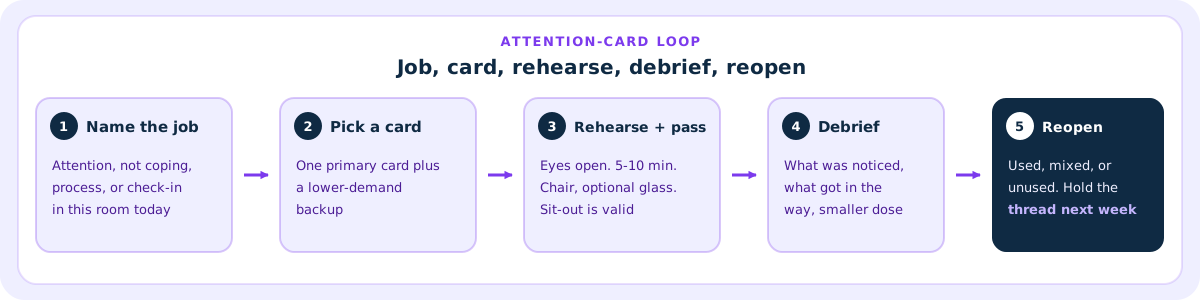
Run one card per hour. Name a lower-demand backup before you start. Materials: the chairs you already have, an optional object, an optional water glass. Give the task five to ten minutes, then debrief. Eyes open unless a member who already tolerates closing their eyes opts in.
Do not run a long body scan, yoga, loving-kindness circle, silent greeting, group hug, outdoor meditation, or competitive counting.
Scroll the visual sideways to view the full diagram
Attention / observe and describe
Shared-object observe (5-8 min). Rest attention on one shared object already in the room, not a wise-mind lecture.
- Set-up: name a clock, window frame, or water glass. Members look. Eyes open.
- Pass: look at the floor, or sit it out.
- Stop if the object becomes a test of “focus” or a shame cue.
- Debrief: what did you notice, when did attention leave, did looking start to feel performative, what would be smaller.
- Continuity: reopen the same object class next week, whether the card was used or not.
Describe without interpretation (5-8 min). Say what is here without the story.
- Set-up: one factual sentence only (“the chair is blue”), written or spoken by choice.
- Pass: no sentence.
- Stop if description turns into confession or analysis.
- Debrief: where interpretation crept in, what the factual line protected, whether speaking it aloud supported attention or felt performative, what to leave unnamed.
- Continuity: one factual line, or the pass.
Label “thinking” once and return (5-8 min). Notice a thought as a thought, then come back.
- Set-up: when a thought arrives, say “thinking” once, internally or on paper, and return to the chosen object. Not a thought record.
- Pass: skip the label.
- Stop if members start grading how often they thought.
- Debrief: did the label loosen the thought or glue it, what came back, whether one label was enough, what not to analyze.
- Continuity: one return, including “I did not label.”
One-mindful sip of water (5-8 min). One sip with attention on temperature, contact, and swallow.
- Set-up: optional water glass. No performance of savoring.
- Pass: skip the sip and watch.
- Stop if eating or drinking would be medically unsafe or shaming.
- Debrief: what the sip did, when it became a show, whether watching was enough, what a smaller dose would be.
- Continuity: one sip or one skip to reopen.
Low-risk grounding
Eyes-open 5-4-3-2-1 demo (6-8 min). Present orientation through the actual room. Use this as an in-room demo; reserve the individual worksheet for private practice.
- Set-up: count from what is here. Eyes open.
- Pass: name one sense, or none.
- Stop if searching the room becomes hypervigilance or if closing the eyes is pushed.
- Debrief: which sense held, which became searching, whether closing the eyes would have cost contact, what to reuse if anything.
- Continuity: one external cue on the way out, not a homework scan.
Sound counting (5-8 min). Rest attention on sounds already in the room.
- Set-up: count distinct sounds without ranking them.
- Pass: listen without counting.
- Stop if silence itself becomes exposure the room did not agree to.
- Debrief: what was countable, what was noise, whether counting supported attention or felt performative, what a pass protected.
- Continuity: reopen the same sound class next week, whether the card was used or not.
Feet-on-floor contact (5-8 min). Feel contact with the chair and floor without a body scan.
- Set-up: notice two contact points. Eyes open.
- Pass: keep the feet still and skip the notice.
- Stop if contact language pulls members into trauma sensation they did not choose.
- Debrief: what contact was available, what was too much, whether the group rushed to label the experience “grounded,” what a smaller notice would be.
- Continuity: the same two points, used or unused.
Object in hand (5-8 min). One object the member already has (pen, cup, chair rail).
- Set-up: feel weight or temperature. No sharing objects.
- Pass: hands still, watch only.
- Stop if the object becomes a fidget contest or a sensory flood.
- Debrief: what the object did for contact, when attention left, whether naming it out loud helped, what would be too much.
- Continuity: reopen the same object class next week, whether the card was used or not.
Present-moment contact
Eyes-open breath counting with opt-out (5-8 min). Optional count of ordinary breath, never a medical protocol and never box-breathing as a test.
- Set-up: count breaths if useful; keep a natural breath if not. Eyes open.
- Pass: skip the count, feet on the floor.
- Stop for dizziness, breath-holds, or compulsive “correct” breathing.
- Debrief: did the count help, did it spike distress, what the opt-out protected, what a smaller dose would be.
- Continuity: reopen breath only if the member wants it.
Three-minute breathing space, adapted (6-10 min). A brief arrive / gather / expand structure with eyes open and a pass.
- Set-up: name the three beats; keep each short. This arrive / gather / expand sequence adapts Segal, Williams, and Teasdale’s MBCT breathing-space structure. This is not an MBCT course.
- Pass: sit through the three minutes without following the beats.
- Stop if the structure becomes a demand for calm or a spiritual frame the room did not choose.
- Debrief: which beat was usable, which felt like a test, what the pass protected, what to leave here.
- Continuity: used, mixed, or unused.
One shared card is enough. If you stack three, you are running a list again.
Contraindications
Name these holds before you start the card, not after someone is already in the practice.
Eyes-closed practice, long body scans, and spiritual framing are not automatically safe in a mixed group. A member can look peaceful and still lose contact with the room. Interoceptive work can intensify sensation. Prayer language, loving-kindness, or “higher self” talk can exclude people who did not consent to a spiritual frame. Meditation-related adverse effects, including anxiety, traumatic re-experiencing, and feeling disconnected, show up in a population-based sample with relatively modest meditation experience (Goldberg et al., 2022). Screen the person in front of you. Keep eyes open as the default. Treat a pass as consent data.
Also pause for recent trauma without a container, compulsive “doing mindfulness right,” medical limits on breath, and any card used as self-punishment. A pass is information. It is not resistance to insight.
Debrief and next-week reopen
Used, mixed, or unused. All three belong in the reopen. Do not grade sincerity when you bring a card back. Do not make the unused card a public confession.
Ask four questions, then stop:
- What did you actually notice, if anything?
- What got in the way without turning it into character?
- What would a smaller dose look like?
- What do you want me to ask next week?
A pass this week is still a thread. Reopen the named card, not a reconstructed circle summary.
Privacy, documentation, and safety
Record the shared intervention once, then each member’s response pattern: rehearsed, mixed, sat out, flooded, needed a smaller dose. Do not paste the circle’s speech into every chart.
Nobody photographs anyone else’s page. A shared table does not make private writing communal. Send follow-up only through the channel your practice already approved for clinical contact. This pack is not monitored in real time.
Each client handout in this pack carries a brief safety boundary: not a crisis service, not a substitute for the agreed safety plan.
How Emosapien carries the practice between groups
Emosapien keeps the attention practice the member agreed to try visible for the next group, so the clinician reopens what actually happened instead of a reconstructed circle summary. Between-session check-ins, journaling, and homework sit with the Engagement Agent. The clinician reviews and signs every note.
The therapist chooses the card, the pass language, and whether a member belongs in the room. Emosapien does not run the hour, score mindfulness, or monitor crisis.
After the pack, keep the named practice visible between groups.
Use the printable facilitator pack
Keep the menu on paper at the desk. The printable pack for mindfulness group activities is four US Letter pages: ten cards by job, timing and pass options, stop rules, debrief prompts, and a one-page facilitator worksheet (room state, primary and backup, eyes-open default, contraindications, what to document, next-week reopen).
Print the pack to plan and facilitate the hour. It is not a client workbook.
Email me the facilitator pack
Get ten timed attention cards, eyes-open defaults, pass language, stop rules, and a one-page facilitator worksheet. Keep individual worksheets with the client, not in this shared hour.
- Ten timed in-room attention cards across observe/describe, grounding, and present-moment contact
- Eyes-open default, pass language, stop conditions, and next-week reopen prompts
- One-page facilitator worksheet for room state, backup, contraindications, and documentation
Free. We'll email the PDF link right away and add you to the therapist toolkit, sent every two weeks. Unsubscribe any time.
Where should we send the link?
We'll email the PDF link right away. You'll also get the therapist toolkit every two weeks. Unsubscribe any time.
✓ Check your inbox
We've sent you the PDF
The download link is on its way to your inbox, usually within a minute or two. The email will come from Emosapien (hello@team.emosapien.com); check your spam folder if you don't see it.
You're also on the therapist toolkit list, sent every two weeks. Unsubscribe any time from the email footer.
References
- Kabat-Zinn, J. University of Massachusetts Center for Mindfulness. About MBSR.
- Segal, Z. V., Williams, J. M. G., & Teasdale, J. D. (2018). Mindfulness-Based Cognitive Therapy for Depression (2nd ed.). Guilford.
- Linehan, M. M. (2025). DBT Skills Training Manual (rev. ed.). Guilford. Previous edition: 2nd ed., 2015, ISBN 9781462516995.
- National Institute for Health and Care Excellence. NG222: Depression in adults.
- Substance Abuse and Mental Health Services Administration. Six guiding principles for a trauma-informed approach.
- Association for Specialists in Group Work. Guiding group work.
- Goldberg, S. B., Lam, S. U., Britton, W. B., & Davidson, R. J. (2022). Prevalence of meditation-related adverse effects in a population-based sample in the United States. Psychotherapy Research.