
PSYPACT for Psychologists: APIT, TAP, and Home State Rules

Outline
A psychologist licensed in Texas gets a portal message: the long-term client is spending three months with family in Colorado. The clinical relationship is stable. The open question is legal authority for the next video session. That is the everyday problem PSYPACT for psychologists is built to solve, and the everyday trap when someone treats the compact like a badge that covers every mental-health license.
This guide keeps the scope tight. It explains what PSYPACT for psychologists does, who it covers, how E.Passport, APIT, IPC, and TAP fit together, what home-state and receiving-state mean in practice, how renewals work, and which professions must look elsewhere. It includes a dated participating-jurisdiction matrix drawn from official PSYPACT Commission materials and a downloadable eligibility worksheet. It is educational guidance for US psychologists and practice staff, not legal advice and not a substitute for the live PSYPACT map and rules.
Free PDF: PSYPACT Eligibility and Jurisdiction Worksheet
A printable APIT/TAP decision tree, home-state controls, renewal calendar, and dated jurisdiction re-check block for psychologists.
- Profession, license, and service-path gates for APIT and TAP
- Home-state location controls and session preflight checklist
- ASPPB and Commission renewal calendar with 90-day reminder fields
- Dated jurisdiction re-check block based on official Commission materials
Free. We'll email the PDF link right away and add you to the therapist toolkit, sent every two weeks. Unsubscribe any time.
Where should we send the link?
We'll email the PDF link right away. You'll also get the therapist toolkit every two weeks. Unsubscribe any time.
✓ Check your inbox
We've sent you the PDF
The download link is on its way to your inbox, usually within a minute or two. The email will come from Emosapien (hello@team.emosapien.com); check your spam folder if you don't see it.
You're also on the therapist toolkit list, sent every two weeks. Unsubscribe any time from the email footer.
Educational resource for licensed US psychologists and the practice staff who support them. Compact membership, fees, and rules change. Verify current status on psypact.gov and with your board before you rely on any cross-state plan.
What PSYPACT for psychologists is, and what it is not
The Psychology Interjurisdictional Compact (PSYPACT) is an interstate agreement that lets eligible psychologists practice telepsychology, and temporary in-person psychology, across participating jurisdictions under uniform authorizations issued by the PSYPACT Commission.
Three boundaries matter immediately:
- Profession. The compact covers psychologists only. It does not authorize professional counselors, clinical social workers, marriage and family therapists, or other license types.
- Degree and license. Compact practice is built around a full, unrestricted psychology license based on a doctoral degree in a participating jurisdiction, plus ASPPB prerequisite certificates.
- Authority type. Telepsychology and temporary face-to-face practice are separate tracks. Holding one does not automatically create the other.
When a compact episode ends or transfers, the receiving clinician needs a treatment summary therapy template, not a compact authorization.
If your question is broader than psychology, stop here and use a profession-first workflow such as the interstate telehealth rules for therapists guide. If your question is psychology-specific, keep reading. Authority to see the client in another state is not the same fact as a policy that answers a board complaint there. Read malpractice insurance for psychologists for the testing, compact, and tail columns before you assume the home-state policy follows the session.
The two practice tracks: APIT and TAP
APIT: telepsychology across participating jurisdictions
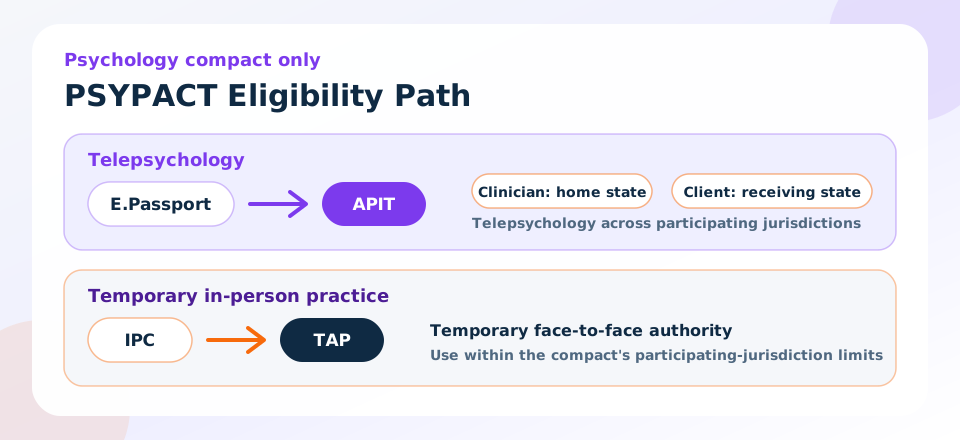
Authority to Practice Interjurisdictional Telepsychology (APIT) is the PSYPACT Commission authorization for synchronous telepsychology into other PSYPACT jurisdictions.
Core sequence:
- Hold a full, unrestricted doctoral psychology license in at least one PSYPACT participating jurisdiction.
- Obtain an E.Passport from the Association of State and Provincial Psychology Boards (ASPPB).
- Apply to the PSYPACT Commission for APIT through the PSYPRO application system.
- Declare a single home state.
- Provide telepsychology only while physically located in that declared home state, to a client who is located in a PSYPACT receiving state.
PSYPACT materials are explicit on physical location. For telepsychology under APIT, home state is both the licensed PSYPACT jurisdiction you declare and the place you must actually be while the service is delivered. Remote work from a vacation rental in a non-home state is not a home-state workaround.
TAP: temporary in-person practice
Temporary Authorization to Practice (TAP) is the PSYPACT Commission authorization for temporary in-person, face-to-face practice in a PSYPACT jurisdiction where you do not hold a license.
Core sequence:
- Hold the required doctoral psychology license in a PSYPACT participating jurisdiction.
- Obtain an Interjurisdictional Practice Certificate (IPC) from ASPPB.
- Apply to the PSYPACT Commission for TAP.
- Practice in person only within the compact’s temporary-practice limits, commonly described as up to 30 calendar days per year per distant state, and only in participating jurisdictions.
APIT and TAP solve different logistics problems. A psychologist who only does video care may need APIT alone. A psychologist who also runs short on-site intensives, court-related interviews, or temporary clinic coverage may need TAP as well.
E.Passport and IPC: the ASPPB prerequisites
ASPPB and the PSYPACT Commission are separate entities. ASPPB issues the prerequisite certificates. The Commission issues APIT and TAP.
| Goal | ASPPB prerequisite | PSYPACT authorization | Typical use |
|---|---|---|---|
| Cross-state telepsychology | E.Passport | APIT | Client in another PSYPACT jurisdiction; you stay in your home state |
| Temporary in-person practice | IPC | TAP | Short face-to-face work in a PSYPACT jurisdiction where you are not licensed |
E.Passport educational pathways and fees live on ASPPB’s site and can change. Primary-source verified transcripts are part of the APIT pathway under Commission policy. Processing times for APIT and TAP commonly run about three to four weeks after a complete application, longer if staff need more documentation.
Do not market “PSYPACT ready” to referral sources until the Commission authorization that matches the service is actually issued and current. PSYPACT for psychologists is an authorization stack, not a slogan.
Home state, receiving state, and session preflight
Use this language the way the compact does:
- Home state: the one PSYPACT jurisdiction where you hold the required license and where you are physically located during APIT telepsychology.
- Receiving state / distant state: the PSYPACT jurisdiction where the client is located while receiving services under compact authority.
Session preflight for every cross-state encounter:
- Confirm your APIT or TAP status is active on the official verification path.
- Confirm you are physically in the declared home state if the service is APIT telepsychology.
- Confirm the client’s physical location that day is a currently participating jurisdiction.
- Confirm the service type matches the authorization (video under APIT; in-person under TAP).
- Confirm you know the receiving state’s practice rules that still apply to compact holders.
- Document location, modality, consent, emergency contacts, and local crisis resources in the note.
- Only then choose billing codes and telehealth modifiers. Coding never cures a missing license or compact authorization.
For the claim side after authority is clear, use the CPT 95 modifier telehealth guide.
Who is outside PSYPACT scope
Write this into intake scripts and website FAQs so clients are not misled:
- Licensed professional counselors and other counseling titles
- Licensed clinical social workers and related social-work licenses
- Licensed marriage and family therapists
- Master’s-level psychology titles that are not the doctoral psychology license the compact requires
- Any clinician whose only license sits in a non-participating jurisdiction
Those clinicians may still practice across state lines when a different compact, temporary practice permit, or full second license allows it. That research is profession-specific. PSYPACT is not the shortcut.
Participating jurisdictions matrix (as of 31 December 2025)
The table below lists jurisdictions that appear with APIT holder activity in the PSYPACT Commission’s official Snapshots materials covering authorizations active as of 31 December 2025. Treat it as a dated research aid, not a live roster. Membership and effective dates change. Always re-check the official PSYPACT map and board contacts before a session.
In mid-2026, additional states publicly reported new PSYPACT legislation (including Alaska and Iowa announcements on compact channels). Enactment is not the same as full participating status with open APIT/TAP practice. Do not treat a news headline as authority until the Commission map and effective-date materials show participation.
| Code | Jurisdiction | In Dec 2025 APIT activity set |
|---|---|---|
| AL | Alabama | |
| AR | Arkansas | |
| AZ | Arizona | |
| CO | Colorado | |
| CT | Connecticut | |
| DC | District of Columbia | |
| DE | Delaware | |
| FL | Florida | |
| GA | Georgia | |
| ID | Idaho | |
| IL | Illinois | |
| IN | Indiana | |
| KS | Kansas | |
| KY | Kentucky | |
| MD | Maryland | |
| ME | Maine | |
| MI | Michigan | |
| MN | Minnesota | |
| MO | Missouri | |
| MS | Mississippi | |
| MT | Montana | |
| NC | North Carolina | |
| ND | North Dakota | |
| NE | Nebraska | |
| NH | New Hampshire | |
| NJ | New Jersey | |
| NMI | Northern Mariana Islands | |
| NV | Nevada | |
| OH | Ohio | |
| OK | Oklahoma | |
| PA | Pennsylvania | |
| RI | Rhode Island | |
| SC | South Carolina | |
| SD | South Dakota | |
| TN | Tennessee | |
| TX | Texas | |
| UT | Utah | |
| VT | Vermont | |
| VA | Virginia | |
| WA | Washington | |
| WI | Wisconsin | |
| WV | West Virginia | |
| WY | Wyoming |
Count in that dated Commission set: 43 jurisdictions. High-population states that often surprise clinicians by their absence from older maps still need a live check every time (examples that have historically been non-participating or delayed include California and New York; never rely on memory).
Fees and renewal path
Commission fee materials published with the same Snapshots set list:
- APIT initial application: $40
- APIT annual renewal: $40
- TAP initial application: $40
- TAP annual renewal: $40
- Late renewal fee example published by the Commission: $25 after the renewal date
E.Passport and IPC fees are separate ASPPB charges. Budget both layers.
Renewal mechanics that protect a caseload:
- Track the anniversary date. It does not float with your last login.
- Renew the ASPPB prerequisite first. Commission renewal waits on prerequisite approval.
- Start early. Commission guidance commonly points holders to the renewal window that opens about 90 days before expiration.
- If renewals are missed, stop compact practice until status is restored. Do not “finish the month” on an expired APIT.
- Two consecutive years without completed renewals can close the authorization path under Commission renewal rules.
Eligibility and renewal decision tree
Use this tree before you advertise multistate availability.
Step A. Profession gate
- Doctoral psychologist with independent license? Continue.
- Any other license type? Exit PSYPACT. Research that profession’s compact or second-license path.
Step B. Geography gate
- Is your license jurisdiction a current PSYPACT participant? If no, PSYPACT is unavailable until that changes or you hold a qualifying license in a participating jurisdiction.
- Will clients be located only in participating jurisdictions on session days? If no, build a non-compact plan for those locations.
Step C. Service gate
- Video only across state lines: E.Passport, then APIT.
- Temporary in-person across state lines: IPC, then TAP.
- Both: complete both prerequisite and authorization pairs.
Step D. Conduct gate
- Full, unrestricted license required.
- No disqualifying disciplinary history on psychology licenses, per application standards.
- Primary-source education verification as required.
Step E. Operations gate
- Home-state declaration on file and still accurate.
- Physical location plan matches APIT rules.
- Receiving-state law checklist assigned to someone in the practice.
- Emergency and local-resource plan for each client location.
- Renewal calendar owned by a named person.
Step F. Documentation gate
- Note captures modality, both locations, consent, and risk or crisis steps.
- Billing only after authority is confirmed.
- Website and informed-consent language match the licenses and authorizations you actually hold.
Practice documentation that supports compact work
Compact authority fails in audits and complaints when the chart cannot show where everyone was and which authority covered the hour.
Minimum chart elements for a PSYPACT telepsychology encounter:
- Date and time
- Service modality (real-time audio-video)
- Clinician physical location (home state)
- Client physical location (receiving state)
- Active authorization relied on (APIT, with verification date if your policy requires it)
- Telehealth consent status
- Local emergency resources discussed or on file
- Standard clinical content for the psychotherapy code billed
Family and couples video work adds attendance documentation. If the identified patient and relatives join from different states, every location is a licensure fact, not a scheduling detail. Pair that charting with the 90847 family psychotherapy guide when the code is family therapy with the patient present.
Common failure modes
- Treating PSYPACT like a universal mental-health passport for the whole group practice
- Starting APIT telepsychology from an airport lounge outside the declared home state
- Seeing a client who traveled to a non-participating state “just this once”
- Letting E.Passport or IPC lapse and assuming APIT or TAP still stands alone
- Marketing “licensed in all PSYPACT states” without distinguishing compact authority from full licensure
- Fixating on modifier 95 while the compact or license gate is still open
- Skipping receiving-state law checks on child abuse reporting, duty to warn, recording, or telehealth consent
- Using supervision under compact authority without reading current Commission guidance on supervision limits
Receiving-state duty to warn is not the same obligation as a duty to protect. The comparison, and why a compact does not settle it, is duty to warn compared with duty to protect.
Download the eligibility and jurisdiction worksheet
The worksheet turns the decision tree and matrix into a one-sitting practice tool: profession gate, home-state declaration, APIT versus TAP path, renewal dates, client-location log headers, and a dated jurisdiction re-check block. It is an educational aid. It does not certify eligibility.
Free PDF: PSYPACT Eligibility and Jurisdiction Worksheet
A printable APIT/TAP decision tree, home-state controls, renewal calendar, and dated jurisdiction re-check block for psychologists.
- Profession, license, and service-path gates for APIT and TAP
- Home-state location controls and session preflight checklist
- ASPPB and Commission renewal calendar with 90-day reminder fields
- Dated jurisdiction re-check block based on official Commission materials
Free. We'll email the PDF link right away and add you to the therapist toolkit, sent every two weeks. Unsubscribe any time.
Where should we send the link?
We'll email the PDF link right away. You'll also get the therapist toolkit every two weeks. Unsubscribe any time.
✓ Check your inbox
We've sent you the PDF
The download link is on its way to your inbox, usually within a minute or two. The email will come from Emosapien (hello@team.emosapien.com); check your spam folder if you don't see it.
You're also on the therapist toolkit list, sent every two weeks. Unsubscribe any time from the email footer.
How Emosapien fits a multistate psychology workflow
Emosapien is built for mental-health clinicians, not generic medical scribing. The Scribe Agent can draft session notes that prompt for telehealth modality and client location so the chart matches the authority decision you already made. It does not decide whether PSYPACT covers the hour. That judgment stays with the psychologist and, when needed, counsel or your board.
If you want review-first documentation support while you run a compact caseload, start a free trial. For the wider US compliance cluster, start at the compliance resource hub.
Closing checklist
- Profession is psychology; other licenses use other pathways
- Home-state declaration is current and matches physical practice location for APIT days
- E.Passport and APIT are both active for telepsychology, or IPC and TAP for temporary in-person work
- Client location is a participating jurisdiction on the session date
- Receiving-state practice rules and emergency plan are on file
- Note documents both locations and modality before billing
- Renewal dates for ASPPB and Commission layers are owned and calendared
- Live PSYPACT map checked after any legislation headline
That is the practical bar for PSYPACT for psychologists: precise eligibility, current authorizations, honest scope limits, and a chart that can explain the cross-state hour without last-minute guesswork.
References
- Psychology Interjurisdictional Compact Commission. PSYPACT overview and official resources.
- Psychology Interjurisdictional Compact Commission. Practicing telepsychology under PSYPACT (APIT).
- Psychology Interjurisdictional Compact Commission. Temporary practice under PSYPACT (TAP).
- Psychology Interjurisdictional Compact Commission. Application FAQs.
- Psychology Interjurisdictional Compact Commission. Practice-related FAQs.
- Psychology Interjurisdictional Compact Commission. PSYPACT map / participating jurisdictions.
- Psychology Interjurisdictional Compact Commission. Snapshots fee and participating-state materials (APIT activity set as of 31 December 2025).
- Association of State and Provincial Psychology Boards. E.Passport.
- Association of State and Provincial Psychology Boards. Temporary practice / IPC information.
- PSYPACT verification directory. verifypsypact.org.