
Interstate Telehealth Rules for Therapists: Session Preflight

Outline
A long-term client texts from an airport: two weeks with family in another state, same Thursday slot, same video link. The clinical work is stable. The open question is legal authority for the next hour. That is the everyday problem interstate telehealth rules for therapists are built to solve, and the everyday trap when a practice treats one home-state license like a national badge.
This guide turns interstate telehealth rules for therapists into a profession-first pre-session workflow. It walks clinician location, client location, license type, compact or temporary authority, emergency plan, consent, payer checks, and documentation before the claim leaves the practice. It pairs with a downloadable cross-state session preflight worksheet. It is educational guidance for US mental-health clinicians, not legal advice and not a substitute for your board, compact commission, or counsel.
Free PDF: Interstate Telehealth Session Preflight Worksheet
A printable cross-state telehealth preflight for client location, license or compact authority, emergency plan, consent, payer coding, and chart language before the session starts.
- Session identity block with clinician and client locations
- License family and compact or temporary-authority checks
- Emergency resources, consent, and payer modifier prompts
- Chart-language checklist for modality, authority, and clinical content
Free. We'll email the PDF link right away and add you to the therapist toolkit, sent every two weeks. Unsubscribe any time.
Where should we send the link?
We'll email the PDF link right away. You'll also get the therapist toolkit every two weeks. Unsubscribe any time.
✓ Check your inbox
We've sent you the PDF
The download link is on its way to your inbox, usually within a minute or two. The email will come from Emosapien (hello@team.emosapien.com); check your spam folder if you don't see it.
You're also on the therapist toolkit list, sent every two weeks. Unsubscribe any time from the email footer.
Educational resource for licensed US mental-health clinicians and the staff who support them. Compact membership, temporary-practice rules, board guidance, and payer telehealth policy change. Re-verify primary sources before you rely on any cross-state plan.
The core location rule
Start every cross-state preflight by recording where the client is physically located during the encounter. Then identify the profession-specific board, commission, or other authority that governs practice for that location; the state printed on your office lease is not enough to complete this check.
Three facts follow immediately:
- Client travel changes the legal map. A stable treatment plan does not automatically travel with the client.
- Clinician travel can change the map too. Some compact pathways (for example PSYPACT telepsychology) also care where you sit during the session.
- License type is not optional flavor text. A rule written for psychologists does not answer an LPC, LCSW, or LMFT question.
If you only remember one sentence from this preflight, make it this: name the profession, name both locations, then prove authority for that pair on the session date.
Which states allow telehealth across state lines for your license
Start with your profession, then check the governing commission or state board for the state where your client sits. The compact-status notes below were checked September 24, 2026; they are research starting points, not permission to practice:
| Your license family | States or pathway to check first | What you must confirm |
|---|---|---|
| Doctoral-level psychologist | Check the PSYPACT commission and the client-location board for the current pathway | Do not use this table as an eligibility determination. Confirm your exact license, location, and authorization directly with the governing sources before the session. |
| Independent professional counselor | The nine live Counseling Compact states: Arizona, Arkansas, Georgia, Indiana, Louisiana, Minnesota, Ohio, Tennessee, and Wyoming | Your home state and the client’s state must both be live for your license title, and you must obtain the remote-state privilege. The Counseling Compact application page was read September 24, 2026; enacted does not mean operational. |
| Clinical social worker | A full second license, a state temporary-practice rule, or another state-board pathway while the Social Work Licensure Compact is still implementing | The official compact site still states that multistate licenses are not yet available. Do not treat compact enactment as current permission to practice. The site was read September 24, 2026. |
| Marriage and family therapist | The client-location board’s full-license, temporary-practice, endorsement, or telehealth registration pathway | The Counseling Compact FAQ says marriage and family therapists do not currently have a Counseling Compact route. Check your own board instead; the FAQ was read September 24, 2026. |
For each license family, open the receiving board or profession commission, save the result, and confirm that your exact license tier, service, and current authorization are covered. Treat the table as a research starting point, not a permission slip.
Telehealth across state lines follows the client location rule
For a cross-state video session, begin with the client’s physical location and also record where you are sitting. Use those two locations when you check the governing board or commission for the applicable authority pathway.
If a client opens the same video link from a different state, repeat the location-and-authority check even when the treatment plan, payer, and appointment time are unchanged. Ask for the client’s location at the start of the encounter and record your own location. For a family or group session, record every participant location and ask the relevant board or commission how its rules apply to that configuration before you begin.
Use this filled decision record when geography changes:
Can I provide telehealth across state lines? Run these five checks first
Before you open the video room, complete these checks in order. Use the governing board or profession commission for the current authority pathway rather than relying on a general telehealth checklist.
- Freeze both locations. Ask the client where they will physically be, record the city and state, and record where you will physically provide the service.
- Match your license family. Select the psychology, counseling, social work, MFT, or other board pathway that actually covers your credential and service. Do not substitute a different profession’s compact.
- Prove current authority. Save the record issued by the pathway you identified. For a compact privilege, wait until the privilege appears in the commission’s record; for a board license, permit, reciprocity approval, or registration, follow that issuing authority’s current verification process before scheduling.
- Read receiving-state instructions. For the pathway you identified, follow the receiving board or commission’s current instructions for scope, consent, reporting, records, supervision, and emergencies. Add the local emergency number, nearest emergency department, and the client’s permitted emergency contact to the chart.
- Close the documentation and payer gates. Record the authority and both locations. Then check the payer’s own current policy for network, telehealth, modifier, and place-of-service requirements; payer coverage does not replace the authority check.
Profession-first authority paths
Do not start with a generic “telehealth license” search. Start with the credential on the wall. If that credential is not issued yet, the startup checklist for a solo counseling practice puts the license on line one. The license is not the business filing. The LLC versus PLLC card for therapists is the other decision, and it does not cover malpractice. The video-session coverage questions that filing does not answer are on the telehealth liability insurance checklist. Whether video is the right modality for this client is a clinical question, not a compact question. Run that fit check on the benefits of telehealth worksheet, then come back here for the authority path. Do not start with a generic “telehealth license” search. Start with the credential on the wall. If that credential is not issued yet, the startup checklist for a solo counseling practice puts the license on line one. The license is not the business filing. The LLC versus PLLC card for therapists is the other decision, and it does not cover malpractice.
| License family | Primary interstate research path | What it is not |
|---|---|---|
| Psychologist (doctoral, independent) | PSYPACT APIT for telepsychology; TAP for temporary in-person work | A pass for counselors, social workers, or LMFTs |
| Professional counselor (LPC/LPCC and state equivalents) | Counseling Compact privilege-to-practice where both home and remote states are operational, plus board temporary rules | PSYPACT; “enacted” is not always the same as privilege issuance |
| Clinical social worker | Social Work Licensure Compact when multistate licenses are available, plus board temporary or endorsement paths | Automatic multistate practice the day a state enacts the compact |
| Marriage and family therapist | State board second license, temporary practice, and any MFT compact pathway your board recognizes | Automatic coverage under psychology or counseling compact rules |
| Associate / intern / supervised license | Supervisor and board rules for the client-location state | Independent compact privileges you do not yet hold |
Operational reality for mid-2026 research (always re-check the live commission site):
- PSYPACT is the mature psychology pathway. Use the dedicated PSYPACT for psychologists guide for E.Passport, APIT, TAP, home-state, and renewal mechanics.
- Counseling Compact has broad enactment and a growing set of states that issue privileges. Confirm both the home state and the client-location state are operational for privilege practice on the compact map before you book the hour.
- Social Work Licensure Compact has been enacted in many states and has moved through activation, but multistate license issuance has lagged enactment. Until the commission’s application path is live for your home state, keep using full second licenses or temporary board pathways. A compact privilege does not answer whether the policy travels. Social workers should read professional liability insurance for social workers for supervisee and telehealth columns before they treat an employer policy as portable. Counselors and other licensees use the therapist professional liability comparison for the same form, limits, and tail questions.
- No compact does not mean no path. Second full licensure, temporary practice permits, and limited telehealth registrations still exist state by state. They are slower, and they still require board verification.
The profession commission map and the client-location board’s current page are the primary starting points. A general tracker can help you find those authorities, but it does not replace the commission map or your board’s temporary-practice page.
How to run the preflight before each cross-state session
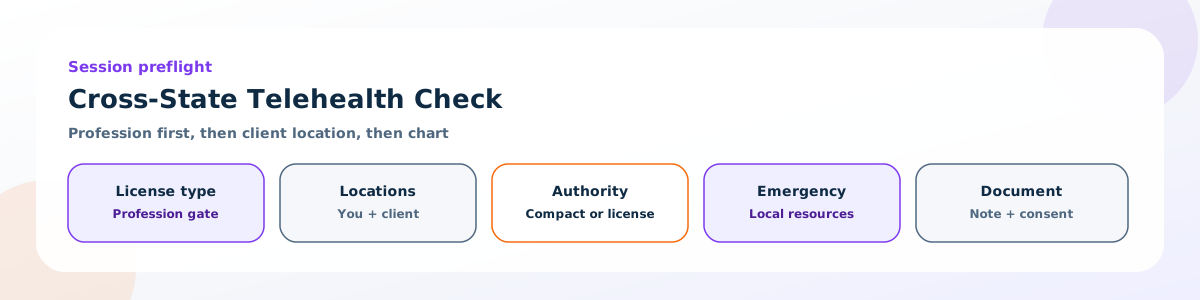
Interstate telehealth rules for therapists only help if you run them before the hour starts. Use this preflight when the client or clinician changes state, when a new referral arrives from another jurisdiction, and on a fixed quarterly cadence for any standing multistate caseload.
1. Freeze the facts for this encounter
- Exact license type and any supervised status
- Clinician physical location on the session date
- Client physical location on the session date (ask; do not assume last week’s address)
- Service type: intake, individual, family, group, crisis
- Modality: real-time audio-video, audio-only, or temporary in-person
2. Choose the authority path
Work top-down:
- Do I already hold a full, active license in the client-location state that covers this service?
- If no, does my profession compact cover both my home-state posture and the client location for this modality, with current privilege or authorization status?
- If no, does the client-location board offer a temporary practice, registration, or telehealth-specific pathway I actually qualify for?
- If no, the honest options are reschedule after authority is obtained, refer locally, or see the client only when they return to a covered geography.
Write the chosen path in the chart. “We have always done Thursday video” is not an authority path.
3. Overlay receiving-state practice duties
Authority to connect on video is not the whole job. Confirm:
- Scope of practice for your license title in that state
- Telehealth consent or disclosure language the board expects
- Child-abuse, vulnerable-adult, and imminent-risk duties for the client location
- Record retention expectations if the case will live across jurisdictions
- Any ban or limit on recording sessions, out-of-state prescribing adjacent work, or cross-border supervision
4. Build the emergency plan for the client location
Before the first cross-state hour, collect:
- Client’s current address or at least city and state for the session
- Local emergency number and nearest emergency department
- Local crisis line when one exists
- Who the client permits you to contact in a safety emergency
- How you will reach local responders if the video drops mid-crisis
A home-state warm line does not replace client-location emergency resources.
5. Separate payer rules from license rules
Only after authority is closed should billing staff apply:
- Covered telehealth status for the code
- Modifier rules (often modifier 95 for commercial audio-video claims)
- Place-of-service codes (commonly POS 10 in the home, POS 02 elsewhere)
- Any payer network or originating-site leftover requirements
Use the telehealth flexibilities for therapists guide for the dates those modifier and place-of-service rules change. A clean claim cannot repair missing license authority. Out-of-network clients still need a superbill template that records POS, the payer-required telehealth modifier when applicable, and the amount actually paid.
6. Document before you finalize the note and claim
Minimum chart elements for a cross-state telehealth encounter:
- Date and time
- Modality (real-time audio-video unless you are intentionally documenting another modality)
- Clinician physical location
- Client physical location
- Authority relied on (license number and state, compact privilege or authorization reference, or temporary pathway)
- Telehealth consent status where required
- Emergency-resource confirmation
- Standard clinical content for the code billed
Scroll the visual sideways to view the full diagram
Worked scenarios
These scenarios show how interstate telehealth rules for therapists change with profession and geography. The clinical hour can look identical; the authority path does not.
Scenario A. Psychologist, client travels inside PSYPACT.
You hold active APIT and sit in your declared home state. The client will be in a currently participating receiving state. Preflight still confirms map status that week, documents both locations, and checks receiving-state reporting and consent overlays. If the client instead lands in a non-participating jurisdiction, APIT does not stretch to cover the week.
Scenario B. LPC, client in a Counseling Compact state.
Confirm your home state and the client state both support privilege practice for your license tier, that your privilege is active, and that the service is within remote-state scope. If either state is enacted-but-not-issuing, the compact row fails and you need another pathway.
Scenario C. LCSW, compact not yet issuing multistate licenses for your home state.
Do not market “compact ready.” Use second licensure, a board temporary rule if one fits, or decline the geography until a lawful path exists.
Scenario D. Family session with participants in two states.
Every participant location can create a licensure fact. Identify the patient of record, every physical location on the call, and whether your authority covers the configuration before you assign a family psychotherapy code.
Common failure modes
- Treating PSYPACT, the Counseling Compact, or the Social Work Compact as interchangeable mental-health passports
- Skipping the “where are you sitting right now?” question because the portal still shows last month’s home address
- Starting the session while “the privilege application is almost done”
- Documenting excellent clinical work and never recording either location
- Letting billing push modifier 95 while the license gate is still open
- Using home-state mandatory-reporting instincts for a client who is physically elsewhere
- Supervised clinicians assuming the supervisor’s multistate footprint automatically covers them
- Website copy that says “licensed in all compact states” without distinguishing privilege, temporary practice, and full licensure
Download the cross-state session preflight worksheet
The worksheet is the reusable artifact: profession gate, location and authority gate, consent and emergency plan, payer gate, chart language, go/no-go decision, and a quarterly map re-check log. It is an educational aid. It does not certify that any encounter is lawful.
Free PDF: Interstate Telehealth Session Preflight Worksheet
A printable cross-state telehealth preflight for client location, license or compact authority, emergency plan, consent, payer coding, and chart language before the session starts.
- Session identity block with clinician and client locations
- License family and compact or temporary-authority checks
- Emergency resources, consent, and payer modifier prompts
- Chart-language checklist for modality, authority, and clinical content
Free. We'll email the PDF link right away and add you to the therapist toolkit, sent every two weeks. Unsubscribe any time.
Where should we send the link?
We'll email the PDF link right away. You'll also get the therapist toolkit every two weeks. Unsubscribe any time.
✓ Check your inbox
We've sent you the PDF
The download link is on its way to your inbox, usually within a minute or two. The email will come from Emosapien (hello@team.emosapien.com); check your spam folder if you don't see it.
You're also on the therapist toolkit list, sent every two weeks. Unsubscribe any time from the email footer.
How Emosapien fits a multistate caseload
Emosapien is built for mental-health clinicians, not generic medical scribing. The Scribe Agent can draft session notes that prompt for telehealth modality and client location so the chart matches the authority decision you already made. It does not decide whether a compact or second license covers the hour. That judgment stays with the clinician and, when needed, counsel or your board.
If you want review-first documentation support while you run a careful multistate caseload, start a free trial. For the wider US compliance cluster, start at the compliance resource hub.
Closing checklist
Treat this as the short form of interstate telehealth rules for therapists before you hit Join:
- Profession and license tier named before any compact search
- Client and clinician physical locations confirmed for this date
- Authority path chosen and current (full license, compact privilege, temporary rule, or no-go)
- Receiving-state practice, reporting, and consent overlays reviewed
- Local emergency resources on file for the client location
- Payer coding applied only after authority is closed
- Note documents modality, both locations, authority, consent, and clinical content
- Live commission or board map re-checked after legislation headlines
That is the practical bar for cross-state video care: profession first, location second, authority third, chart last, and no silent assumptions when someone opens a laptop in a new state.
References
- Psychology Interjurisdictional Compact Commission. PSYPACT official site.
- Counseling Compact Commission. Counseling Compact official site.
- Social Work Licensure Compact. Official compact site.
- Centers for Medicare and Medicaid Services. Medicare telehealth services.
- American Medical Association. CPT code set and telehealth modifiers.