
Social Skills Worksheets for Adults in Therapy

Outline
Authored by Dr. Hannah Lin, counseling psychologist trained in CBT, ACT, and IFS, with over a decade of clinical practice in anxiety and complex trauma.
Jordan can draft a clean request on paper. Joining the Tuesday lunch table is a different job, and the request-repair sheet does not cover it. He knows what he would ask a partner. He does not know how to sit down, keep one thread going, and leave without disappearing.
Social skills worksheets for adults are therapist-chosen rehearsal sheets for that narrower job: joining, starting, maintaining, and exiting one ordinary adult conversation, reading one cue, and naming one next try. They are for licensed therapists working with adult clients in outpatient talk therapy. They are not a classroom pack.
The pack names join/start/exit, perspective-taking, one next-practice log, and a clinician debrief card. Name the purpose of each field with the client so the assignment stays one conversation, not a scored social-skill test across a week of small talk.
Educational content for licensed therapists, not clinical, legal, or emergency advice. Worksheet selection sits inside formulation, consent, culture, accessibility, and risk review. These sheets do not replace supervision, a safety plan, or a social-anxiety protocol.
What this pack is and is not
This is an adult rehearsal aid. It holds one upcoming situation. It does not grade eye contact, teach a sharing circle, or treat social difficulty as a character defect.
The APA Dictionary of Psychology defines social skills as learned abilities for a given social context, not as a trait score. Keep that definition. Do not import a deficit label because a printable asked for one.
The wider library of therapy worksheets in clinical practice covers choosing forms by clinical task. Use this printable pack when the next hour needs one rehearsed join, not a high-stakes ask.
| This pack is | This pack is not |
|---|---|
| One upcoming adult situation (coworker, neighbor, group member, acquaintance) | A kids SEL, sharing-circle, or personal-space printable |
| Join or start, one maintain move, and an exit | A request, reflective listening check, and repair line |
| Cue-reading with one alternative meaning | An emotion-faces chart or an eye-contact quota |
| One named try before the next session | A SUDS ladder or a week of forced exposures |
| Therapist-chosen purpose and cadence | An ABA program, token board, or RBT data sheet |
If the job is a request, a listening check, and a repair in a known dyad, use the communication skills worksheet. If the job is a felt signal, a named limit, and an assertive script, use the boundaries worksheet. If the job is a style grid (passive, aggressive, assertive) plus one graded rehearsal rung, use the assertiveness style-grid worksheet. DEAR MAN, GIVE, and FAST stay in the DBT interpersonal pack. A seven-step ask or refusal is that worksheet, not this joining sheet. When the job is an adult-role sheet rather than a joining rehearsal, use adulthood worksheets.
Email me the social skills worksheet pack
Get join/start/exit, cue-reading, one next-practice log, and a clinician debrief card for purpose, cadence, stop conditions, and next-session reopen.
- Join, start, maintain, and exit one upcoming adult conversation
- Perspective-taking and cue-reading with one alternative meaning
- One named next-practice log, not a SUDS ladder
- Clinician debrief card for purpose, cadence, stop conditions, and next-session reopen
Free. We'll email the PDF link right away and add you to the therapist toolkit, sent every two weeks. Unsubscribe any time.
Where should we send the link?
We'll email the PDF link right away. You'll also get the therapist toolkit every two weeks. Unsubscribe any time.
✓ Check your inbox
We've sent you the PDF
The download link is on its way to your inbox, usually within a minute or two. The email will come from Emosapien (hello@team.emosapien.com); check your spam folder if you don't see it.
You're also on the therapist toolkit list, sent every two weeks. Unsubscribe any time from the email footer.
When social skills worksheets for adults fit
Use them when an adult client has a specific upcoming social situation that is not already a high-stakes ask, a limit to state, or a feared-evaluation hierarchy. “I will sit with two coworkers at Thursday lunch, greet, ask one follow-up, and leave at 12:40” is a situation. “Be better at networking” is not.
They are useful across a work, community, or group gap when the next hour needs one rehearsed move. CBT rehearsal is the technique, not a personality makeover. ACT can keep the try values-sized. IFS can name a part that wants to vanish at the door without turning the exit into a performance.
Agree on a purpose before the page leaves. “Notice how you join and how you leave, and we will start there” is a purpose. “Practice until you look comfortable” is a test, and a test will find a failing client.
The assignment is optional in the sense that a skipped try or a blank return still belongs in the next hour. Completion is not proof of alliance. Non-completion is not proof that the client “will not do the work.”
When to pause the work
Pause social skills worksheets for adults when the paper would cost safety, dignity, or the real clinical job.
Stop, shrink, or switch tasks when:
- Coercive control or IPV is in the field. Practicing a join, a maintain move, or a “read the room” check in an unsafe relationship can increase risk. Complete a risk assessment and safety plan first. Cue-reading is not a substitute for assessing control.
- The client floods or freezes. A rehearsal that overwhelms working memory is the wrong dose. Regulate first. Do not push a friendlier close through shutdown.
- The indicated work is different. Request-repair, a limit script, DEAR MAN, or a graded exposure / SAD pack each have their own form. Hope, Heimberg, and Turk’s Managing Social Anxiety protocol is that other job. Use an exposure hierarchy worksheet when a SUDS ladder is the clinical task. Do not stretch this pack into a fear hierarchy.
- The sheet would become a classroom SEL lesson or an ABA program. Discrete-trial social drills, token boards, and RBT data collection are out of scope for this audience. If that is the treatment frame, this pack is the wrong paper.
- Identified-deficit language is doing shame work. “Social skills deficit” on a take-home page is not a formulation. It is a verdict.
- A neurotypical small-talk drill is the only intervention for an autistic or ADHD adult. Adapt cue-reading. Slow the inference. Allow a written check. Do not run an eye-contact quota or a networking promise as the treatment.
SAMHSA’s trauma-informed principles put safety, trustworthiness, and choice ahead of any exercise. If last week’s review felt like a grade on likability, this week’s page will stay in the bag. Repair that first.
What these worksheets contain
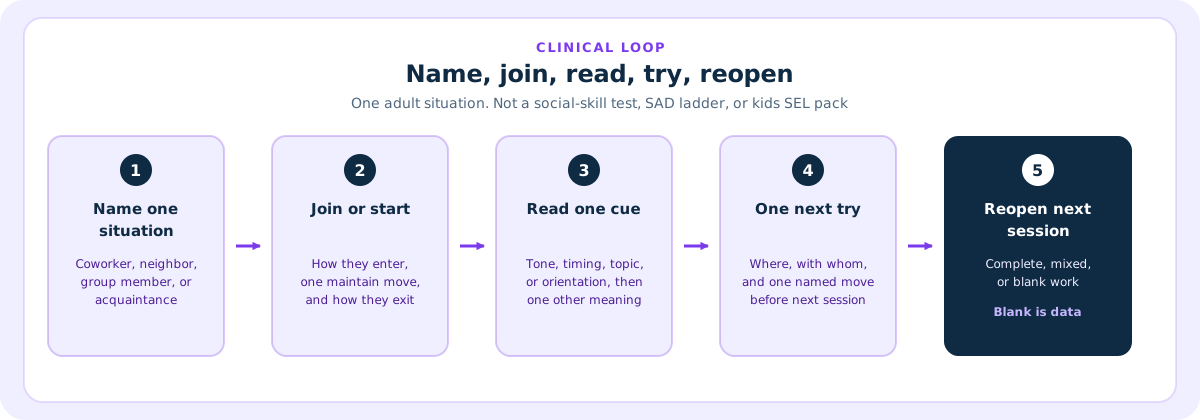
The fields stay short on purpose. Walk join, cue-reading, and one next try once in session before the page goes home. Do not hand a week-long social report card unless you have already seen that a shorter sheet comes back without becoming a performance review.
Scroll the visual sideways to view the full diagram
1. Join, start, maintain, exit
One upcoming adult situation. What the client will try in order: how they join or start, one maintain move, how they exit. Not a request-reflect-repair form and not an intimate-partner conflict script.
Fields. Where. Who will be there. What this conversation is for. The first move. One maintain move. The exit. What actually happened, if they want to write it.
Introduce. “We are writing the first sit-down, one thing that keeps it going, and a clear leave. We are not writing the ask you already know how to draft.”
Stop. A high-stakes negotiation. A limit the client still cannot name. A script meant to manage an unsafe partner.
2. Perspective-taking / cue-reading
What the client noticed (tone, timing, topic change, body orientation, in ordinary language). What they inferred. What else it might have meant. One check they could use next time.
Fields. The cue, in what was seen or heard. The inference. One alternative that still fits the facts. One smaller check. A fit check: still joining practice, actually a limit, actually a repair, or pause.
Introduce. “We want one other meaning that still fits, not a verdict about their personality.”
This is not an emotion-faces chart for children. It is not mind-reading as a cognitive-distortion drill. If the real job is a thought record, use a thought record instead.
Stop. Eye-contact quotas. “They definitely felt X.” Cue-reading used to justify staying in an unsafe exchange.
3. Next-practice log
One named try before the next session: where, with whom, the single move, what happened, what the client wants to reopen. Not a SUDS hierarchy and not a week of forced exposures.
Fields. Where. With whom. The single move. Tried as planned, smaller, changed, or not tried. What happened. What to reopen. Privacy choice.
Introduce. “One try. If it stays blank, that is still the start of next hour.”
Stop. A ten-row exposure list. A workplace performance review. Scoring the try as pass or fail.
Reopen complete, mixed, or blank sheets
Name the sheet at the start of the next hour. Ask what the page missed before you interpret motivation.
| Return state | First clinical move |
|---|---|
| Complete | Ask what the page flattened, including the part that wanted to leave earlier |
| Mixed | Find which move was usable and which one became a performance |
| Cue sheet overfilled | Check whether inference turned into mind-reading or self-attack |
| Blank | Ask what happened around the form before you read it as avoidance |
| Flood or freeze on the page | Leave rehearsal. Regulate. Do not grade the shutdown |
A useful reopen is specific: “You wrote that you sat down and asked one question, then left the exit blank. Where should we begin?” If the client wants a different starting point, follow that.
Blank work is information. It can mean the prompt was too large, the lunch table was not the real job, last week’s review felt like a grade, or a part that expects rejection ran the hour. None of those possibilities should be scored from the page.
The APA Ethics Code keeps informed consent and competence in view when you send work home. Say what the sheet is for, who will see it, when you will read it, and that it is not monitored between sessions.
Privacy, documentation, and safety
Agree on delivery, storage, and sharing before anyone writes private social notes.
Delivery. Deliver it on paper, through a portal the practice already uses, or complete it together in session. Do not send clinical content through ordinary consumer email or SMS.
Storage. The working copy may stay with the client or enter the file under practice policy. Portal copies belong in the approved record system. Do not leave a sheet where a workplace, a roommate, or an unsafe household can turn it into a record.
Sharing. A supervisor or group facilitator sees only what consent already allows. A manager does not receive the client’s private joining notes.
Documentation. Record the clinically relevant signal, the intervention, the response, and the next step. Do not paste the sheet verbatim into the note unless there is a specific clinical reason.
A concise entry might read:
Reviewed between-session joining sheet for one Thursday lunch. Client described sitting down and asking one follow-up; exit line left blank. Explored the blank line as a freeze at leave-taking, not as noncompliance. Agreed to keep one named try and to pause any sharing with work.
Safety boundaries. This sheet is not a crisis service, is not monitored in real time, and does not replace the agreed safety plan. It is not a workplace performance review. It is not a social-skill test. If the client needs urgent support, they use the crisis path you already set.
If risk language, marked deterioration, or a safety concern appears, leave worksheet mode. Follow the practice’s risk, consultation, and emergency procedures.
How Emosapien carries the thread
Emosapien keeps the social practice the client agreed to try visible for the next appointment so you can reopen what actually happened, not a reconstructed story about the week. You choose the situation, the cadence, and the response plan. It does not pick the conversation, score a social-skill grade, monitor crisis risk, or contact emergency services.
See how that layer supports client engagement between sessions while clinical judgment stays with you.
Download the pack
The printable social skills worksheets for adults pack fits three client sheets plus one clinician debrief card onto 3 to 4 US Letter pages with selectable text:
- Join, start, maintain, exit
- Perspective-taking and cue-reading
- Next-practice log
- Clinician debrief card: purpose and cadence; delivery and storage; fit and stop; next-session reopen for complete, mixed, or blank work; documentation prompt
Each client page carries a printed safety line: not a crisis service, not monitored in real time, not a substitute for the agreed safety plan, not a workplace performance review, not a social-skill test.
Assign one situation at a time. A second sheet belongs only after the first one came back without turning ordinary joining into a test.
Email me the social skills worksheet pack
Get join/start/exit, cue-reading, one next-practice log, and a clinician debrief card for purpose, cadence, stop conditions, and next-session reopen.
- Join, start, maintain, and exit one upcoming adult conversation
- Perspective-taking and cue-reading with one alternative meaning
- One named next-practice log, not a SUDS ladder
- Clinician debrief card for purpose, cadence, stop conditions, and next-session reopen
Free. We'll email the PDF link right away and add you to the therapist toolkit, sent every two weeks. Unsubscribe any time.
Where should we send the link?
We'll email the PDF link right away. You'll also get the therapist toolkit every two weeks. Unsubscribe any time.
✓ Check your inbox
We've sent you the PDF
The download link is on its way to your inbox, usually within a minute or two. The email will come from Emosapien (hello@team.emosapien.com); check your spam folder if you don't see it.
You're also on the therapist toolkit list, sent every two weeks. Unsubscribe any time from the email footer.
References
- American Psychological Association. APA Dictionary of Psychology: social skills.
- American Psychological Association. Ethical Principles of Psychologists and Code of Conduct.
- Substance Abuse and Mental Health Services Administration. (2014). SAMHSA’s Concept of Trauma and Guidance for a Trauma-Informed Approach. HHS Publication No. (SMA) 14-4884.
- Hope, D. A., Heimberg, R. G., & Turk, C. L. (2010). Managing Social Anxiety: A Cognitive-Behavioral Therapy Approach, Workbook (2nd ed.). Oxford University Press.