
Stages of Change Worksheet for Therapists: Free PDF

Outline
Authored by Dr. Hannah Lin, counseling psychologist trained in CBT, ACT, and IFS, with over a decade of clinical practice across anxiety and complex trauma.
A stages of change worksheet is a structured conversation aid for one specific behavior, not a label for who the client is. Used well, it helps you hear readiness without turning ambivalence into resistance, and it ends with a next move small enough to review next week.
Readiness can move forward, backward, sideways, or stay uncertain. The therapist and client can name that non-linear movement together, then choose something concrete to try.
Download the stages of change worksheet
The printable two-page PDF is built for session use and a planned return, not as a one-time quiz. Page 1 captures one behavior, reasons for and against change, separate importance and confidence ratings, a plain-language readiness description (including “not sure”), and evidence in the client’s words. Page 2 holds the stage-matched next move, barrier and support, markers of useful movement, the review point, and a short clinician note prompt.
Download the stages of change worksheet (PDF)
Use the field skeleton later on this page when you want the prompts in the chart before you print. The PDF is the version designed to leave the room with the client and come back next session.
This resource sits among therapy worksheets for clinical practice. For tool selection by presenting concern, see mental health worksheets by presenting concern.
Educational content for licensed therapists, not clinical or legal advice. This worksheet does not replace formulation, risk assessment, supervision, medical coordination, or modality-specific training.
What the model can and cannot tell you
The Transtheoretical Model describes how people move toward a new pattern of behavior. In clinical rooms it is most useful as a readiness map for one target, not as a personality trait or a compliance score.
Scroll the visual sideways to view the full diagram
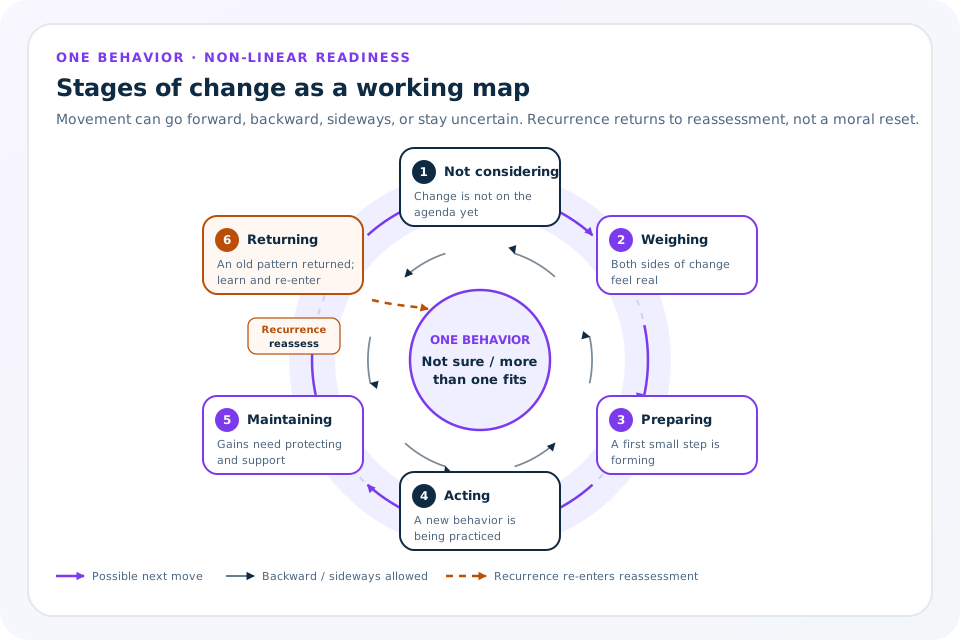
A client can be acting on sleep while only contemplating alcohol reduction. The same person can protect gains at work and return to an old avoidance pattern in relationships. When you hear “they are precontemplative,” ask: about which behavior, in which context, supported by what words or actions today?
A stage description is a working hypothesis. It is supported by what the client says and does. It is not a validated diagnosis, a risk instrument, or proof of motivation. SAMHSA’s TIP 35 on enhancing motivation for change frames motivational work as meeting ambivalence with reflection rather than argument. That stance travels beyond substance-use treatment when you keep recommendations proportionate to the presenting concern and do not import SUD-only medical guidance as universal advice.
Six readiness descriptions in plain language
Use language the client can recognize without feeling judged.
| Readiness | Plain description | What you often hear or see |
|---|---|---|
| Not considering | Change is not on the agenda yet | Little perceived problem; curiosity may be low; external pressure may be the reason they are in the room |
| Weighing | Both sides of the change are active | Pros and cons both feel real; “I know, but…”; movement feels costly |
| Preparing | A first step is forming | Concrete talk about when, where, or with whom; requests for a plan that is still small |
| Acting | A new behavior is being practiced | Recent attempts, tracking, troubleshooting, uneven success |
| Maintaining | Gains need protecting | Focus on early-warning signs, supports, and preventing drift |
| Returning after recurrence | An old pattern returned | Lapse or return with data about triggers, supports, and what to revise |
Allow “not sure” or “more than one fits.” Forcing a single circle when the evidence is mixed teaches the client that the form matters more than their experience. Recurrence is information about the plan and the context, not a moral verdict and not a hard reset to zero.
Do not imply that every client must reach a termination stage or climb the list in order. The clinical job is fit for today, not completion of a ladder.
How to use a stages of change worksheet in session
Keep the sequence tight so the page supports conversation rather than replacing it.
- Agree on one behavior or decision. Write it in the client’s words. “Drink less on weeknights,” “attend the weekly social commitment,” or “open the exposure hierarchy item we chose” is clearer than “get healthier.”
- Elicit change talk and sustain talk. Ask what change might give and what the current pattern still provides or protects. Reflect both sides without arguing one away.
- Rate importance and confidence separately on simple 0 to 10 rulers. Do not average them into a single motivation score.
- Ask which readiness description fits today, including not sure.
- Record evidence in a few of the client’s phrases or observable actions. A circled stage without evidence is a guess you will not defend later.
- Choose one next move that matches current readiness, not the stage you wish they were in.
- Set when and how you will review it. A date, a session agenda item, or a clear condition beats “we’ll see how it goes.”
Do not use the form to argue a client into action. Premature planning can make accurate ambivalence look like noncompliance.
Match the next move to readiness
| Readiness | Therapist aim | Useful move | Avoid |
|---|---|---|---|
| Not considering | Engagement and perspective | Permission-based information, reflective listening, exploring how the current pattern works for them | Confrontation, lectures, or a detailed action plan |
| Weighing | Make ambivalence speakable | Decisional balance, values link, follow-up on the lower of importance or confidence | Treating ambivalence as resistance or stalling |
| Preparing | Make the first step specific | Implementation intention, one barrier, one support | An oversized multi-step overhaul |
| Acting | Support practice and feedback | Skills rehearsal, simple tracking, troubleshooting slips | Assuming one successful week equals stable change |
| Maintaining | Protect gains | Early-warning signs, support renewal, lapse plan | Removing structure too early because things “look fine” |
| Returning after recurrence | Learn and re-enter | Chain review, self-compassion, revised support and step size | Shame language, “back to square one,” or compliance framing |
Stay inside your scope, watch for acute risk, and do not let a worksheet substitute for safety work or medical coordination when those are indicated.
For a fuller motivational interviewing application, see motivational interviewing and substance use counseling. The worksheet does not replace modality-specific training or supervision. When the next move is already client-chosen 12-step participation, use 12 step recovery worksheets for clinician-led care rather than another readiness map. Coded motivational interviewing hours, practice review, and the trainer pathway are on the MI training hours and practice review. When readiness is already practice, use in-room coping skills group activities rather than another readiness map. When the take-home is one urge-and-support stem rather than another readiness map, assign recovery journal prompts.
Worked example: the weekly social commitment
Client (anxiety, social avoidance): “I should go to Thursday dinner. I always cancel. I’m just not a social person.”
The therapist does not write “client is precontemplative about anxiety” as an identity. The target behavior is attending Thursday dinner this week, or a smaller version if needed.
Why change might matter: “I miss my friends. I hate that I disappear.”
What canceling still protects: “If I cancel, I avoid the night-before dread and the feeling that everyone is watching me.”
Importance: 8.
Confidence: 3.
Readiness that fits today: weighing, with a pull toward preparing if the step shrinks. Evidence: client names both sides without a planned time, place, or support person.
Stage-matched next move: stay with ambivalence long enough to make it speakable, then test one implementation intention rather than a full social overhaul. Agreed experiment: text one friend by Wednesday noon to confirm a 45-minute attendance window, and leave after dessert if activation climbs past 7/10. Barrier: Wednesday afternoon rumination. Support: calendar block plus a two-line grounding plan before the text.
Review point: first ten minutes of next session. Markers of useful movement: the text sent, attendance attempted, or clearer language about what the dread protects. Not “became a social person.”
Common misuses
Labeling the whole client. Stages attach to behaviors. “They are a contemplator” collapses context and freezes formulation.
Treating “not considering” as denial or defiance. The client may not share your problem definition, may be protecting safety, or may be responding to coercion. Curiosity first.
Confusing confidence with importance. Pushing action when importance is high and confidence is low often produces a plan the client cannot carry. Shrink the step or build support before you write a schedule.
Pushing action planning before the client has chosen change. Detailed planners handed to someone still weighing both sides teach them that therapy does not hear them.
Using recurrence as moral or compliance failure. Returns carry chain data. Shame language may make future recurrence harder to discuss.
Assigning a stages of change worksheet without a review plan. An unread handout is not a clinical intervention.
Recording a stage with no supporting client language or behavior. If you cannot quote or describe the evidence, you do not yet have a stage hypothesis worth charting.
Copy-ready field skeleton
Use this structure live beside the printable PDF, or as a teaching scaffold for trainees who are learning readiness mapping before they facilitate alone.
Documentation handoff
Keep the chart lean. The note should carry the clinical thread without photocopying the form.
Do not state a stage as diagnostic fact. Do not paste every worksheet field into the EHR. Name the behavior, the intervention, the response, and the review point so the next clinician (including future you) can continue the work.
Where Emosapien fits
Readiness work produces a thin but high-value thread: the target behavior, the importance and confidence split, the chosen next move, the barrier, and the review condition. That thread is easy to lose between sessions when notes stay generic.
Emosapien’s Scribe Agent drafts from in-session clinical context so the readiness signal, intervention, client response, and next review point can land in a clinician-reviewed note. The therapist still decides formulation, pacing, and what belongs in the chart. Emosapien does not determine a client’s stage. It supports structured continuity between sessions so the next hour starts from last week’s actual experiment rather than a reconstructed guess.