
Stanley Brown Safety Plan Template: Chart Companion

Outline
Risk is already on the table. You screened, you formulated, and the disposition includes a collaborative plan the client can actually use when the next spike comes. That is where a stanley brown safety plan template belongs: after assessment, not instead of it. In a child trauma course, keep the safety plan in front of any in-session trauma narrative worksheet and sequence the rest with the TF-CBT trauma-focused CBT guide. Learning the Columbia question set, before you fill this plan, is C-SSRS training for clinicians. Risk is already on the table. You screened, you formulated, and the disposition includes a collaborative plan the client can actually use when the next spike comes. That is where a stanley brown safety plan template belongs: after assessment, not instead of it. Score the ideation and behavior level before you treat the plan as the whole response, on the C-SSRS level card. In a child trauma course, keep the safety plan in front of any in-session trauma narrative worksheet and sequence the rest with the TF-CBT trauma-focused CBT guide.
This guide is for US mental-health clinicians. It is educational content, not clinical, legal, or crisis advice, and it does not establish a standard of care.
If a client is in immediate danger, follow your local emergency protocol before any worksheet. In the US, the 988 Suicide and Crisis Lifeline is reachable by call or text at 988.
Document the plan after assessment
After risk assessment indicates a collaborative plan, complete the official Stanley-Brown form with the client. Then record the stanley brown safety plan template follow-through in the chart: step content, means-safety actions, sharing, and the next review date.
Use these when the work is assessment or compliance rather than the plan itself:
- Screening, factors, formulation, and disposition structure: suicide risk assessment template
- Multi-domain risk framework: mental health risk assessment guide
- Federal and state compliance spokes: compliance resource hub
Do not use a safety plan as a full risk instrument. Do not treat a chart companion as a hosted or redesigned official form. Keep documentation on plan implementation and chart follow-through only.
Use the official form; document in the chart
Barbara Stanley and Gregory K. Brown developed the Safety Planning Intervention as a brief collaborative intervention for people who have experienced suicidal crisis. The purpose is a concrete set of coping steps and resources the person can use so risk can rise and fall without suicidal behavior.
The official client-facing Stanley-Brown Safety Plan PDF is published on the developers’ forms page: Stanley-Brown Safety Plan (official form). Individual use of that form is permitted there. The same page asks clinicians to request written permission for changes to the forms or use in an electronic medical record.
This emosapien.com guide does not recreate, rebrand, or host a derivative of that form. Use it for implementation help and the chart companion below, then open the official PDF for the paper the client keeps.
The intervention is more than filling boxes
The developers describe the Safety Planning Intervention as a set of clinician tasks, not a solitary form fill. In order, the public intervention overview includes risk assessment and a recent-crisis description, review of how risk rises and falls, a rationale for planning, collaborative development, completion of the plan steps, teaching how to use the plan, discussion of location and sharing and barriers, and a follow-up review.
If your note only says “safety plan given,” you documented a handout, not the intervention. Write the collaboration, the means discussion, where the plan lives, and when you will review it.
The six plan steps clinicians walk through
The plan steps themselves are hierarchical. The client tries earlier steps first and moves down the list if distress stays high. Labels below follow the official intervention site.
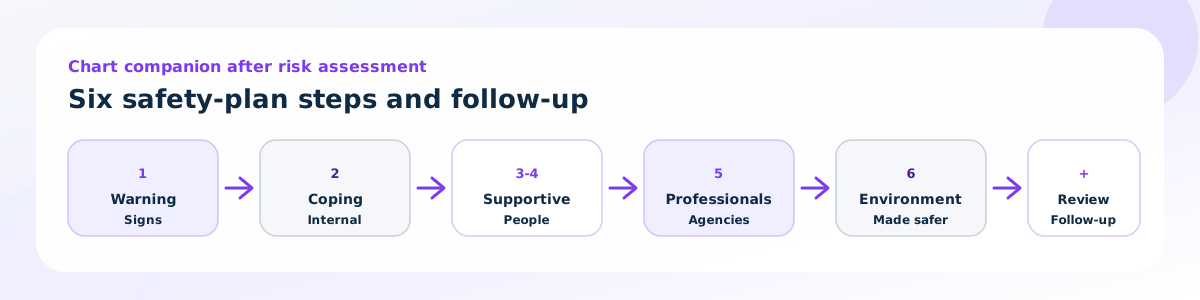
- Warning signs. Personal situations, thoughts, moods, or behaviors that signal a crisis is starting so the person retrieves the plan early.
- Internal coping strategies. What the person can do alone to distract and let time pass without suicidal behavior.
- Social contacts and settings for distraction. People or healthy places that pull attention off the crisis without requiring a full disclosure yet.
- Family members or friends who can help. Named people the client can tell they are in crisis and ask for support.
- Professionals or agencies. Clinician, clinic crisis line, 988, emergency services, and other trained responders, with workable contact details.
- Making the environment safer. Concrete lethal-means steps (firearms, medications, other methods relevant to this client), including who will secure what and by when.
Reasons for living appears as an optional seventh element on the official site. If you include it, keep the client’s own language and do not use reasons for living as a substitute for means safety or crisis contacts.
Walk the steps in session. Prefer the client’s words. A plan written by the clinician alone rarely gets used between sessions.
Clinician documentation companion (not the official form)
Use the official PDF with the client. Use the companion below in the progress note or EHR free-text so the chart shows what was done, shared, and scheduled for review. This companion is original chart scaffolding for the stanley brown safety plan template workflow. It is not a substitute for the Stanley-Brown form.
A complete chart companion for this intervention usually answers eight questions: when was the plan completed, which format, what landed in each step, what means actions were taken, who holds copies, what sharing was consented, what barriers exist, and when will you review.
Continuity: the plan has to survive the week
A plan that lives only in today’s note fails the client who no-shows Thursday. Continuity is clinical work, not afterthought paperwork. The client’s story has to remain findable across gaps, covering clinicians, and handoffs:
- Name the holder. Who has a copy besides the chart: client, partner, parent, roommate, IOP case manager.
- Name the retrieval path. Phone note, printed card, or a portal message the client can open when distressed.
- Name the gap plan. If the client misses the next session after elevated risk, who calls, by when, and what wording authorizes outreach.
- Name the review. Put the next review on the schedule the way you would put a lab follow-up on a medical chart.
When care is fragmented (waitlist, vacation coverage, transfer), write who holds the safety thread. Covering clinicians should not reconstruct the plan from memory or from a vague “safety plan completed” line.
Means safety is not optional color commentary
Step 6 is often the step charts skip. Lethal-means counseling is a recognized part of suicide prevention practice. Document access discussed, actions agreed, and whether a third party will secure weapons or excess medication. If the client declines a specific action, document the discussion and the residual risk in the formulation, then match disposition to that residual.
Do not let “denies plan” stand in for a means conversation when dynamic risk is elevated.
When emergency escalation comes first
A stanley brown safety plan template session is the wrong tool while the client is imminently unable to keep themselves safe in the room or on the call. Indicators that planning waits:
- Active intent with a method at hand and inability to engage collaboratively
- Acute intoxication that blocks meaningful planning
- Medical emergency from self-harm already underway
- Clear need for emergency services or higher level of care before outpatient steps
Document the emergency pathway you used, who you contacted, and when planning will resume if the client returns to outpatient care. Never backfill a fictional collaborative plan for a session that was actually a crisis transfer.
Chart gaps that weaken safety-plan notes
- “Safety plan completed” with no step content or means actions
- Clinician-authored plan the client never endorsed
- No location, sharing, or barrier discussion
- No follow-up review date after a high-risk week
- Plan used to avoid documenting risk level or disposition
- Official form redesigned into the EHR without rights clearance
- Continuity silence after no-shows
How Emosapien fits
Emosapien drafts session-linked note language for licensed clinicians, including candidate wording for interventions you actually completed. The therapist still owns risk judgment, the collaborative plan, means counseling, emergency decisions, and the signed chart. The product does not complete a Stanley-Brown form for the client and does not replace your crisis protocol.
If you want draft support after you settle the safety-plan documentation habit, start a free Emosapien trial.
References
- Suicide Prevention Resource Center: Stanley-Brown Safety Plan
- Stanley-Brown Safety Plan forms (official PDF and permission note)
This guide is a documentation and workflow reference for licensed clinicians. It does not replace clinical judgment, supervision, counsel, or your organization’s crisis protocol. If you or someone you are with is in immediate danger, contact local emergency services. In the US, call or text 988.