
Mental Health Risk Assessment Guide for Therapists

Outline
A chart reader who never met your client will often open the risk section first. Payers, supervisors, covering clinicians, licensing boards, and, in the worst case, attorneys look for evidence that you screened, weighed context, reached a judgment, acted, and planned follow-up. A mental health risk assessment guide exists to structure that work across domains, not to hand you an automatic score.
This guide is the broad clinical framework. It covers risk domains, static and dynamic factors, protective factors, tool selection, documentation, level-of-care and escalation judgment, supervision, safety planning handoff, and follow-up. It is not a universal scoring instrument and not an emergency protocol. For the suicide chart instrument, use the suicide risk assessment template. For safety-plan steps after assessment, use the Stanley-Brown safety plan template. For crisis session coding, use the CPT 90839 crisis psychotherapy guide.
Educational reference for licensed mental health practitioners. It is not clinical, legal, or crisis advice, and it does not establish a standard of care. Requirements vary by state, payer, license, and setting. Verify against your board, payer contracts, clinic policy, and supervisor before you adopt any workflow. If a client is in immediate danger, follow your local emergency protocol. In the US, the 988 Suicide and Crisis Lifeline is reachable by call or text at 988.
What this mental health risk assessment guide covers
Risk work in outpatient therapy is wider than a single suicide checkbox. A usable mental health risk assessment guide keeps five domains in view and forces the same loop in every domain: screen, gather factors, formulate, act, document, follow up.
Scroll the table sideways to view every column
| Domain | What you are asking | Chart must show |
|---|---|---|
| Suicide | Ideation, method, plan, intent, preparatory behavior, prior attempts | Instrument or structured inquiry, responses, formulation, action |
| Self-harm | Non-suicidal self-injury, frequency, medical severity, functions | Behavior description, intent distinction, safety steps |
| Harm to others | Homicidal ideation, targeted threats, access to means, history of violence | Specific inquiry, duty-to-protect considerations under local law |
| Neglect or abuse | Child, elder, or dependent-adult harm; imminent danger disclosures | Facts considered, report decision, notifications |
| Functional decompensation | Rapid loss of self-care, psychosis risk, substance collapse, inability to keep self safe | Functional evidence, level-of-care rationale |
The point of the table is breadth. Leaving a domain blank because the presenting problem was “anxiety” is how charts look thin when a later crisis is reconstructed. When the domain is harm to others, warning a named person and taking other protective steps are not the same act. That warn-versus-protect distinction is the next page, not a cell in this table.
Static factors, dynamic factors, and protective factors
Separate what is historical from what is changeable. That split is what lets a formulation explain acute versus chronic risk.
Static factors are relatively fixed: prior attempts, prior psychiatric hospitalization, long-standing diagnoses, trauma history, demographic patterns your setting tracks carefully, family history of suicide, and chronic access to lethal means.
Dynamic factors move with the week: current ideation, plan or intent, insomnia, intoxication, interpersonal rupture, job loss, isolation, command hallucinations, recent discharge, or a sudden change in medication adherence.
Protective factors matter and still do not erase risk. Attachment to children, treatment engagement, cultural or spiritual reasons for living, future orientation, and restricted means access belong in the formulation. They are not a mathematical offset that turns an acute picture into a low one without clinical reasoning.
When the chart only lists positives (“has kids, denies plan”), reviewers cannot see how you weighed the whole picture. When the chart only lists risk markers with no protective context, the disposition can look arbitrary. Write both, then state the judgment.
Tool selection without turning tools into verdicts
Pick instruments that fit the domain and the setting, then write the name of what you used.
- Columbia Protocol (C-SSRS). A validated screen for suicidal ideation and behavior severity. Questions and training materials are published by the Columbia Lighthouse Project.
- SAFE-T. SAMHSA’s five-step suicide assessment framework moves from risk and protective factors through risk-level judgment to intervention and documentation. The pocket card is available from SAMHSA.
- Companion measures. PHQ-9 item 9, substance screens, and psychosis or mania probes can widen the picture. They do not replace a structured risk conversation when ideation is present.
Accredited organizations often expect a validated tool and a documented risk-level rationale. The Joint Commission’s National Patient Safety Goal 15.01.01 is the reference many hospital and larger outpatient systems map to. Private-practice charts still benefit from the same discipline: name the tool, record the responses that drove the judgment, and avoid a bare “denies SI.”
Use the dedicated suicide risk assessment template when you need the chart entry structure for suicide risk. Keep this page for the multi-domain framework around that entry.
Formulation, level of care, and escalation
Formulation is the sentence a stranger can defend. State the level, then the why.
A workable pattern:
- Acute and chronic dimensions when both apply (for example, moderate chronic risk with low acute risk today).
- Elevating factors drawn from static and dynamic lists.
- Mitigating factors that currently lower acute concern.
- Disposition matched to that picture: continue outpatient care, intensify contact, involve collaterals, step up level of care, initiate emergency pathways, or complete a mandated report.
Scroll the visual sideways to view the full diagram
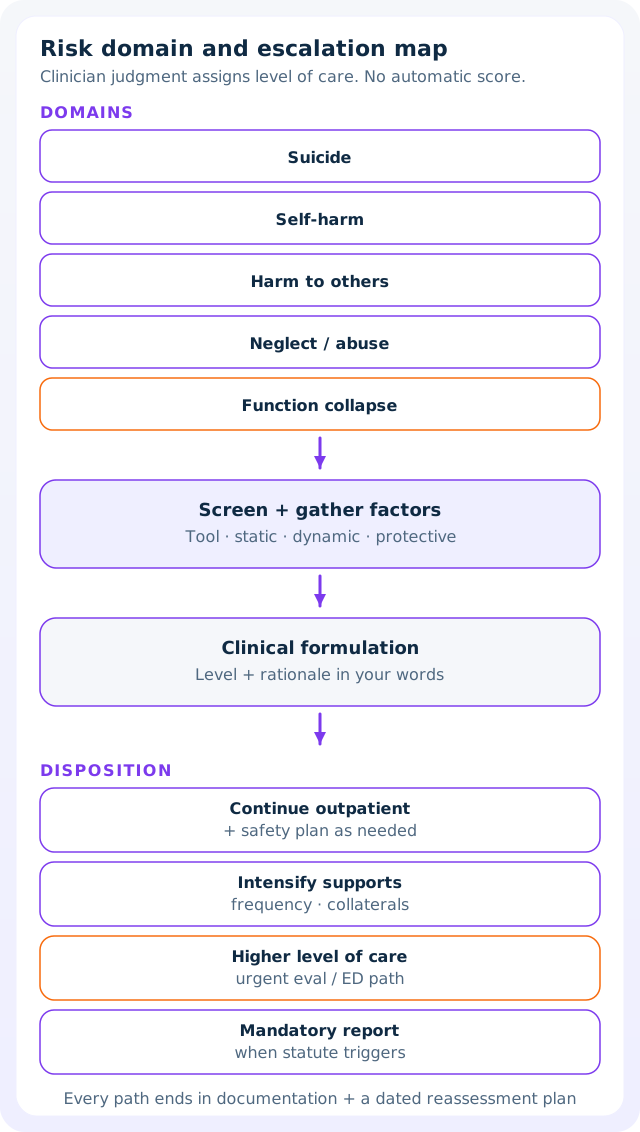
Escalation is a clinical decision path, not a form total. Software may draft candidate language. The therapist still owns the level-of-care call, the emergency steps, and the signed record. If crisis psychotherapy coding becomes the service delivered, document against the CPT 90839 crisis psychotherapy guide rather than stretching a routine psychotherapy note.
Documentation that holds up months later
Reviewers rarely punish a thoughtful judgment they disagree with. They punish missing pieces. A defensible risk note usually shows six elements in order:
- Screening method and key responses (client language where possible)
- Risk factors and warning signs, static versus dynamic
- Protective factors
- Clinical risk formulation with rationale
- Interventions and disposition
- Reassessment plan and earlier-review triggers
Anchor the same language across the mental status exam thought-content line, the intake risk section, and the progress note. The mental status exam cheat sheet holds observational vocabulary. The biopsychosocial template for mental health holds the intake home for the first full risk block. A trauma worksheet pack is not a risk instrument or a safety plan; keep assessment here, and send non-crisis adult trauma homework to free trauma worksheets for adults. Consistency across those documents is what lets a covering clinician reconstruct the risk picture without guessing.
Download the printable mental health risk assessment checklist (PDF)
Supervision, safety planning, and continuity
High-ambiguity risk is a supervision issue, not a solo puzzle. Document when you consulted, what you presented, and what changed in the plan. Supervision notes belong in their own record system; the client chart still needs the clinical outcome of that consult.
Safety planning starts after assessment indicates it. Collaborative plans such as the Stanley-Brown format organize warning signs, internal coping, social contacts, and crisis resources. Document plan implementation on the Stanley-Brown safety plan template. On this page, the rule is simpler: if you assessed elevated risk and took no corresponding action, the chart will read as incomplete.
Continuity is where risk work fails quietly. Name the next session, the outreach plan after a no-show, who holds the safety plan copy, and what happens if the client is waitlisted or transferring. A strong assessment without a follow-through plan leaves the next clinician holding an unfinished story.
Common gaps that weaken the record
- Conclusion without rationale. “Low risk” with no why.
- Protective factors used as a cancel button. Children or faith listed as if they erase acute markers.
- No means discussion. Firearms, medications, and other lethal means never appear.
- Risk level with no matching action. Moderate or high risk recorded, then routine outpatient care with no safety steps.
- One intake screen, never revisited. Dynamic factors changed and the chart stayed frozen.
- Domain blindness. Suicide checked, harm-to-others and neglect never considered when the content raised them.
- Unsigned automated labels. A tool score pasted in as if it were the clinical judgment.
How Emosapien supports the workflow
Emosapien drafts session-linked note language for licensed clinicians, including candidate risk wording drawn from what was discussed. The therapist reviews every risk statement, corrects the formulation, confirms disposition language, and signs before anything becomes the chart of record. The product does not assign a clinical risk level and does not replace your emergency protocol.
Use this mental health risk assessment guide as the review checklist while you edit drafts. If you want that workflow after you settle your risk documentation habits, start a free Emosapien trial.
This guide is a documentation and workflow reference for licensed clinicians. It does not replace clinical judgment, supervision, counsel, or your organization’s crisis protocol. If you or someone you are with is in immediate danger, contact local emergency services. In the US, call or text 988.