
Therapy Workbooks for Adults in Outpatient Care

Outline
Authored by Dr. Hannah Lin, counseling psychologist trained in CBT, ACT, and IFS, with over a decade of clinical practice across anxiety and complex trauma.
The worksheet comes back blank for the third week. You write a new one anyway, and the pass never starts.
Therapy workbooks for adults are therapist-paced, 4-week packets with one treatment goal, a weekly home practice, a mid-pass review, and a close or next step. They are for licensed therapists choosing, assigning, and reviewing a short pass in outpatient adult talk therapy, not for consumers hunting a 200-page book.
The pack below names four client pages and one clinician pacing card. Download it, and keep the fit and stop rules in view during the hour so the workbook does not become a daily journal, an exposure protocol, or a substitute for the session. If the job is one agreed-skill writing stem rather than a 4-week pass, assign journal prompts for self growth.
Email me the adult therapy workbook pack
Get four client pages plus a clinician pacing card for purpose, cadence, stop conditions, and next-session reopen.
- Treatment-goal map, weekly loop for weeks 1 to 4, mid-pass review, and close/next
- Clinician pacing card for purpose, cadence, delivery, and storage
- Fit and stop prompts for trauma flooding, OCD reassurance, unsupervised exposure, and coerced self-help
- Next-session reopen paths for complete, mixed, or blank weeks
Free. We'll email the PDF link right away and add you to the therapist toolkit, sent every two weeks. Unsubscribe any time.
Where should we send the link?
We'll email the PDF link right away. You'll also get the therapist toolkit every two weeks. Unsubscribe any time.
✓ Check your inbox
We've sent you the PDF
The download link is on its way to your inbox, usually within a minute or two. The email will come from Emosapien (hello@team.emosapien.com); check your spam folder if you don't see it.
You're also on the therapist toolkit list, sent every two weeks. Unsubscribe any time from the email footer.
Educational content for licensed therapists, not clinical, legal, or emergency advice. Workbook selection sits inside formulation, consent, risk, culture, and setting. These pages do not replace supervision, a safety plan, or trauma-specific care.
What this pack is and is not
This is a short pass. It holds one goal across four weeks. It does not reprint a Treatments That Work chapter, score a diagnosis, or sell a consumer curriculum.
The wider library of therapy worksheets in clinical practice covers choosing forms by clinical task. Therapy workbooks for adults belong here when the missing piece is pacing: a start, a weekly loop, a review, and a stop rule.
| This pack is | This pack is not |
|---|---|
| One 4-week, therapist-chosen goal | A 200-page consumer CBT book |
| A weekly home practice with a done line | A daily journal or 30-day challenge |
| A mid-pass review, including blank weeks | An NHS Talking Therapies client PDF |
| A close that keeps, switches, or stops | A speech-language or school workbook |
| A clinician card for fit, pause, and reopen | A teen pack or a group curriculum |
A therapy workbook for adults is not a dysphagia or aphasia packet, not a classroom reproducible, and not a self-guided somatic trade paperback. Keep it inside outpatient talk therapy.
If the job is a thought record or a behavioral experiment, use the CBT worksheets pack. If the job is a how-to-practice record on one already-named skill, use the how skills worksheet for therapists. If the job is why last week’s sheet never came back, start with homework adherence therapy.
When therapy workbooks for adults fit
This starter fits after enough stabilization that a weekly practice will not overwrite the presenting pain. The client can still name what hurts. The page sits beside that, not on top of it.
It is useful when one worksheet keeps dying because there is no pass, no review, and no stop rule. The client fills a sheet once, never hears it mentioned again, and learns that written work was theater. Kazantzis and colleagues found that both the quality and quantity of homework compliance were associated with CBT outcomes. A 4-week frame exists so the weekly pass has a named review date on the calendar.
Agree on one goal and a weekly cadence before the packet leaves. “Notice one avoided situation this week and we will reopen it next time” is a purpose. “Work through the book” is not.
The assignment is optional in the sense that refusal, shrinkage, or a blank return still belongs in the next hour. Completion is not proof of alliance. Non-completion is not proof of resistance.
Stay with the pass when the goal is still the right one and the practice is still small enough to finish. Shrink the practice before you add a second week of volume. Switch to a single sheet when the client only needed one clinical move. Stop when the packet starts doing harm.
When to pause the work
Pause the workbook when the prompt would flood the week, feed a ritual, or replace the session.
Stop, shrink, or switch tasks when:
- Acute risk is active. Safety planning and direct assessment take the hour. A 4-week packet does not sit on top of that.
- Trauma material is recent or uncontained. A weekly written pass can become flooding. Stabilization and choice come first.
- OCD reassurance loops are active. Recopying a workbook page can function as a ritual. Do not use this pack as an ERP protocol, a Y-BOCS packet, or a contamination hierarchy.
- Exposure would be unsupervised. Do not send a feared situation home as a workbook task without a planned, reviewed experiment and a safety frame.
- Self-help is being coerced. A partner, parent, employer, or program that demands “just do the book” can turn the pass into compliance theater.
- Home is not private or safe enough to leave a written packet lying around.
- The client is a teen, or family work is the indicated frame. This pack is adult individual outpatient care.
- The indicated job is different. Speech-language or medical rehab workbooks, CBT or DBT single sheets, and homework-adherence repair each have their own home.
Forced positivity and daily quotas belong in the same stop pile. If last week’s review felt like a grade, this week’s pages will stay in the bag. Repair that first.
What the four pages contain
The printable pack exposes the same fields the client will see. Walk the goal map and week 1 in session before the packet goes home. Do not hand all four weeks at once unless the client asks and the burden is truly small.
Scroll the visual sideways to view the full diagram
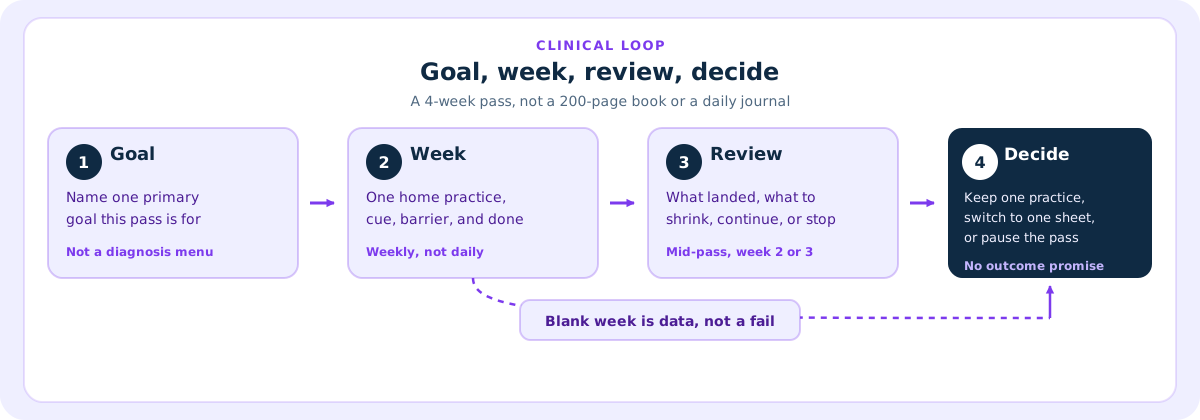
1. Treatment-goal map
One 4-week pass. Client and therapist name one primary goal this pass is for, such as mood, anxiety, avoidance, or between-session practice. This is not a diagnosis, not a personality test, and not a 12-module menu.
Fields. Primary goal in the client’s words. What this pass is not for. Cadence (weekly). How we will know the pass is still the right frame. A skip line if naming a goal this week is too large.
Introduce. “We are picking one thing this pass can hold, not a new life plan.”
Stop. The map becomes a symptom inventory, a scored test, or a demand to improve every domain at once.
2. Weekly loop
Session takeaway, one home practice, a cue, a predicted barrier, and what “done” looks like this week. Repeat the same frame for weeks 1 through 4. This is not a daily journal and not a thought-record reprint.
Fields. Week number. Session takeaway. One practice. Cue. Predicted barrier. Done line. Optional note. A blank-week line.
Introduce. “One practice. If the week is blank, bring the blank. That still counts as information.”
Stop. The loop turns into unsupervised exposure, a reassurance log, or four practices stacked because last week looked “noncompliant.”
3. Mid-pass review
What landed, what to shrink, whether to continue, switch to a single worksheet, or stop. Blank weeks count as information.
Fields. What landed. What cost too much. Continue, shrink, switch, or stop. What the blank or mixed weeks told us. Next smaller practice, if any.
Introduce. “We are checking the frame, not grading you on page count.”
Stop. The review becomes a productivity meeting, a forced-positivity recap, or a reason to add more modules.
4. Close / next
Keep one practice, move to a focused single-sheet tool, or pause. This is not a graduation certificate and not an outcome guarantee.
Fields. Keep, move on, or pause. The one practice that stays, if any. The next focused sheet, if any. What this pass does not claim to have proved.
Introduce. “Ending the pass is a clinical decision. It is not a failure and not a cure.”
Stop. The close page is used as a treatment-completion certificate, an HR record, or a promise that four weeks changed the diagnosis.
Reopen complete, mixed, or blank weeks
Name the week at the start of the next hour. The review is part of the intervention. A packet that never comes back into the room taught both of you that the assignment was theater.
| Return state | First clinical move |
|---|---|
| Complete | Ask what the week missed, not only what it captured |
| Mixed | Find which practice fit and which one cost too much |
| Blank | Ask what happened around the packet before you interpret motivation |
| Ritualized recopying | Treat the writing as a possible reassurance loop and stop the pass |
| Performed completion | Name the performance without shaming it. Ask what would have been true |
A useful reopen is specific: “Week 1 has a done line, week 2 is blank, and the goal still says ‘less avoidance.’ Where should we begin?” If the client wants a different starting point, follow that.
Blank work is information. It can mean the practice was too large, the home was not private, last week’s review felt like a grade, or the pain needed the whole hour. None of those possibilities should be scored from the page.
The APA Ethics Code keeps informed consent and competence in view when you send work home. Say what the packet is for, when you will read it, and that it is not monitored between sessions.
Privacy, documentation, and safety
Agree on delivery and storage before anyone writes private material.
Delivery. Deliver it on paper, through a portal the practice already uses, or complete it together in session. Do not send clinical content through ordinary consumer email or SMS.
Storage. The working copy may stay with the client or enter the file under practice policy. Portal copies belong in the approved record system. Do not leave a packet where an unsafe household can read it.
Documentation. Record the clinically relevant signal, the intervention, the client’s response, and the next step. Do not paste the workbook verbatim into the note unless there is a specific clinical reason.
A concise entry might read:
Reviewed week 2 of the 4-week pass. Goal remained “one avoided phone call.” Client left the done line blank and said the cue felt like a test. Explored whether the practice was too large. Agreed to shrink to a 2-minute script rehearsal and reopen week 3 next session.
Safety boundaries. This page is not a crisis service, is not monitored in real time, and does not replace the agreed safety plan. It is not a diagnosis, not a school record, and not an HR record. If the client needs urgent support, they use the crisis path you already set.
If risk language, marked deterioration, or a safety concern appears, leave workbook mode. Follow the practice’s risk, consultation, and emergency procedures.
How Emosapien carries the thread
Emosapien keeps the one weekly practice the client agreed to try visible for the next appointment so you can reopen what actually happened across the 4-week pass, not a reconstructed story about the month. You choose the goal, the cadence, and the stop rule. Emosapien does not pick the prompt, score the workbook, monitor crisis risk, or contact emergency services.
See how that layer supports client engagement between sessions while clinical judgment stays with you.
Download the pack
The printable therapy workbooks for adults pack fits four client pages plus one clinician pacing card onto 3 to 4 US Letter pages with selectable text:
- Treatment-goal map
- Weekly loop (weeks 1 to 4)
- Mid-pass review
- Close / next
- Clinician pacing card: purpose and cadence; delivery and storage; fit and stop; next-session reopen for complete, mixed, or blank weeks; documentation prompt; when to move to a CBT sheet, a DBT sheet, or homework-adherence repair
Assign one week at a time unless the client has already shown that a second page stays small enough to finish.
Email me the adult therapy workbook pack
Get four client pages plus a clinician pacing card for purpose, cadence, stop conditions, and next-session reopen.
- Treatment-goal map, weekly loop for weeks 1 to 4, mid-pass review, and close/next
- Clinician pacing card for purpose, cadence, delivery, and storage
- Fit and stop prompts for trauma flooding, OCD reassurance, unsupervised exposure, and coerced self-help
- Next-session reopen paths for complete, mixed, or blank weeks
Free. We'll email the PDF link right away and add you to the therapist toolkit, sent every two weeks. Unsubscribe any time.
Where should we send the link?
We'll email the PDF link right away. You'll also get the therapist toolkit every two weeks. Unsubscribe any time.
✓ Check your inbox
We've sent you the PDF
The download link is on its way to your inbox, usually within a minute or two. The email will come from Emosapien (hello@team.emosapien.com); check your spam folder if you don't see it.
You're also on the therapist toolkit list, sent every two weeks. Unsubscribe any time from the email footer.
References
- Kazantzis, N., Whittington, C., Zelencich, L., Kyrios, M., Norton, P. J., and Hofmann, S. G. (2016). Quantity and quality of homework compliance: A meta-analysis of relations with outcome in cognitive behavior therapy. Behavior Therapy, 47(5), 755-772.
- American Psychological Association. Ethical Principles of Psychologists and Code of Conduct.
- NHS England. NHS Talking Therapies for anxiety and depression. UK service client workbooks are a different job from this US outpatient pack.