
12 Step Recovery Worksheets for Clinician-Led Care

Outline
Authored by Priya Mehta, Licensed Clinical Social Worker with eight years in addiction recovery and intensive outpatient programs.
A client who already attends a fellowship does not need a therapist to become their sponsor. They need a way to bring chosen step work back into treatment without turning the hour into program doctrine. 12 step recovery worksheets give the clinician that structure: one original form, tied to a treatment goal, used only when the client has chosen this pathway.
Licensed therapists and supervised recovery-program clinicians keep the broader worksheet rules from the therapy worksheets clinical guide. Then they come back here for step-work reflection, not for a meeting script.
Educational content for licensed therapists, not clinical or legal advice. Worksheet selection sits inside formulation, consent, and risk review. What follows is facilitation guidance, not a protocol, crisis procedure, or fellowship curriculum.
Clinician scope and client choice
Twelve-step participation is one recovery pathway. It is not a requirement, and it is not the only way people get well. SAMHSA’s recovery principles keep recovery person-driven and open to many pathways. The therapist names that choice out loud before anyone writes.
Ask, in the client’s words:
- Do they want fellowship language in treatment this month, or only outside the room?
- Which program, if any, do they actually attend?
- What role do they want for meetings, a sponsor, peers, and therapy?
- What words do they refuse: higher power, inventory, amends, powerlessness, or none of those?
If the answer is “I was told I have to,” stop. Mandated attendance is not the same as chosen participation. A form used to enforce a program becomes coercion on paper.
NIAAA’s Twelve Step Facilitation Therapy Manual treats facilitation as a clinical method that can support 12-step involvement. Facilitation is not sitting in a meeting and not sponsor work; use the 12 step facilitation group guide for a six-session clinician-run group plan rather than a reflection form.
What these worksheets are and are not
These formats are original clinician reflection tools. They are not Alcoholics Anonymous worksheets, Narcotics Anonymous worksheets, or a reprint of any fellowship workbook.
They are not:
- Official step lists or program doctrine
- A replacement for meetings, literature, or a sponsor
- A crisis plan, withdrawal protocol, or medication decision
- Proof of compliance, sincerity, or moral progress
- A question bank for group discussion
Link to official program material when the client wants the fellowship’s own wording. Do not copy it onto a therapy sheet. Do not paraphrase a Step Working Guide. If the client uses Narcotics Anonymous or another fellowship, verify that fellowship’s literature rather than importing AA language as if it were universal.
Choose 12 step recovery worksheets by clinical job
Match the form to the current step-work task, readiness, treatment goal, individual versus group context, activation, literacy, and access. Use one form at a time. A stack of sheets is not more recovery. It is more paper.
| Clinical job | Format | Therapist limit | Stop cue |
|---|---|---|---|
| Confirm fit and language before any step talk | Program-fit and client-language check | Do not translate the client’s words into doctrine | The client cannot refuse the frame |
| Separate control from influence without a lecture | Control, influence, and support map | Do not preach powerlessness or power | Used to shame “control issues” |
| Name hope in the client’s meaning system | Values, hope, and chosen-meaning sheet | Do not supply a higher-power definition | Religious language is being pressed |
| Bound what will be inventoried, and for how long | Inventory scope and pacing plan | Do not run inventory as exposure | Shame, flooding, or “tell it all today” |
| Decide whether disclosure is safe | Disclosure-readiness and support plan | Do not require confession in group or the chart | Unsafe recipient or legal jeopardy |
| Turn willingness into one next behavior | Willingness and next-change matrix | Do not treat willingness as compliance | Performed agreement for therapist or sponsor |
| Rehearse asking for help | Help-seeking practice plan | Do not become the on-call sponsor | The “ask” is actually a crisis |
| Name relational impact without a blame list | Relationship-impact inventory | Do not assign guilt or innocence | Violence, stalking, or unsafe contact |
| Screen amends ideas for safety and legality | Amends safety and feasibility screen | Do not direct contact or confrontation | Protective order, danger, or pressure to make contact |
| Scan one day against treatment goals | Daily recovery review | Do not grade the day | Shame inventory or productivity score |
| Connect reflection to people, not isolation | Reflective practice and connection plan | Do not replace peers with more paper | Isolation is rising and the form is the only contact |
| Map sustainable service and community | Service, community, and continuity map | Do not prescribe service hours | Service is being used to skip rest or treatment |
Twelve formats for clinician-led reflection
Treat the twelve sheets as formats, not files. Each format names a job, the minimum fields, a therapist limit, a hold cue, and how the writing returns to treatment. Use one. Switching mid-session usually means the job was never named.
1. Program-fit and client-language check
Job. Decide whether fellowship language is a chosen frame this month.
Minimum fields. Pathway I am choosing now. Words I use for this program. Words I refuse. What I want therapy to do with that language. What I want therapy to leave alone.
Therapist limit. Do not convert client language into AA or NA doctrine.
Hold. The client is mandated and cannot refuse the frame, or they asked for secular language and the sheet only works in program vocabulary.
Return. Record preferred language and the chosen role of meetings in the treatment plan. That is a consent note, not a conversion goal.
2. Control, influence, and support map
Job. Separate what the client can change from what they cannot, without a powerlessness lecture. When the job is turning the mind toward what cannot change, use a radical acceptance worksheet rather than another control map.
Minimum fields. One current stressor. What is in my control today. What I can influence. Who or what I will not try to manage. Support I will ask for.
Therapist limit. Do not preach powerlessness or power.
Hold. The page is used to shame “control issues,” or the stressor is an acute safety problem that needs a plan, not a map.
Return. Carry one controllable next action into the plan.
3. Values, hope, and chosen-meaning sheet
Job. Name hope and meaning in the client’s words, including fully secular language.
Minimum fields. What I want my days to stand for. Meaning I choose, spiritual, secular, or mixed. One hope that is not a slogan. One value I will practice this week.
Therapist limit. Do not supply a higher-power definition.
Hold. Someone in the room is pressing religious language, or the client is performing belief to stay in the group.
Return. Write one value-linked treatment goal in the client’s words.
4. Inventory scope and pacing plan
Job. Bound what will be inventoried and over how many sessions.
Minimum fields. Topic I am willing to look at now. Topic I will wait on. How many sessions I can tolerate. Body cues that mean stop. Who holds the writing.
Therapist limit. Do not run a moral inventory as exposure.
Hold. Activation, flooding, dissociation, or a push to “get it all out today.”
Return. Pace the next session. Do not expand the list because the page had empty lines.
5. Disclosure-readiness and support plan
Job. Decide whether, to whom, and how much to disclose.
Minimum fields. What I might share. With whom. What I will not share yet. Risk if it leaks. Support I need after I speak, or after I wait.
Therapist limit. Do not require confession in group, in a meeting, or in the chart.
Hold. Coercion, an unsafe recipient, or legal exposure.
Return. A yes, no, or delay. Not a confrontation script.
6. Willingness and next-change matrix
Job. Translate “willing” into one next behavior change.
Minimum fields. Change I say I am willing to try. Change I am not willing to try yet. First 24-hour action. Likely obstacle. Backup if I skip it.
Therapist limit. Do not treat willingness as compliance.
Hold. The client is performing willingness for the therapist, the sponsor, or the court.
Return. One small behavioral experiment in the plan, with a review date.
7. Help-seeking practice plan
Job. Rehearse asking for help without making the therapist the sponsor.
Minimum fields. Kind of help I need. Person or place I will ask. Exact ask in one sentence. When I will ask. What I will do if they cannot.
Therapist limit. Do not become the on-call sponsor or interpret program guidance.
Hold. The “ask” is actually withdrawal, acute risk, or a medical decision. Those stay off this sheet.
Return. One practiced ask, documented as a skill.
8. Relationship-impact inventory
Job. Name impact on relationships without building a blame list.
Minimum fields. Relationship I am considering. Impact I caused that I can own. Impact I am not sure about. Impact I will not discuss with that person yet. Care I need while I look at this.
Therapist limit. Do not assign guilt or innocence.
Hold. Intimate-partner violence, stalking, a protective order, or any contact that could increase danger.
Return. Keep the work in the therapy room, or wait. Do not send the client out to “make it right” from a worksheet.
9. Amends safety and feasibility screen
Job. Screen amends ideas for safety, legality, and consent. This is not an amends letter.
Minimum fields. Person or institution I am considering. Can contact happen without harm. Legal or protective-order issue. What “amend” means here: direct, living amends, or not now. Who else reviews safety besides the therapist.
Therapist limit. Do not direct contact, apology, or confrontation. Do not act as sponsor.
Hold. Any yes to danger, legal risk, or pressure from a group, court, or family member.
Return. Hold, delay, or keep the work inside therapy. Never a contact assignment.
10. Daily recovery review
Job. A short end-of-day scan tied to treatment goals, not a confession log.
Minimum fields. One thing that supported recovery today. One cue I noticed. One action I took or skipped. Urge or mood, 0 to 10. One need for tomorrow.
Therapist limit. Do not grade the day.
Hold. The log becomes a shame inventory, a productivity score, or a stand-in for meals, sleep, or a safety plan.
Return. Patterns that belong in the next session. Not a stack of unfinished logs.
11. Reflective practice and connection plan
Job. Connect reflection to people, not to more isolation.
Minimum fields. What I noticed in myself this week. Who I told. Who I avoided. One connection I will make. What I will not process alone.
Therapist limit. Do not replace meetings or peer contact with another sheet.
Hold. Isolation is increasing and the form is the only “connection.”
Return. One relational next step in the plan.
12. Service, community, and continuity map
Job. Map sustainable service and community without treating overwork as recovery.
Minimum fields. Community I already have. Service I can give without depleting. Service I will not take on yet. How this supports a treatment goal. Date I will review the load.
Therapist limit. Do not prescribe service hours or a service identity.
Hold. Service is being used to skip rest, treatment, medication, or safety.
Return. Continuity supports. Not a new role assignment.
How to introduce and debrief one worksheet
Keep the loop small enough to finish.
Scroll the visual sideways to view the full diagram
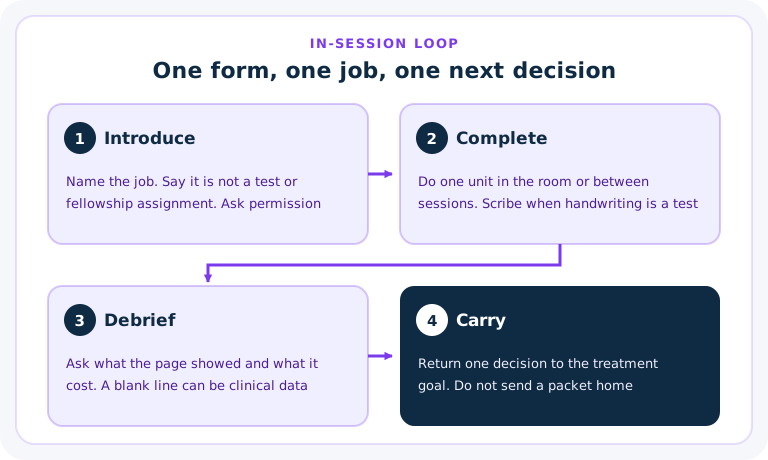
Introduce through choice. Name the job in one sentence. “This sheet helps us decide whether disclosure is safe,” or “This sheet bounds what we will inventory this month.” Say what it is not: a test, a fellowship assignment, or proof of recovery. Ask permission to use paper.
Complete it in the room, or between sessions if the client has the capacity. Do one unit. One language preference. One pacing limit. One safety screen. Scribe when literacy, language, motor access, or shame would turn handwriting into a test.
Debrief impact, not compliance. What did the page show? What did it cost? Where did it get in the way? A blank line can be clinical data. It is not noncompliance.
Link the result to the treatment goal and the next session. Carry one decision forward. If anything goes home, send one continuation of that same move. Do not send a packet.
In a group, introduce the form only when cohesion can hold it and each member can pass. Do not use a shared sheet to extract inventory, disclosure, or amends in the circle.
Role-boundary map
Keep the jobs from collapsing into each other.
Clinician. Formulation, pacing, risk, treatment integration, and documentation. The therapist does not interpret program doctrine or act as sponsor.
Client. Choice, language, disclosure, consent, and goals. The client can refuse a form and still be in treatment.
Sponsor or peer-support relationship. Program-specific guidance and lived fellowship support. That relationship stays outside the therapist’s role.
Meeting or fellowship. Official literature, group customs, and peer recovery. Link to the Twelve Steps as published by Alcoholics Anonymous when the client wants AA’s own wording. Do not reprint that list here.
Crisis, withdrawal, medical care, legal decisions, and medication stay off the worksheet. Those are clinical, medical, or legal tasks. Paper is the wrong tool.
When not to use 12 step recovery worksheets
Hold the form, or never take it out, when:
- Acute risk or crisis. A client who is suicidal, homicidal, at overdose risk, or otherwise not safe needs assessment and a safety plan, not a reflection sheet.
- Coercion or mandated participation without meaningful choice. A court, family member, or program cannot be laundered into “willingness” on paper.
- High activation, shame, or disclosure risk that cannot be held. If the client is outside a workable range, the paper is too slow.
- Unsafe contact or legal concerns around amends. Protective orders, violence, stalking, and pending charges are stops, not prompts.
- Literacy, language, cognitive, disability, or access barriers the form does not accommodate. Scribe, translate, enlarge, or drop it.
- The form replacing relational work or direct safety planning. If you are hiding behind the clipboard, put the clipboard down.
These are clinical holds. They are not a moral ranking of people who “are not ready for step work.”
What 12 step recovery worksheets do not replace
Use choose a recovery group topic by stage when the hour needs a theme, not a worksheet. Use map cues with a recovery triggers worksheet when the job is mapping cues, urges, and responses. Use map readiness for one recovery behavior when the job is readiness for one recovery behavior. Facilitated discussion uses recovery group questions, not a step-work form.
Do not turn these formats into a topic bank, an activity menu, or a discussion-prompt list.
The Recovery Group Pack is adjacent facilitator support: a stage-and-cohesion checklist, recovery-group activity ideas, a weekly planner, and after-group note stems. It does not contain the twelve formats above. Do not treat that PDF as a 12-step worksheet set.
Download the Recovery Group Pack
Stage-and-cohesion checklist, activity ideas, weekly planner, and after-group note stems. It does not contain the twelve reflection formats above.
- Stage and cohesion decision checklist before you pick an activity
- 12 recovery group activities across opening, craving/trigger work, skills and repair, and closing
- Primary activity plus backup planner for activated rooms
- After-group note stems for intervention, response, risk, and next step
Free. We'll email the PDF link right away and add you to the therapist toolkit, sent every two weeks. Unsubscribe any time.
Where should we send the link?
We'll email the PDF link right away. You'll also get the therapist toolkit every two weeks. Unsubscribe any time.
✓ Check your inbox
We've sent you the PDF
The download link is on its way to your inbox, usually within a minute or two. The email will come from Emosapien (hello@team.emosapien.com); check your spam folder if you don't see it.
You're also on the therapist toolkit list, sent every two weeks. Unsubscribe any time from the email footer.
Who keeps the writing after the hour
The client keeps the sheet unless they asked you to hold it. Private inventory, disclosure plans, and amends screens are not chart attachments by default. The progress note records the intervention, the response, and the one decision that returns to treatment. It does not paste step work into the record because the page had lines.
In a group, nobody photographs anyone else’s page. A shared table does not make private writing communal. If a member wants language from the form in the record, treat that as a consent decision, not a convenience.
If the writing leaves the room, name who can see it and what happens if it is found. Unused formats stay in the drawer. They are not homework.
Where Emosapien fits
A chosen 12-step reflection hour still has to return one decision to treatment: a language preference, a pacing limit, a hold on contact, or a help-seeking ask. Emosapien drafts a SOAP, BIRP, or GIRP note from that hour so the therapist can record the intervention and the response without pasting private step work into the chart.
The therapist stays with the client and the role boundary. Emosapien organizes the treatment-goal carry-forward, between-session check-ins, and next-session cue so the next hour starts from the decision that was made, not from a reconstructed worksheet.
Start your journey with Emosapien and keep chosen step-work reflection connected to the treatment plan.
12 step recovery worksheets earn a place when the next hour is clearer because chosen step work met a treatment goal, a safety limit, or a language the client actually uses. Keep the job small, the fellowship in its own lane, and the paper optional.
References
- Alcoholics Anonymous. The Twelve Steps.
- National Institute on Alcohol Abuse and Alcoholism. Project MATCH Monograph Series.
- Nowinski, J., Baker, S., & Carroll, K. (1999). Twelve Step Facilitation Therapy Manual. Project MATCH Monograph Series, Volume 1. NIAAA.
- Substance Abuse and Mental Health Services Administration. About recovery.