
12 Step Facilitation Group Guide for Therapy Groups

Outline
Authored by Priya Mehta, Licensed Clinical Social Worker with eight years in addiction recovery and intensive outpatient programs.
Thursday IOP can sound like a meeting by accident: a slogan, a chair coaching like a sponsor, silence read as resistance. The therapist feels the pull to “run 12-step” without a plan that is actually treatment.
A 12 step facilitation group guide is a clinician-run Twelve-Step Facilitation (TSF) session plan for outpatient and IOP rooms. It is not a fellowship meeting, not a sponsor script, and not a reprint of Alcoholics Anonymous or Narcotics Anonymous literature. It is for licensed therapists and recovery-program clinicians.
The pack names six sessions, a Review / New material / Recovery tasks hour, readiness questions, and stop conditions. Run that structure in the room. Download the printable plan when you want it at the desk.
Email me the TSF session plan
Get the readiness screen, six-session outline, hour template, and stop conditions. Fellowship literature stays with the fellowship.
- Readiness, choice, and scope checks before anyone is put in TSF
- Six original clinician session cards, not a fellowship reprint
- Review / New material / Recovery tasks template for 60- and 90-minute rooms
- Stop conditions for coercion, flooding, unsafe amends, and sponsor drift
Free. We'll email the PDF link right away and add you to the therapist toolkit, sent every two weeks. Unsubscribe any time.
Where should we send the link?
We'll email the PDF link right away. You'll also get the therapist toolkit every two weeks. Unsubscribe any time.
✓ Check your inbox
We've sent you the PDF
The download link is on its way to your inbox, usually within a minute or two. The email will come from Emosapien (hello@team.emosapien.com); check your spam folder if you don't see it.
You're also on the therapist toolkit list, sent every two weeks. Unsubscribe any time from the email footer.
Educational resource for licensed mental-health clinicians facilitating substance-use and recovery groups. TSF selection sits inside formulation, consent, and risk review. This is not a fellowship curriculum, not a crisis service, and not a substitute for the agreed safety plan.
What TSF is in a therapy group
TSF is a treatment method that can support chosen 12-step involvement. NIAAA’s Project MATCH Twelve Step Facilitation Therapy Manual describes TSF as professional treatment intended to facilitate AA participation, and it states the manual has no official relationship with AA. Keep sponsor work with the fellowship; the therapist stays in the treatment chair.
Donovan and colleagues’ STAGE-12 stimulant-use protocol used five 90-minute group sessions plus three individual sessions. The pack uses original clinician cards for a six-session outpatient or IOP loop. It is not a reprint of those manuals and not a paid facilitator kit.
SAMHSA recovery principles keep recovery person-driven and open to many pathways. Kelly and colleagues’ Cochrane review of AA and TSF found that AA/TSF can increase continuous abstinence for alcohol use disorder compared with some other treatments. That is not a claim that TSF is required, that it fits every person, or that Emosapien delivers TSF.
For the wider group directory, start with group therapy resources. Use this guide when the job is a repeating TSF protocol.
TSF versus fellowship versus worksheets versus activities
Name the job before you pick a tool.
| Job in the room | Use |
|---|---|
| Clinician-run TSF session plan | This 12 step facilitation group guide |
| Activity menu by stage and phase | recovery group activities |
| Relapse-prevention exercises after the theme is locked | relapse prevention group activities |
| Client reflection forms after chosen step work | 12 step recovery worksheets |
TSF is a protocol. It is not an activity list, not a topic bank, and not paper for inventory or amends. Fellowship literature stays with the fellowship the member actually attends. Do not paste step text onto the plan. When the take-home is one urge-and-support stem rather than step-work paper, assign recovery journal prompts.
When a TSF group fits
Use a 12 step facilitation group guide when members have chosen, or are willing to try, 12-step involvement. Mandated attendance is not consent. A court paper in the circle is a threat, not readiness.
The room has to hold a repeating structure: IOP or outpatient group, enough cohesion to allow a pass. The therapist has to stay out of the sponsor chair. Performing sobriety, advice-giving, and spiritual direction from the next seat are interpersonal events to name, not proof the protocol is “working.”
Secular wording and other-fellowship wording stay on the table. If a member refuses higher-power language, keep their words. One-week experiment is a valid start. Commitment is not the price of admission.
When to pause the protocol
Stop, shrink, or switch when:
- Acute risk, withdrawal, or medical instability is in the room
- Coercion shows up: court papers used as a threat, family pressure laundered into “willingness”
- Flooding, shame theater, or cross-talk that turns into advice
- Protective orders, unsafe amends, or legal exposure around contact
- The therapist starts preaching, matching sponsors, or interpreting program doctrine
- A member needs motivational interviewing, CBT coping, or life-skills work instead of TSF
These are clinical holds. They are not a moral ranking of people who “are not ready for 12-step.”
Six clinician-run sessions
Walk original cards. Do not reprint fellowship steps, prayers, chips, or slogans as treatment.
1. Readiness and choice. What TSF is, what it is not, one-week experiment versus commitment. Ask who wants fellowship language in this room and who wants it only outside. A pass is data.
2. Acceptance. Powerlessness and unmanageability as a clinical theme: what the person could not control this week, and what still sits in their influence. Not a moral verdict.
3. People, places, and routines. One cue, one avoid-or-change move, one support. Keep it small enough to test before the next hour.
4. Asking for help. Steps 2 and 3 themes as trust and outside help, including fully secular language: a person, a clinic, a peer, a practice. The therapist is not the higher power and not the on-call sponsor.
5. Getting active. Meeting types the member actually uses, sponsorship as the member’s choice, what “active” looks like this week. Do not assign a home group.
6. Emotions and next tasks. HALT-style drift (hungry, angry, lonely, tired) as one session, not a full relapse-prevention curriculum. One recovery task. One follow-up into treatment.
Newcomers can enter a rolling group. Do not force a closed cohort that delays care. Repeat a card if the room was not ready. Do not stack two topics to catch up.
How to run the hour
Scroll the visual sideways to view the full diagram
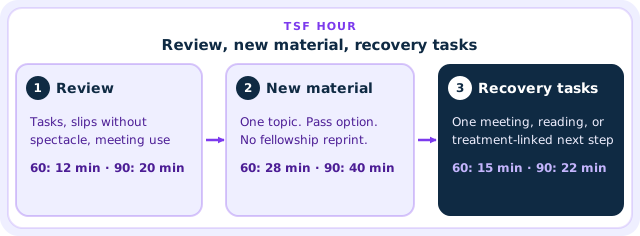
Review. Tasks, slips without spectacle, meeting involvement. Do not run a public inventory. Do not grade sincerity.
New material. One topic from the six cards. Teach, then let members try the idea in their own words. Protect the pass option. Stop cross-talk that becomes advice.
Recovery tasks. Meetings or reading the member actually uses, plus one treatment-linked next step. Paper they did not choose does not go home.
Time box. In 60 minutes: about 12 minutes review, 28 minutes new material, 15 minutes tasks, with a short close. In 90 minutes: about 20 / 40 / 22, with more room to name dynamics without turning the hour into process group. Association for Specialists in Group Work best practice guidelines cover group-worker scope and ethical practice. SAMHSA TIP 41 on group therapy covers group leadership, preparation, and phase-specific tasks.
Rolling groups admit newcomers on any card. Closed groups can finish the six and stop. Either way, do not make late members “catch up” on private step work in the circle.
Privacy, documentation, and Part 2
Record the shared intervention once, then each member’s response. Do not paste private step work, sponsor names, or meeting-level disclosure into the chart unless there is a specific clinical reason and consent.
42 CFR Part 2 still applies when the program is a Part 2 program. Meeting attendance and sponsor detail are often more than a progress note needs. The session plan is not a Part 2 manual. Use judgment before you share those details.
Nobody photographs anyone else’s page. A shared table does not make private writing communal.
How Emosapien carries recovery tasks
Emosapien keeps the recovery task the member named in group visible for the next hour, so the clinician reopens what actually happened instead of a copied group speech. Emosapien’s Engagement Agent carries between-session check-ins and homework. The clinician signs off on every drafted note.
The therapist chooses TSF, cadence, and whether a member belongs in the room. Emosapien does not run TSF, match sponsors, find meetings, or monitor crisis.
After the pack, keep named recovery tasks visible between sessions.
Use the printable session plan
The 12 step facilitation group guide pack is four US Letter pages: readiness, choice, and scope; six original clinician cards; the hour template with 60- and 90-minute boxes; and stop conditions. Each page carries a printed safety line: educational, not a fellowship curriculum, not a crisis service, not monitored in real time, not a substitute for the agreed safety plan.
Do not treat the PDF as AA or NA literature. It is a printable plan, not a live builder.
Email me the TSF session plan
Get the readiness screen, six-session outline, hour template, and stop conditions. Fellowship literature stays with the fellowship.
- Readiness, choice, and scope checks before anyone is put in TSF
- Six original clinician session cards, not a fellowship reprint
- Review / New material / Recovery tasks template for 60- and 90-minute rooms
- Stop conditions for coercion, flooding, unsafe amends, and sponsor drift
Free. We'll email the PDF link right away and add you to the therapist toolkit, sent every two weeks. Unsubscribe any time.
Where should we send the link?
We'll email the PDF link right away. You'll also get the therapist toolkit every two weeks. Unsubscribe any time.
✓ Check your inbox
We've sent you the PDF
The download link is on its way to your inbox, usually within a minute or two. The email will come from Emosapien (hello@team.emosapien.com); check your spam folder if you don't see it.
You're also on the therapist toolkit list, sent every two weeks. Unsubscribe any time from the email footer.
References
- Nowinski, J., Baker, S., and Carroll, K. Twelve Step Facilitation Therapy Manual. Project MATCH Monograph Series, Volume 1. NIAAA.
- Donovan, D. M., et al. STAGE-12. Journal of Substance Abuse Treatment.
- Winhusen, T., et al. STAGE-12 secondary outcomes. Drug and Alcohol Dependence.
- Substance Abuse and Mental Health Services Administration. TIP 41: Substance Abuse Treatment and Group Therapy.
- Substance Abuse and Mental Health Services Administration. About recovery.
- Kelly, J. F., Humphreys, K., and Ferri, M. (2020). Alcoholics Anonymous and other 12-step programs for alcohol use disorder. Cochrane Database of Systematic Reviews.
- Association for Specialists in Group Work. Guiding group work.