
Accountability Worksheets for Collaborative Follow-Through

Outline
Authored by Dr. Hannah Lin, a counseling psychologist trained in CBT, ACT, and IFS, with over a decade of clinical practice in anxiety and complex trauma.
Accountability worksheets can help a therapist and client turn one chosen commitment into a reviewable clinical loop. The client names an observable action, anticipates the barrier, chooses support, records what happened, and returns the result to the next session. Accountability means answerability plus support and repair. It does not mean surveillance, punishment, or proof of motivation.
The narrow job matters. Broad therapy worksheets in clinical practice help with selection across modalities. This resource is for licensed therapists who need one commitment, barrier, support, observation, review, and repair sequence without a compliance grade.
Download the collaborative accountability worksheets
Get five printable therapist pages for choosing one commitment, planning barriers and support, reviewing what happened, and repairing after a missed step without blame.
- Therapist fit, consent, power, privacy, and safety screen
- One-commitment plan with barrier, smallest version, support, and boundary fields
- Observation log with tried, partly tried, changed, and not tried paths
- Next-session review and repair-after-a-miss worksheets
Free. We'll email the PDF link right away and add you to the therapist toolkit, sent every two weeks. Unsubscribe any time.
Where should we send the link?
We'll email the PDF link right away. You'll also get the therapist toolkit every two weeks. Unsubscribe any time.
✓ Check your inbox
We've sent you the PDF
The download link is on its way to your inbox, usually within a minute or two. The email will come from Emosapien (hello@team.emosapien.com); check your spam folder if you don't see it.
You're also on the therapist toolkit list, sent every two weeks. Unsubscribe any time from the email footer.
Educational content for licensed therapists, not clinical or legal advice. Keep risk assessment, crisis procedures, mandated duties, supervision, and modality-specific treatment outside a worksheet shortcut.
What accountability is and is not in therapy
Clinical accountability is specific. It asks what the client chose, what happened, what impact followed, what responsibility is actually theirs, and what the next workable step may be. It leaves room for context, changed priorities, access barriers, ambivalence, and a decision to stop.
Blame works differently. It turns a missed action into a judgment about the person: careless, resistant, lazy, unmotivated. Punishment adds an imposed cost. Surveillance assumes that more observation will produce better behavior. None of those moves belongs inside collaborative accountability.
A useful distinction is:
| Accountability keeps | Accountability leaves out |
|---|---|
| A voluntary, observable commitment | A demand presented as client choice |
| Barriers and support named in advance | A test of willpower |
| Tried, partly tried, changed, and not tried paths | Pass or fail grading |
| Specific impact and proportionate responsibility | Global self-condemnation |
| A feasible repair or revised action | Forced apology or forgiveness |
| A next-session clinical decision | Public scorekeeping or constant monitoring |
The worksheet does not certify honesty or motivation. It gives therapist and client a shared artifact for deciding whether to repeat, shrink, change, add support, pause, or stop an action.
When accountability worksheets fit
Use the form when the client can freely choose a behavior that connects to treatment and can be reviewed without danger or coercion. Common fits include:
- one small behavior experiment in CBT-informed work;
- one values-consistent action after the value direction is already clear;
- a communication or boundary step that can be attempted safely;
- treatment-plan continuity between outpatient sessions;
- a recovery-support action with appropriate clinical containment;
- a specific repair the client chooses after a missed commitment.
Readiness is behavior-specific. A client may be ready to send one appointment email and not ready to address alcohol use, family contact, or trauma material between sessions. Use a stages of change worksheet when readiness itself needs careful formulation before a commitment is set. When the smallest reviewable action is one skill stem, assign journal prompts for self growth.
Pause the worksheet when acute risk, intoxication, withdrawal, severe flooding, dissociation, unsafe home privacy, or coercive relationship dynamics need attention first. Keep unsupervised exposure and trauma processing out of a take-home accountability frame. Stop when the form becomes a power struggle between therapist and client.
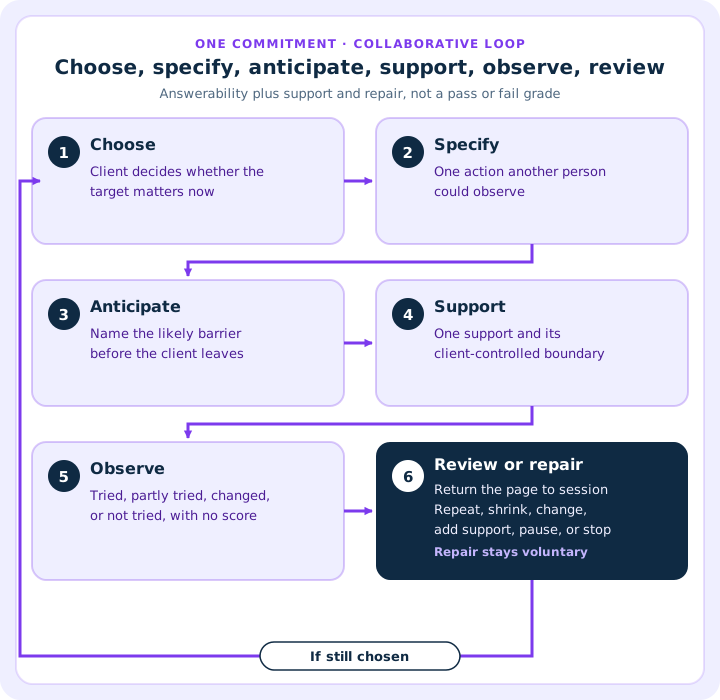
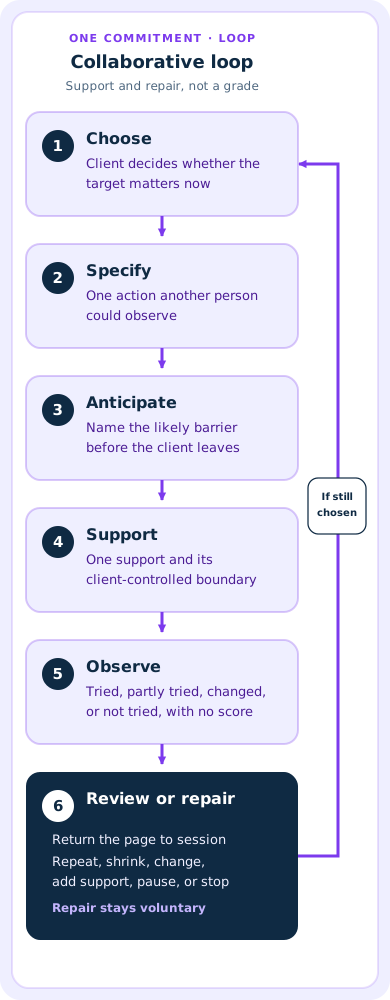
The six-part collaborative accountability loop
The loop is short enough to remember and specific enough to guide the next session.
- Choose. The client decides whether the target matters now. Declining is information, not defiance.
- Specify. Write one action another person could observe. “Send the scheduling email by Thursday” is reviewable. “Be responsible” is not.
- Anticipate. Name the most likely barrier before the client leaves the room. Include access, privacy, shame, fatigue, uncertainty, and relationship conditions, not motivation alone.
- Support. Choose one support and its boundary. A reminder may help one client and feel intrusive to another.
- Observe. Record tried, partly tried, changed, or not tried, plus what showed up before, during, and after. No streak or moral score is needed.
- Review or repair. Return the page to treatment. Decide what the outcome changed in the formulation and whether a repair or revised commitment still fits.
The evidence base for therapy homework is strongest when clinicians avoid reducing it to raw completion. A CBT meta-analysis found relationships between both homework quantity and quality and treatment outcomes, while noting important limits in how compliance was measured across studies. That supports careful review, not a claim that a worksheet causes improvement on its own.
Walk through the worksheet fields
Imagine a client who has repeatedly avoided replying to a sibling after canceling a shared plan. The treatment target is avoidance after shame. The accountability form should not start with “make things right.” It should start with choice and safety.
One chosen action
Write the smallest observable behavior the client is willing to try. The client chooses: “Draft a two-sentence text that acknowledges I canceled and asks whether they want to reschedule.” Drafting may be the whole commitment. Sending it may require another safety and readiness check.
Timing or cue
Attach the action to a usable moment: “Wednesday after lunch, before opening work chat.” A vague deadline leaves the cue implicit and makes review less useful.
Why it matters now
Tie the action to treatment, not to worth. In this example, the reason is practicing repair without disappearing after shame. If the direction itself is unclear, use a values clarification worksheet before turning it into committed action.
Barrier and smallest viable version
The likely barrier is the thought, “If I cannot explain everything, I should say nothing.” The smallest version is opening a note and writing one acknowledgment sentence. This is not lowering the clinical standard. It reveals where the avoidance loop becomes workable.
Support request and boundary
The client may ask the therapist to review the draft next session. The boundary is no between-session editing. Another client might choose a calendar reminder with no reply expected from anyone. Support remains client-controlled.
Observation and return point
The sheet records what happened before, during, and after the attempt. It also names when the form will return. Without that return point, accountability becomes private self-monitoring rather than collaborative treatment.
Four paths instead of pass or fail
Binary review hides useful information. Accountability worksheets need four outcome paths.
Tried
Ask what the client learned that neither of you could know in advance. The action may have been possible but emotionally costly. It may have exposed a new prediction or relationship boundary. Decide whether to repeat, generalize, or revise.
Partly tried
Find the point where the task changed. The client may have drafted the message and not sent it. That is not a disguised failure. It may show that language was available while interpersonal exposure exceeded current willingness.
Changed
A client may choose a safer or more relevant version once real life arrives. Ask what made the new version fit better. Adaptation can be clinical judgment in action, not avoidance.
Not tried
Begin with, “What happened between choosing this and meeting it in real life?” Check whether the action was available, small enough, private enough, and still relevant. Ask what feelings or predictions arrived. Review how the task was offered. The separate homework adherence strategies for therapy guide goes deeper on assignment fit and non-completion across different kinds of between-session work. When the between-session job is a finishable page rather than one commitment, use between sessions worksheets. When the agreed between-session job is a SAD experiment (one situation, one safety behavior to drop, predicted versus actual), use social anxiety worksheets rather than a general accountability sheet.
Repair after a missed commitment
Repair starts with specificity. What impact occurred? What responsibility is actually the client’s? What is not theirs? What action, if any, would be proportionate and safe?
A missed promise to bring a form to therapy may need only acknowledgment and a new cue. A missed agreement in a close relationship may carry interpersonal impact. Even then, repair is not automatic contact, forced disclosure, apology on demand, or forgiveness. The client may need to strengthen a boundary, delay contact, seek consultation, or work only in session.
Keep global self-condemnation out of the panel. “I did not send the message I chose to send” is specific. “I ruin every relationship” is a clinical target, not an accountability conclusion.
The repair page uses five prompts:
- What impact, if any, did the missed commitment have?
- What responsibility is actually mine?
- What is not mine to carry?
- What repair or support request may fit?
- If I still choose the commitment, what revised version is workable?
Adapt the loop by modality
CBT and behavioral work
Treat the action as a hypothesis. Specify the prediction, the barrier, and the observable result. Review what the attempt added to the maintaining-cycle formulation. Do not let completion replace the clinical question.
ACT-informed work
Name the chosen value direction before the commitment. Make room for discomfort instead of requiring it to disappear first. Keep the page on committed action and willingness without duplicating a full ACT process worksheet.
DBT-informed work
Place the commitment inside the treatment hierarchy and choose one skill or target to review. Do not imitate a diary card or use the sheet to bypass chain analysis, phone-coaching boundaries, or risk procedures.
Recovery and group work
Strengthen containment. Keep entries private unless the client freely chooses what to share. Do not use peer enforcement, public tallies, or consequences contracts. SAMHSA’s motivational interviewing guidance describes a collaborative partnership that supports autonomy and evokes the client’s own reasons for change. That stance is a useful guard against coercive accountability.
Document the clinical move, not the whole sheet
The progress note can name the treatment target, agreed action, anticipated barrier, client response, and next plan. It does not need a line-by-line copy of the worksheet.
A concise note might read:
Collaboratively reviewed avoidance after interpersonal shame. Client chose to draft a two-sentence repair message before next session, identified perfectionistic explanation as the likely barrier, and selected a one-sentence minimum version. Plan is to review tried, partly tried, changed, or not tried outcome and reassess whether sending remains safe and values-consistent.
Document risk assessment, safety decisions, mandated actions, or higher-level-of-care planning in the appropriate clinical record rather than treating this form as their substitute.
Bring the sheet back to the next session
The worksheet becomes useful when it returns. Start with the outcome path, ask what happened around the action, and let the answer change the treatment decision.
Use accountability worksheets for one chosen commitment at a time. Let tried, partly tried, changed, and not tried actions all produce information. Keep responsibility specific, support bounded, and repair voluntary.
Get the collaborative accountability worksheet pack
Print the therapist fit screen, one-commitment plan, observation log, next-session review, and repair-after-a-miss page.
- Therapist fit, consent, power, privacy, and safety screen
- One-commitment plan with barrier, smallest version, support, and boundary fields
- Observation log with tried, partly tried, changed, and not tried paths
- Next-session review and repair-after-a-miss worksheets
Free. We'll email the PDF link right away and add you to the therapist toolkit, sent every two weeks. Unsubscribe any time.
Where should we send the link?
We'll email the PDF link right away. You'll also get the therapist toolkit every two weeks. Unsubscribe any time.
✓ Check your inbox
We've sent you the PDF
The download link is on its way to your inbox, usually within a minute or two. The email will come from Emosapien (hello@team.emosapien.com); check your spam folder if you don't see it.
You're also on the therapist toolkit list, sent every two weeks. Unsubscribe any time from the email footer.
References
- Kazantzis, N., Whittington, C., Zelencich, L., Kyrios, M., Norton, P. J., & Hofmann, S. G. (2016). Quantity and quality of homework compliance: A meta-analysis of relations with outcome in cognitive behavior therapy. Behavior Therapy, 47(5), 755-772.
- Substance Abuse and Mental Health Services Administration. Motivational interviewing as a counseling style. In Enhancing Motivation for Change in Substance Use Disorder Treatment: TIP 35.