
Social Anxiety Worksheets You Can Use This Hour

Outline
Authored by Dr. Hannah Lin, counseling psychologist trained in CBT, ACT, and IFS, with over a decade of clinical practice in anxiety and complex trauma.
The client can describe the meeting. They cannot describe what they did to survive it. They rehearsed every sentence, held the phone like a prop, then replayed the pause for two hours. Fear of negative evaluation ran the hour. The sheet that would have helped was not a thought record and not a joining drill.
Social anxiety worksheets are SAD-specific sheets for licensed therapists: a safety-behavior inventory, a prediction log, a compact social or performance ladder with one drop, an attention-shift, and a review. The therapist chooses the situation, the drop, and the cadence. The pack does not diagnose, score, or promise that anyone will overcome social anxiety.
Clinical guidance below is available without email. Email the printable pack when you want the five jobs and debrief notes beside the session plan.
Email me the printable SAD pack
Get a safety-behavior inventory, prediction log, compact ladder, attention-shift, review sheet, and clinician debrief notes.
- Safety-behavior inventory for one social or performance situation
- Prediction log plus a compact ladder with one safety behavior to drop
- Attention-shift and predicted-versus-actual review
- Clinician debrief card for fit, stop conditions, and next-session reopen
Free. We'll email the PDF link right away and add you to the therapist toolkit, sent every two weeks. Unsubscribe any time.
Where should we send the link?
We'll email the PDF link right away. You'll also get the therapist toolkit every two weeks. Unsubscribe any time.
✓ Check your inbox
We've sent you the PDF
The download link is on its way to your inbox, usually within a minute or two. The email will come from Emosapien (hello@team.emosapien.com); check your spam folder if you don't see it.
You're also on the therapist toolkit list, sent every two weeks. Unsubscribe any time from the email footer.
Educational content for licensed therapists, not clinical, legal, or emergency advice. Worksheet selection sits inside formulation, consent, and risk review. These sheets do not replace supervision, a safety plan, or a diagnostic assessment.
What this pack is and is not
Use the parent library of therapy worksheets when you are choosing forms across modalities. Use this pack when the job is one social or performance experiment with a safety behavior to drop.
| This pack is | This pack is not |
|---|---|
| Safety behaviors before, during, and after one situation | A general coping-skills list |
| A prediction log (feared outcome, how you will know, confidence) | A seven-column thought record |
| Four to six social or performance rungs plus one drop | The full generic exposure hierarchy worksheet |
| Self-focus versus one external anchor | Mindfulness-group cards or a grounding rewrite |
| Adult outpatient talk therapy first | A kids SEL workbook, LSAS scoring, or joining practice |
The Hope, Heimberg, and Turk Managing Social Anxiety workbook is a full protocol. Name it in supervision if that is the training frame. This short pack does not replace that protocol or protocol-specific training. For presentation-matched technique selection across GAD, panic, and social anxiety, use CBT techniques for anxiety. For ICD-10-CM documentation, use F40.10 social anxiety disorder. This pack does not diagnose.
Teen adaptation here is a literacy and consent note; the pack is written for adult social anxiety work.
When social anxiety worksheets belong in the hour
It fits when three conditions hold.
Fear of negative evaluation in a social or performance situation is the maintaining cycle, in the sense Clark and Wells described: safety behaviors, self-focused attention, and post-event processing close the client off from disconfirming information. The client can name one situation. You can choose one safety behavior to drop and review what happened.
“Speak more at work” is not a situation. “Ask one question in Thursday’s stand-up without reading it off the phone” is a situation.
NICE CG159 lists individual CBT developed for social anxiety disorder as an indicated treatment for adults. That is a treatment-selection note. The five-page pack is a clinician aid, not a substitute for the full treatment protocol. Mayo-Wilson and colleagues’ 2014 network meta-analysis likewise found individual CBT among the stronger options for adult SAD.
The assignment is optional in the sense that a skipped line or a blank return still belongs in the next hour. Completion is not proof of alliance.
When to pause the pack
Pause when the paper would become a different protocol, a flood, or a test.
Stop, shrink, or switch tasks when:
- The indicated work is OCD ERP. Contamination, checking, or other response-prevention targets need an ERP-competent plan, not a SAD drop.
- Trauma flooding or dissociation. If the client leaves the window, put the page down. Grounding belongs in that hour, not a compact ladder.
- Acute risk. Safety planning takes the hour. A prediction log does not sit on top of that.
- The job is joining or cue-reading. If the formulation is skill, not evaluation fear, this pack is the wrong paper.
- The job is a generic phobia hierarchy. Use the full generic exposure hierarchy worksheet for the SUDS builder and non-SAD phobia work.
- The job is a thought record. Do not stretch the prediction log into seven columns. When the job is an ABCDE belief dispute rather than a social prediction log, use the rebt worksheet.
- The job is a diagnostic code or an LSAS score. This pack does not diagnose.
- Kids classroom packs, ABA programs, IPV or coercive control, or shyness without impairment. Out of audience, or the wrong clinical question.
Autistic or ADHD clients may use a behavior that looks like a safety move as a sensory, processing, or communication support. Do not drop that support because a SAD protocol says to. Change the scaffold.
SAMHSA’s trauma-informed principles put safety, trustworthiness, and choice ahead of any exercise. If last week’s review felt like a grade on courage, this week’s page will stay in the bag.
Walk the five jobs
The printable pack exposes the same fields the client will see. Walk one situation in session before these social anxiety worksheets go home.
Scroll the visual sideways to view the full diagram
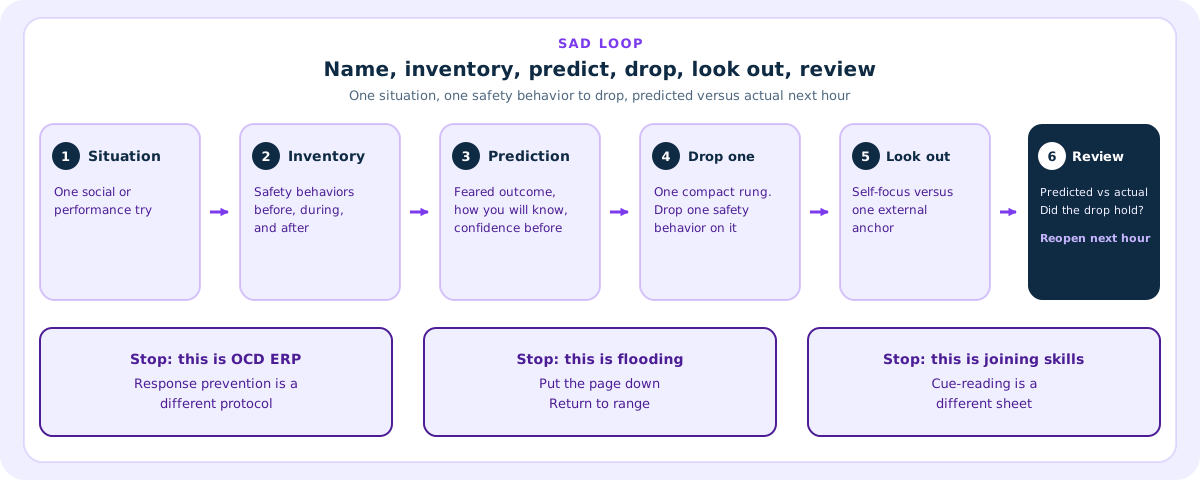
Safety-behavior inventory
Job. Name what the client does before, during, or after a social or performance situation to prevent the feared evaluation.
Therapist sets. One situation. Before, during, and after columns. Cost of the behavior. One behavior to drop on the next try.
Client writes. Rehearsing lines, avoiding eye contact, holding a phone, over-preparing, post-event replay, or whatever they actually do. Not a general coping list.
Stop. If the list becomes every way they manage a day, shrink to this situation. If the behavior is a needed support, do not drop it.
Sample. Situation: Thursday stand-up. Before: rewrite the update three times. During: read from the phone and skip questions. After: replay the pause for two hours. Cost: no test of the feared outcome. Drop next time: the phone script.
Prediction log
Job. Situation, feared outcome, how the client will know it happened, confidence before.
Therapist sets. One upcoming try. Confidence as a 0 to 100 guess, not a test score.
Client writes. “People will think I sound incompetent” plus the observable sign they would treat as proof, and a confidence number.
Stop. If the columns multiply into a thought record, stop this page.
Sample. Situation: ask one unscripted question. Feared outcome: the room goes quiet and someone looks annoyed. How I will know: two seconds of silence and a frown. Confidence: 75.
Compact exposure ladder
Job. Four to six social or performance rungs: situation, predicted SUDS, safety behavior to drop, actual SUDS, what happened.
Therapist sets. One ladder for this fear, not every avoided cue in the client’s life. Adjacent rungs close enough to repeat.
Client writes. The next rung they can actually try, not a heroic jump.
Stop. If you need duration rules, a 12-step phobia ladder, or a non-SAD cue, use the generic SUDS builder in the exposure hierarchy worksheet instead of this pack.
Sample.
| Rung | Situation | Predicted SUDS | Drop | Actual SUDS | What happened |
|---|---|---|---|---|---|
| 1 | One unscripted sentence in session | 35 | Silent rehearsal | 30 | Sentence landed. No comment. |
| 2 | One question in a three-person huddle | 45 | Phone script | 50 | Two-second pause. Then an answer. |
| 3 | One update with three bullets, not a script | 55 | Hour of prep |
The printable pack carries the remaining rungs; this table is a short excerpt, not a full hierarchy.
Attention-shift exercise
Job. Self-focused versus external attention in the situation. One concrete external anchor.
Therapist sets. The same situation as the drop. One thing in the room the client can actually look at or listen to.
Client writes. Where attention went (face heat, voice, imagined audience) and the external anchor they will use instead (the clock, the table edge, the question being asked).
Stop. If the client is flooding, this is not a mindfulness-group card and not a grounding rewrite. Put the page down.
Sample. Self-focus: watching my face get hot and counting how long I have been talking. External anchor: the question on the table. During the try, I will look at the question, not at my heat.
Review sheet
Job. Predicted versus actual, whether the dropped safety behavior stayed dropped, how long post-event replay ran, what to reopen next session.
Therapist sets. Reopen at the start of the next hour, not as a grade at the door.
Client writes. What they predicted, what happened, whether the phone script stayed in the bag, how long the replay ran, and one line they want you to start with.
Stop. If the review becomes a two-hour cross-examination of the week, shrink to this try.
Sample. Predicted: two seconds of silence means they think I am incompetent. Actual: two seconds, then an answer. Drop held: phone stayed in the bag. Replay: forty minutes, then it faded. Reopen: the pause, not the whole meeting.
Reopen complete, mixed, or blank sheets
Name the sheet at the start of the next hour. Treat blank work as information.
| Return state | First clinical move |
|---|---|
| Complete | Ask what the page missed, including any safety behavior that crept back in |
| Mixed | Find which rung produced a usable drop and which one became endurance |
| Replay-heavy | Time the post-event processing. Shrink the next try if the replay outran the situation |
| Blank | Ask what happened around the form before you interpret motivation |
| Courage lecture | Name the collapse without shaming it. Put the client back in a situation, not in the dock |
A useful reopen is specific: “You wrote that the phone stayed in the bag, and the replay ran forty minutes. Where should we begin?” If the client wants a different starting point, follow that.
Blank work can mean the prompt was too large, the home was not private, last week’s review felt like a grade, or the week needed the whole hour. None of those possibilities should be scored from the page.
The APA Ethics Code keeps informed consent and competence in view when you send work home. Say what the sheet is for, who will see it, when you will read it, and that it is not monitored between sessions.
Privacy, documentation, and safety
Agree on delivery, storage, and sharing before anyone writes private material.
Delivery. Deliver it on paper, through a portal the practice already uses, or complete it together in session. Do not send clinical content through ordinary consumer email or SMS.
Storage. The working copy may stay with the client or enter the file under practice policy. Portal copies belong in the approved record system. Do not leave a sheet where an unsafe household can turn it into a record.
Documentation. Record the clinically relevant signal: situation, drop, predicted versus actual, post-event processing, and the next step. Do not paste the sheet verbatim into the note unless there is a specific clinical reason.
A concise entry might read:
Reviewed between-session SAD experiment for Thursday stand-up. Client dropped the phone script, predicted a two-second pause as proof of incompetence, and reported a pause then an answer. Replay ran about forty minutes. Agreed to keep one situation and one drop this week.
Safety boundaries. This sheet is not a crisis service, is not monitored in real time, is not a diagnosis, does not replace the agreed safety plan, is not a social-skills test, and is not a scored LSAS. If the client needs urgent support, they use the crisis path you already set.
If risk language, marked deterioration, or a safety concern appears, leave worksheet mode. Follow the practice’s risk, consultation, and emergency procedures.
How Emosapien carries the experiment
Emosapien keeps the social or performance experiment the client agreed to try visible for the next appointment so you can reopen predicted versus actual and whether the safety behavior stayed dropped, not a reconstructed story about the week. You choose the situation, the drop, the cadence, and the response plan. Emosapien does not pick the rung, score social skill, monitor crisis risk, or contact emergency services.
See how that layer supports client engagement between sessions while clinical judgment stays with you.
Download the pack
The printable social anxiety worksheets pack fits five client jobs and one clinician debrief card onto 4 to 5 US Letter pages with selectable text:
- Clinician debrief: whether a SAD pack is the job, how to pick one situation and one drop, delivery and storage, fit and stop, next-session reopen, documentation stem, what carries
- Safety-behavior inventory
- Prediction log and compact social or performance ladder
- Attention-shift and review sheet
Each client page carries a printed safety line: not a crisis service, not monitored in real time, not a diagnosis, not a substitute for the agreed safety plan, not a social-skills test, not a scored LSAS.
Assign one situation at a time. A second page belongs only after the first one came back without turning evaluation fear into a character test.
Email me the printable SAD pack
Get a safety-behavior inventory, prediction log, compact ladder, attention-shift, review sheet, and clinician debrief notes.
- Safety-behavior inventory for one social or performance situation
- Prediction log plus a compact ladder with one safety behavior to drop
- Attention-shift and predicted-versus-actual review
- Clinician debrief card for fit, stop conditions, and next-session reopen
Free. We'll email the PDF link right away and add you to the therapist toolkit, sent every two weeks. Unsubscribe any time.
Where should we send the link?
We'll email the PDF link right away. You'll also get the therapist toolkit every two weeks. Unsubscribe any time.
✓ Check your inbox
We've sent you the PDF
The download link is on its way to your inbox, usually within a minute or two. The email will come from Emosapien (hello@team.emosapien.com); check your spam folder if you don't see it.
You're also on the therapist toolkit list, sent every two weeks. Unsubscribe any time from the email footer.
References
- Clark, D. M., & Wells, A. (1995). A cognitive model of social phobia. Discussed in Leigh, E., & Clark, D. M. (2018). Understanding social anxiety disorder in adolescents and improving treatment outcomes: Applying the cognitive model of Clark and Wells (1995). Clinical Child and Family Psychology Review, 21, 388-414.
- National Institute for Health and Care Excellence. (2013, last reviewed 2024). Social anxiety disorder: recognition, assessment and treatment (CG159).
- Mayo-Wilson, E., Dias, S., Mavranezouli, I., Kew, K., Clark, D. M., Ades, A. E., & Pilling, S. (2014). Psychological and pharmacological interventions for social anxiety disorder in adults: A systematic review and network meta-analysis. The Lancet Psychiatry, 1(5), 368-376.
- Substance Abuse and Mental Health Services Administration. (2014). SAMHSA’s Concept of Trauma and Guidance for a Trauma-Informed Approach. HHS Publication No. (SMA) 14-4884.
- American Psychological Association. Ethical Principles of Psychologists and Code of Conduct.