
Bipolar Chart for Daily Mood Tracking

Outline
Authored by Dr. Hannah Lin, counseling psychologist trained in CBT, ACT, and IFS, with over a decade of clinical practice across anxiety and complex trauma.
It is Monday at 10. Jordan says last week was “pretty fine.” Sleep was four hours on Thursday. A new evening walk turned into a night they could not sit still. Nobody wrote it down, so you spend the first twenty minutes reconstructing polarity from memory.
A bipolar chart is a therapist-assigned daily log of mood polarity, sleep hours, activation, medication-change, and support-contact. You pick the marks in session, name a watch window, and reopen the sheet in the next hour. It gives outpatient therapists a shared record of the week’s polarity, sleep, activation, medication changes, and support contacts to review with the client at the next session.
The pack below shows a 7-day client sheet, an optional second week or weekly summary strip, and a clinician review card. Review every field below before you download the printable PDF.
Email me the daily polarity pack
Get the 7-day client sheet, optional second week or summary strip, and a clinician card for fit, stop rules, next-session reopen, and the crisis caveat.
- 7-day client sheet plus an optional second week or weekly summary strip
- Fields for polarity, sleep hours, activation, medication-change, and support-contact
- Clinician card for fit, stop rules, next-session reopen, documentation, and the crisis caveat
- Worked example of one outpatient week, initials only
Free. We'll email the PDF link right away and add you to the therapist toolkit, sent every two weeks. Unsubscribe any time.
Where should we send the link?
We'll email the PDF link right away. You'll also get the therapist toolkit every two weeks. Unsubscribe any time.
✓ Check your inbox
We've sent you the PDF
The download link is on its way to your inbox, usually within a minute or two. The email will come from Emosapien (hello@team.emosapien.com); check your spam folder if you don't see it.
You're also on the therapist toolkit list, sent every two weeks. Unsubscribe any time from the email footer.
Educational content for licensed therapists, not clinical, legal, or emergency advice. Sheet selection sits inside formulation, consent, and risk review. This pack does not diagnose bipolar disorder, replace a validated measure, or monitor anyone between sessions.
What this pack is and is not
This is an idiographic between-session aid. You already have a clinical question about polarity, sleep, and activation. The sheet makes that week visible enough to use in the next hour. It does not finish a mania or hypomania interview, and it does not score a syndrome.
Set cadence, review, and plan adjustment through your measurement based care protocol. Use this sheet only as a daily polarity log.
| This pack is | This pack is not |
|---|---|
| A daily polarity, sleep, and activation log | A diagnosis of bipolar I, II, mixed features, or cyclothymia |
| Marks you and the client already agreed | NIMH Life Chart Method, YMRS, ASRM, or PHQ-9 |
| A named watch window, not a forever diary | A weekly mental health check-in worksheet |
| Paper, portal, or in-session completion | An app recommendation or consumer mood graph |
| Reviewed at the next visit | A crisis service or real-time monitor |
NIMH’s bipolar disorder topic page is a public overview of the illness. It is not a worksheet, and this pack does not copy a life-chart method or rating-scale items.
When a daily polarity log fits
Assign the sheet when the client is already in outpatient care, can mark a day in a few minutes, and you want sleep, polarity, activation, and medication-change sitting on the table next visit. Useful situations include:
- a short watch window after sleep collapse, new restlessness, or mixed days that keep disappearing in the retelling;
- a period when medication-change (taken, missed, late, or a dose change the client was already told to record) matters to the next clinical question;
- a client who can use agreed marks such as low / mixed / baseline / high, or an idiographic -3 to +3 you defined together;
- a week where reconstructing the story keeps crowding out the actual work.
Fit depends on formulation. Some clients experience a small daily mark as containing. Others experience any log as surveillance, a test they can fail, or proof they are “manic” or “fine.” Introduce it as an option with a stop date.
If the clinical job is still unipolar depression planning, including bipolar-depression keep-out, stay with the depression treatment plan rather than stretching this sheet into a plan.
When to pause the sheet
Pause the chart when the clinical task calls for a different instrument.
Stop for active crisis. Use the practice safety plan. Do not add another row.
Stop when the client uses the sheet as proof they are “fine” or “manic,” when tracking becomes compulsive or ruminative, or when a partner, co-parent, or custody process could seize the page. For psychologists, APA’s Ethics Code covers informed consent and confidentiality. Consent is ongoing, not captured once by handing over paper.
Stop when the differential is still unipolar versus bipolar and needs an interview, not a DIY graph. Stop when the actual job is PHQ-9, YMRS, ASRM, NIMH Life Chart, or a 96136 battery. Stop when a weekly tracker or weekly pulse is enough. Stop when there is no consent. When the take-home is a name-peak-move stem rather than a daily polarity log, assign journal for emotional regulation.
SAMHSA’s trauma and violence framing is useful here: safety and collaboration come before another self-report task. Interpersonal and social rhythm work can sit nearby as a clinical cousin. This pack is not an IPSRT course.
Fields on a bipolar chart
Keep the sheet short enough to finish on a low-energy day. It is not a 90-day research life chart.
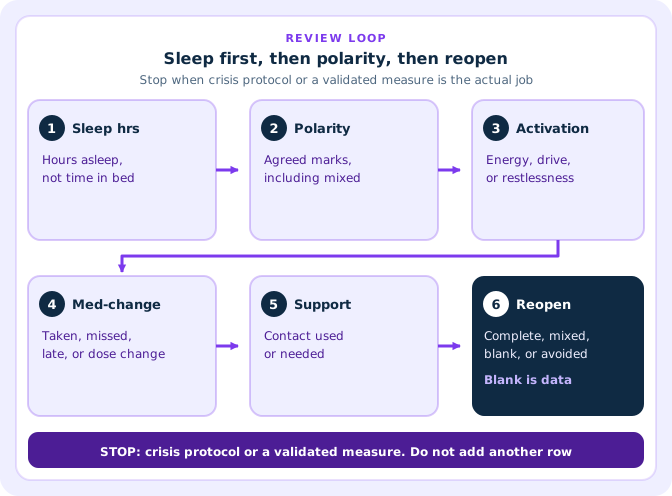
- Sleep hours. Time asleep, not time in bed. Read this column before you interpret mood. A “high” Tuesday after four hours of sleep is a different clinical object than the same mark after eight.
- Mood polarity. Use only the polarity marks you already agreed. Mixed is allowed when both poles showed up. Do not substitute smiley-face ratings.
- Activation or energy. Drive, restlessness, depletion. This is often the column that makes a “fine” week make sense.
- Medication-change. Taken, missed, late, or a dose change the prescriber already instructed the client to record. It is not a prescribing box.
- Support-contact. Used or needed. These are the client’s agreed people, not a hotline substitute and not your after-hours inbox.
One optional note line is enough. If the client needs an app container instead of paper, use apps to recommend to therapy clients to assess consent, privacy, and fit.
Scroll the visual sideways to view the full diagram
Debrief the next session
Review the bipolar chart from the return state. Blank is information.
| Return state | First clinical move |
|---|---|
| Complete | Name sleep and one polarity or activation shift, then ask what the sheet missed |
| Mixed day | Ask what both poles looked like in the same day, without calling it a diagnosis |
| Blank | Ask what happened around the sheet before you interpret motivation |
| Avoided | Check burden, privacy, shame, or a mark that felt like a verdict |
A useful reopen is specific: “Thursday sleep was four hours and activation jumped. Where should we start?” If the client wants a different starting point, follow that too.
Privacy, documentation, and safety
Deliver on paper, through the practice portal, or in session. Do not send PHI through consumer email or SMS.
The chart is not monitored between sessions. Say that out loud. If the client would be safer completing it with you at the start of the hour, do that.
Document the clinically relevant signal: sleep collapse, new activation, missed doses, support-contact use. Do not paste the sheet into the note. A short entry might read:
Reviewed 7-day polarity log. Thursday sleep dropped to four hours with a missed evening dose and a late jump in activation. Explored mixed Wednesday without treating it as a diagnostic conclusion. Agreed to keep the watch window one more week and to complete Thursday-Friday rows together if home privacy stays limited.
Each client page carries a printed safety line in plain words: not a diagnosis, not a validated measure, not a crisis service, not monitored in real time, not a substitute for the agreed safety plan.
How Emosapien carries the thread
Emosapien keeps the polarity, sleep, and activation marks you asked for visible at the next appointment, so you reopen what happened instead of reconstructing the week. You still choose the fields, cadence, and stop rule. The Engagement Agent can run between-session check-ins and auto-schedule validated measures. This paper sheet is not that automated measure. Emosapien does not diagnose, score mania, or watch crisis risk between visits.
See how Emosapien supports client engagement between sessions.
Download the printable pack
The bipolar chart PDF is 3 to 4 US Letter pages:
- a 7-day client sheet with sleep, polarity, activation, medication-change, support-contact, mixed-day marks, and the safety footer;
- an optional second week or one-line weekly summary strip;
- a clinician review card for purpose, cadence, delivery, fit, stop, reopen, documentation, and the crisis caveat, plus the worked example.
Assign a watch window. Review what returns.
Email me the daily polarity pack
Get the 7-day client sheet, optional second week or summary strip, and a clinician card for fit, stop rules, next-session reopen, and the crisis caveat.
- 7-day client sheet plus an optional second week or weekly summary strip
- Fields for polarity, sleep hours, activation, medication-change, and support-contact
- Clinician card for fit, stop rules, next-session reopen, documentation, and the crisis caveat
- Worked example of one outpatient week, initials only
Free. We'll email the PDF link right away and add you to the therapist toolkit, sent every two weeks. Unsubscribe any time.
Where should we send the link?
We'll email the PDF link right away. You'll also get the therapist toolkit every two weeks. Unsubscribe any time.
✓ Check your inbox
We've sent you the PDF
The download link is on its way to your inbox, usually within a minute or two. The email will come from Emosapien (hello@team.emosapien.com); check your spam folder if you don't see it.
You're also on the therapist toolkit list, sent every two weeks. Unsubscribe any time from the email footer.
References
- National Institute of Mental Health. Bipolar disorder.
- American Psychological Association. Ethical principles of psychologists and code of conduct.
- Substance Abuse and Mental Health Services Administration. Trauma and violence.