Mental Health Check-In Worksheet for Weekly Client Review

Outline
Authored by Amara Collins, clinical psychologist focused on continuity of care across no-shows, waitlists, and the long gaps between sessions.
A mental health check-in worksheet is a short, therapist-selected form that carries one week of lived context into the next appointment. This version gives the client a light weekly pulse and gives the clinician a separate setup-and-review card. It is for licensed therapists, not a consumer self-test.
The worksheet stays deliberately narrow. The wider therapy worksheets in clinical practice guide covers choosing forms across modalities and clinical tasks. This page owns one repeatable pulse, its boundaries, and the return to the room. When the take-home is a target-skill-urge stem rather than a weekly pulse, assign dbt journal prompts. When the take-home is an observe-describe-participate trial rather than a weekly pulse, assign the what skills practice log.
Download the two-page weekly check-in worksheet
Get the client-ready pulse plus the clinician card for purpose, cadence, privacy, response windows, and next-session review.
- Client-ready weekly pulse with brief ratings and one carry-forward field
- Privacy choice and clear non-monitoring boundary
- Clinician setup card for purpose, cadence, delivery, storage, and response window
- Next-session review paths for complete, partial, changed, or blank responses
Free. We'll email the PDF link right away and add you to the therapist toolkit, sent every two weeks. Unsubscribe any time.
Where should we send the link?
We'll email the PDF link right away. You'll also get the therapist toolkit every two weeks. Unsubscribe any time.
✓ Check your inbox
We've sent you the PDF
The download link is on its way to your inbox, usually within a minute or two. The email will come from Emosapien (hello@team.emosapien.com); check your spam folder if you don't see it.
You're also on the therapist toolkit list, sent every two weeks. Unsubscribe any time from the email footer.
Educational content for licensed therapists, not clinical, legal, or emergency advice. Adapt the form to formulation, consent, risk, culture, accessibility, setting, and applicable practice requirements.
What this worksheet is and is not
This is a continuity aid. It gives therapist and client a small shared artifact to reopen after a week, a missed appointment, or a longer gap. It does not decide what matters clinically. It does not interpret the client’s week, detect deterioration, diagnose a condition, or tell either person what treatment should do next.
| This worksheet is | This worksheet is not |
|---|---|
| A brief qualitative pulse | A validated outcome measure |
| A pre-session agenda signal | A broad prompt bank |
| A way to name one standout moment | A daily bipolar chart |
| A shared return point for the next appointment | A progress dashboard |
| A therapist-framed workflow with agreed boundaries | A crisis screen or real-time monitoring service |
The distinction protects the relationship. A rating can open a conversation, but it cannot carry the meaning of a number on its own. A blank field can reflect privacy, fatigue, uncertainty, protest, poor fit, or a week in which the form simply fell away. None of those possibilities should be graded from the page.
When a weekly pulse fits
A brief form can fit when the client wants help holding the thread between appointments but does not need a full diary, formal measure, or structured course review. Useful situations include:
- a weekly pulse before a regular outpatient appointment;
- one recent signal after a break in care or a missed session;
- a short trial when the first minutes of therapy repeatedly go to reconstructing the week;
- one agenda cue when memory, stress, or competing demands make it hard to know where to start;
- a continuity aid after a waitlist, travel gap, illness, or schedule disruption.
Fit remains individual. Some clients experience a small form as containing. Others experience any written tracking as pressure, surveillance, or another task they can fail. Introduce the worksheet as an option, name the smallest useful response, and agree that the client may skip, change, or complete it with you.
SAMHSA’s trauma-informed approach centers safety, trust, collaboration, and empowerment. Those principles support a simple practice here: consent is ongoing, not captured once by handing over a page.
When to pause or change the format
Pause the form when acute risk needs direct assessment, when writing increases flooding or dissociation, or when privacy at home is not workable. Change the format when literacy, language, vision, attention, disability, culture, or device access makes the page a poor container.
Also watch for coercion. A client should not have to prove engagement by completing a form. A partner, caregiver, parent, employer, or group member should not gain access by default. If the client would rather speak for two minutes at the start of the appointment, that may preserve more continuity than a worksheet they cannot safely keep.
The form should stop when it becomes repetitive, burdensome, disconnected from the treatment plan, or a source of rupture. Naming that openly can itself support repair: “I notice this has started to feel like something you have to hand in. Should we shrink it, complete it together, or stop?”
How to use the mental health check-in worksheet
Page 1 belongs to the client. Page 2 belongs to the clinician setup and review process. Complete the setup card before the first send, then revisit it when the cadence, privacy conditions, treatment phase, or client preference changes.
Week and date
A date keeps the pulse attached to a real interval. The name or identifier can remain optional on paper when the practice can safely match the page another way. Avoid unnecessary identifying detail on a form that may travel outside the chart.
Overall week
The 0–10 rating is a client-chosen summary, not a clinical severity band. Ask what the endpoints mean to this client before comparing one week with another. “Four” may mean depleted but functioning for one person and close to crisis for another.
Body and routine pulse
Sleep, energy, and stress are optional brief ratings. They are present because clients often remember the week through routines and body state before they can build a narrative. Leave room to skip any field that feels irrelevant or intrusive.
One moment that stands out
The standout moment may be positive, difficult, mixed, or hard to name. This field keeps the form from reducing the week to symptom intensity. A moment of ease, connection, anger, avoidance, or pride may hold the treatment thread more clearly than the highest number.
Skill, support, or action tried
The response paths are tried, partly tried, changed, or not this week. “Not this week” is a valid response. It prevents the field from becoming a hidden adherence score and gives the next session a place to explore access, burden, timing, consent, and fit.
For a deeper review of incomplete or changed between-session work, use the homework adherence strategies for therapy guide rather than adding more fields here.
Carry-forward line
The final client field asks for one feeling, pattern, question, need, or moment to bring back. One line is enough. The therapist can reopen it by name, ask one clarifying question, and then decide with the client whether it should shape the session agenda.
Privacy choice
The client chooses paper, an approved secure portal, or completion together in session. The form also states that it is not monitored in real time and is not a crisis service. That boundary must match the actual practice workflow, not sit on the page as boilerplate.
Set purpose, cadence, and response expectations
Before using the mental health check-in worksheet, agree on five points:
- Purpose: what the pulse is meant to help notice or carry forward.
- Cadence: weekly, immediately before the appointment, or for a limited trial.
- Delivery and storage: paper, approved secure portal, or in-session completion.
- Response window: when the therapist reviews it and what is not monitored.
- Return point: how the response will be reopened in the next appointment.
Scroll the visual sideways to view the full diagram
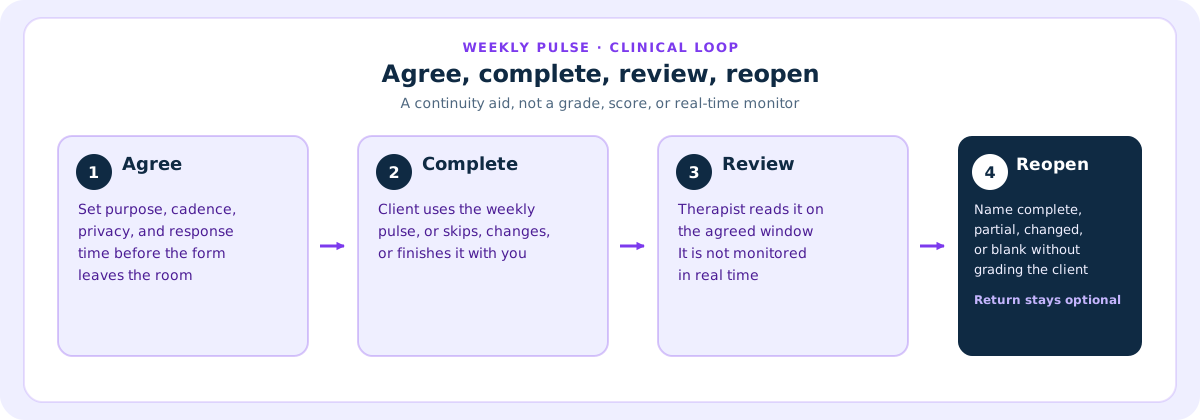
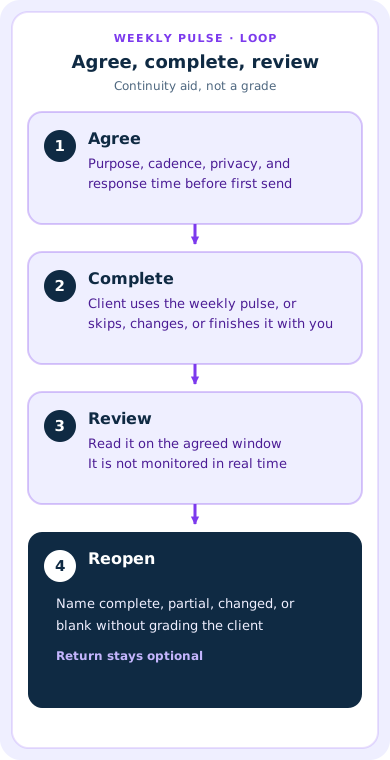
The broader workflow for between-session therapy check-ins covers delivery, message framing, and response handling in more detail. Whatever channel you use, do not collect a reply that no one will review.
When digital responses contain protected health information, use the practice’s approved systems, access controls, retention rules, and contracts. HHS explains when a service acting on behalf of a covered entity may be a business associate. HIPAA applicability, local law, payer rules, and record policy still require practice-specific review.
Review complete, partial, changed, or blank responses
Open the next session from the return state without treating it as a grade.
| Return state | First clinical move |
|---|---|
| Complete | Name one useful signal and ask what the page missed |
| Partial | Find where burden, privacy, activation, or uncertainty changed the task |
| Changed | Ask what made the client’s version more workable or more relevant |
| Blank | Explore what happened around the form before interpreting motivation |
Routine feedback research supports bringing client experience into clinical decisions, while the meaning still depends on context and judgment. Lambert and Shimokawa’s review of client feedback describes feedback as part of a clinical process, not a score that speaks for itself.
A useful reopen sounds specific: “You marked sleep as harder and wrote that Tuesday stood out. Where should we begin?” If the client wants a different starting point, follow that information too. The worksheet serves continuity only when the client can still redirect the room.
Know when a formal measure is the better tool
Use a validated measure when the clinical job requires standardized instructions, scoring, comparison, or threshold interpretation. The simple ratings on this mental health check-in worksheet are qualitative pulse fields. They have no diagnostic cutoffs, severity bands, reliable-change rules, or automated alert meaning.
A practice may use a weekly pulse and a validated measure together, but their jobs stay separate: the weekly pulse carries context, while a validated measure supports structured assessment of its defined construct.
If high distress, risk language, or a marked change appears, move out of worksheet mode. Follow the practice’s existing risk assessment, consultation, safety, and emergency procedures. Do not wait for the next scheduled review when the clinical situation requires direct action.
Document the signal, not the whole page
The clinical record can name the relevant signal, therapist response, and agreed next step. It rarely needs a line-by-line copy of every field. Apply the recordkeeping requirements of the setting, payer, jurisdiction, and practice policy.
A concise entry might read:
Reviewed weekly pulse returned before session. Client identified disrupted sleep and a difficult workplace exchange as the main carry-forward signals. Explored how avoidance after the exchange affected the treatment target. Agreed to pause weekly sends for two weeks and complete the next pulse together because home privacy is limited.
The note shows what became clinically relevant and what changed in the plan. It does not convert a client worksheet into a transcript.
How Emosapien carries the thread
Emosapien carries therapist-defined check-ins and client reflections into the next appointment so the clinician can review the signal before the session. The therapist chooses the target, cadence, response plan, and next clinical move. Emosapien does not diagnose, score the client, monitor crisis risk, or contact emergency services.
See how Emosapien supports client engagement between sessions while keeping clinical judgment with the therapist.
Download the printable mental health check-in worksheet
The PDF includes two US Letter pages:
- a client-ready weekly pulse with overall-week, sleep, energy, stress, standout-moment, action, carry-forward, and privacy fields; and
- a clinician card for purpose, cadence, delivery, storage, response window, fit, stop conditions, next-session review, and concise documentation.
Use the download form near the top of this page to print both pages before the next weekly trial.
References
- Substance Abuse and Mental Health Services Administration. Trauma and violence.
- U.S. Department of Health and Human Services, Office for Civil Rights. Business associates.
- Lambert, M. J., & Shimokawa, K. (2011). Collecting client feedback. Psychotherapy, 48(1), 72-79.