
HIPAA for Group Practices: Roles, Access, and Incident Ownership

Outline
A solo therapist can keep HIPAA mostly in one head and one laptop. A multi-clinician clinic cannot. If you have not chosen which of those you are, the private practice versus group practice card is the decision. HIPAA for group practices breaks where roles overlap: the front desk who can open every chart, the supervisor who needs caseload visibility, the weekend contractor with admin rights, and the 9 p.m. incident nobody owns.
This guide is an operating system for that reality. It maps six roles, sets minimum-necessary access, runs joiner-mover-leaver without delay, and names incident ownership before something goes wrong. It is educational guidance for US mental-health group practices, not a certification checklist and not legal advice.
Solo operators who need the one-person version should use the solo practitioner HIPAA guide. For the wider compliance cluster, start at the therapy compliance hub.
Free PDF: Group Practice HIPAA Role and Access Matrix
A printable multi-clinician HIPAA worksheet: six-role inventory, minimum-necessary access, joiner-mover-leaver steps, and incident ownership.
- Six-role inventory with ePHI scope and access boundaries
- Minimum-necessary access map for shared clinic systems
- Same-day joiner, mover, and leaver checklist fields
- Named incident lead, backup, and escalation path block
Free. We'll email the PDF link right away and add you to the therapist toolkit, sent every two weeks. Unsubscribe any time.
Where should we send the link?
We'll email the PDF link right away. You'll also get the therapist toolkit every two weeks. Unsubscribe any time.
✓ Check your inbox
We've sent you the PDF
The download link is on its way to your inbox, usually within a minute or two. The email will come from Emosapien (hello@team.emosapien.com); check your spam folder if you don't see it.
You're also on the therapist toolkit list, sent every two weeks. Unsubscribe any time from the email footer.
Educational resource for licensed US mental-health clinicians and practice leaders. HIPAA Privacy, Security, and Breach Notification Rules change. Verify current requirements against official HHS sources, your BAAs, state law, and qualified counsel before you rely on any workflow.
Why HIPAA for group practices is a role problem
The Privacy Rule and Security Rule still apply the same federal baselines to a covered entity of any size. What changes in a group is the surface area: more workforce members, more systems, more business associates, and more ways minimum-necessary access can fail without anyone noticing.
Three group-specific risks drive most chart and audit findings:
- Role creep. Access granted for a temporary cover never gets removed.
- Shared identity. One front-desk login, one shared owner password, or an unlogged admin account erases the audit trail the Security Rule expects.
- Ownerless incidents. A wrong-recipient fax or lost laptop sits until Monday because nobody is named to lead after hours.
A workable group program is not a thicker policy binder. It is a living map of who can see what, who provisions access, and who leads when something breaks.
Start with a six-role inventory
List every person and vendor class that can create, receive, maintain, or transmit ePHI. Name people under each class. If a role has no named owner, you do not yet have a control.
| Role | Typical ePHI need | Usual access boundary |
|---|---|---|
| Owner / privacy or security officer | Policy, risk analysis, breach coordination, full admin when required | Full administrative rights; clinical chart access only when the job requires it |
| Treating clinician | Own caseload notes, measures, messages | Other clinicians’ charts only when covering, co-treating, or supervising under policy |
| Clinical supervisor | Supervisee charts, risk notes, quality review | Limited to assigned supervisees unless coverage expands the set |
| Front desk / practice admin | Demographics, schedule, insurance, payments | Clinical narrative and risk detail closed by default |
| Billing staff | Claims, diagnosis codes needed for payment | Full psychotherapy narrative only when a claim or audit truly requires it |
| Non-workforce contractor or vendor (business associate when the definition and exceptions fit) | Only the data the BAA and job function allow | No broad EHR browsing; time-bound accounts; subcontractor flow-down |
Scroll the visual sideways to view the full diagram
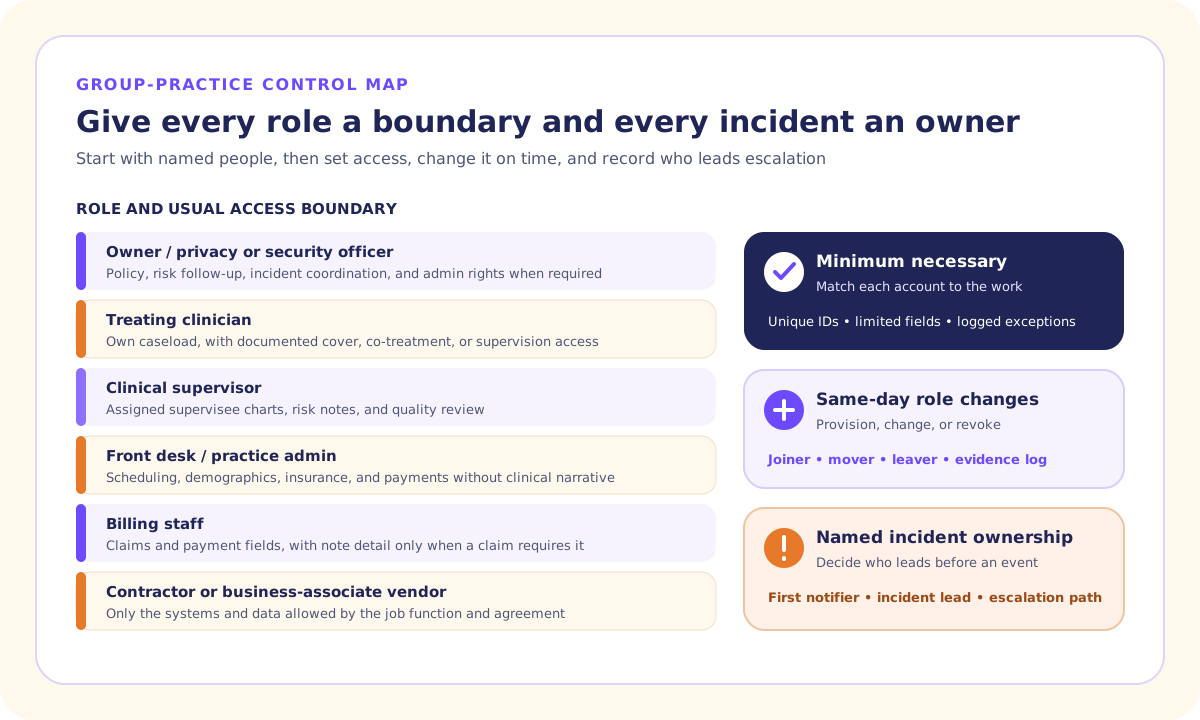
Add specialty roles your practice actually has: utilization review, quality improvement, student trainees, PRN coverage, or an external medical director. Do not invent roles you do not staff. Do not leave “everyone in the EHR” as an unspoken seventh role.
When session audio, transcripts, and note drafts enter the stack, evaluate HIPAA-compliant AI transcription and map who can open each copy. Keep this page for role inventory and incident ownership; use that guide for transcription procurement.
Set minimum-necessary access by role
The Privacy Rule’s minimum necessary standard expects covered entities to limit uses, disclosures, and requests for PHI to what the job needs. For internal uses, that means policies that identify workforce classes, the categories of PHI each class needs, and the conditions of access. For HIPAA for group practices, that standard is the difference between a shared clinic login and a defensible access map.
Translate that into group practice terms:
- Clinicians open their assigned charts. Coverage and co-treatment expand access with a documented reason, not a permanent “all charts” switch.
- Supervisors see supervisee panels and risk flags. Broad all-clinic clinical access is a deliberate design choice, not a default EHR toggle.
- Admin and billing get the fields their tasks require. If the front desk only needs the next appointment and balance, the full progress-note body stays closed.
- IT and contractors get system administration rights without standing clinical read access. Break-glass clinical access is rare, logged, and reviewed.
- Vendors receive only what the business associate agreement and implementation actually require. A notes vendor does not need your full billing export by default.
Write the access matrix in the same document your security officer can defend in a review. The downloadable matrix at the end of this page is built for that purpose.
Run joiner, mover, and leaver on the same day
Group practices lose control between HR moments and IT moments. Fix the sequence, not just the form.
Joiner
- Role and manager named before any account is created.
- Unique user identity provisioned in EHR, email, telehealth, billing, and shared drives.
- Training completed and logged before live ePHI access.
- Assess whether the person is outside the workforce and handles PHI on the practice’s behalf for a covered function; if so, sign the required business associate agreement before disclosure, unless a HIPAA exception applies.
- Access scope matches the role table, not a copy of a peer’s over-broad profile.
Mover
- Role change request names old scope and new scope.
- Remove old rights the same day the new role starts.
- Notify the clinical supervisor when chart panels change.
- Re-check shared mailbox, vault, and device encryption on the new path.
Leaver
- Disable accounts on the last working day, including SSO, EHR, email, telehealth, billing, and password vaults.
- Recover devices, badges, and MFA tokens.
- Rotate credentials the leaver knew, including shared owner vaults that should not have been shared.
- Confirm no personal forwarders or local chart exports remain.
- File an exit access log with date, systems, and who performed the revocation.
A leaver who still opens the EHR on Tuesday is not a technology failure. It is an ownership failure.
Name incident ownership before you need it
When something goes wrong, the chart does not need a seminar on breach definitions. It needs a person who leads.
Build a simple ownership matrix for the events groups actually see:
| Event type | First notifier | Incident lead | Escalates to |
|---|---|---|---|
| Lost or stolen device | Discoverer | Security officer | Owner and counsel |
| Wrong-recipient email, fax, or portal message | Discoverer | Privacy officer | Owner and counsel |
| Vendor or business associate incident notice | Security officer | Security officer | Owner, counsel, insurer |
| Suspected insider snooping | Supervisor or peer | Privacy officer | Owner and HR |
| Ransomware or multi-user outage | IT lead | Security officer | Owner, counsel, insurer |
The lead documents discovery time, systems touched, containment steps, and who was notified. Whether an event is a reportable breach is a later risk-assessment question. Do not ask the front desk to decide federal notification thresholds alone. For the therapist-facing response path after a suspected incident, use the HIPAA breach notification guide for therapists.
Administrative, physical, and technical controls that scale
Administrative
- Written policies for access, sanctions, contingency planning, and business associate management.
- A current risk analysis that names real systems your group uses, not a generic clinic template from five years ago.
- Workforce training on hire and when roles or tools change, with attendance logged.
- A sanctions path that is applied when policy is ignored, including well-liked clinicians.
Physical
- Locked chart storage and device storage when paper still exists.
- Screen privacy in shared offices and open admin bays.
- Visitor controls for areas where ePHI is visible.
- Secure disposal for paper and retired drives.
Technical
- Unique user IDs and MFA on EHR, email, and telehealth.
- Automatic logoff and encryption on laptops and phones that hold ePHI.
- Audit logs reviewed on a cadence the security officer can describe.
- Transmission protection for email and file transfer when PHI must leave the EHR.
- Backup and recovery tested enough that a Monday outage does not become a week of lost notes.
HHS summarizes these Security Rule expectations for regulated entities, including workforce security, information access management, and access control. Pair the federal baseline with your state licensing board’s record and confidentiality rules.
Vendors, BAAs, and multi-clinician tools
Every tool that touches group PHI sits on one of two sides of the table: inside your workforce, or under a business associate agreement. Scheduling, notes, billing, telehealth, e-fax, transcription, AI documentation, and cloud storage almost always need a written BAA when a vendor handles PHI for you.
Group-specific checks:
- Confirm the BAA names your legal entity and the vendor entity that actually processes data.
- Confirm subcontractor flow-down if the vendor uses subprocessors.
- Confirm incident notice timing and your right to cooperate on risk assessment.
- Confirm termination, return, and destruction of PHI.
- Confirm whether the product supports role-based access that matches your matrix, not one shared clinic login.
Product security pages are useful context for how a vendor designs controls. They do not replace your BAA review or your internal access design.
Training, sanctions, and the annual review
A matrix that nobody reviews becomes fiction. Put four recurring jobs on the calendar:
- On hire and role change: short role-specific HIPAA orientation, not a generic video with no attendance record.
- After tool changes: when you add a notes platform, AI scribe, or billing vendor, retrain the people who will use it.
- After incidents: close the loop with the people involved and update the matrix if ownership was unclear.
- Annual access review: every named user, every elevated right, every contractor account, every shared mailbox.
Sanctions policy is part of the control set. If a clinician looks up a neighbor’s chart without a treatment relationship, the response has to be documented. A policy that is never applied does not protect the practice.
How Emosapien fits a group HIPAA workflow
Emosapien is therapy software for multi-clinician practices, not a generic medical scribe. In a group setting it supports the controls this guide describes in three practical ways:
- Clinician-controlled documentation. Draft notes stay under clinician review and sign-off. The treating clinician remains accountable for the record.
- Team workflow without shared mystery accounts. Group practices can standardize note structure and supervisor review without collapsing everyone into one login pattern.
- BAA-backed product path. A business associate agreement is available on Professional and Enterprise plans. Security controls include encryption in transit and at rest, and session content is not used to train public models. Details live on the security page.
Software does not replace your privacy officer, your access matrix, or your counsel. It should make the role boundaries easier to keep. If you want to test documentation support inside a review-first group workflow, start a free trial.
Download the role and access matrix
The printable matrix is the artifact that makes HIPAA for group practices operational: blank rows for the six core roles, joiner-mover-leaver steps, and incident ownership fields your security officer can fill in a single sitting. Complete it with real names, then schedule the annual access review before the sheet goes stale.
Free PDF: Group Practice HIPAA Role and Access Matrix
A printable multi-clinician HIPAA worksheet: six-role inventory, minimum-necessary access, joiner-mover-leaver steps, and incident ownership.
- Six-role inventory with ePHI scope and access boundaries
- Minimum-necessary access map for shared clinic systems
- Same-day joiner, mover, and leaver checklist fields
- Named incident lead, backup, and escalation path block
Free. We'll email the PDF link right away and add you to the therapist toolkit, sent every two weeks. Unsubscribe any time.
Where should we send the link?
We'll email the PDF link right away. You'll also get the therapist toolkit every two weeks. Unsubscribe any time.
✓ Check your inbox
We've sent you the PDF
The download link is on its way to your inbox, usually within a minute or two. The email will come from Emosapien (hello@team.emosapien.com); check your spam folder if you don't see it.
You're also on the therapist toolkit list, sent every two weeks. Unsubscribe any time from the email footer.
Closing checklist
- Name a privacy or security officer and a backup.
- Inventory owner, clinician, supervisor, admin, contractor, and vendor roles with real people under each.
- Write minimum-necessary ePHI scope per role and enforce it in the EHR.
- Run joiner, mover, and leaver the same day the relationship changes.
- Publish an incident ownership matrix before the next lost laptop.
- Assess business-associate status and sign and file BAAs before PHI moves to a business associate; do not require a BAA where a HIPAA exception applies.
- Train on hire and on tool change; log attendance.
- Review every elevated account at least annually.
HIPAA for group practices is the discipline of knowing who holds which keys, and who picks up the phone when a key is lost. Build the map once, keep it current, and treat delayed offboarding as a clinical-risk event, not an IT backlog item.
References
- U.S. Department of Health and Human Services. Summary of the HIPAA Privacy Rule and the Minimum Necessary Requirement.
- U.S. Department of Health and Human Services. Summary of the HIPAA Security Rule (administrative, physical, and technical safeguards; workforce security; information access management; access control).
- U.S. Department of Health and Human Services. Breach Notification Rule and Business Associates.