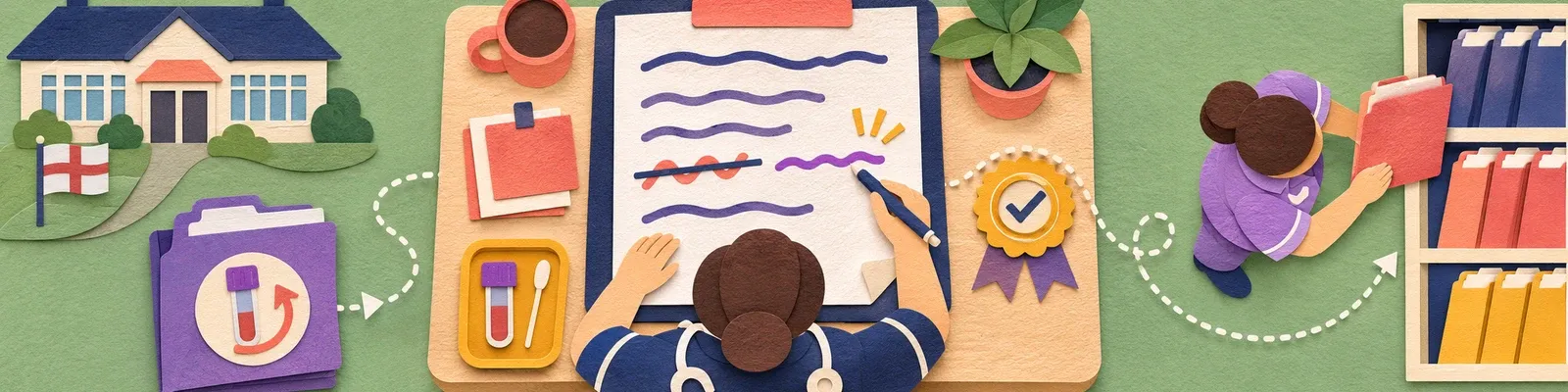
CQC AI Guidance: Can Your Service Trace a Scribe Error?

Outline
Two notes, one unresolved review
Your sample finds two drafts with a statement about a safety discussion that the treating clinicians cannot substantiate. For sample A, Dr Ellis reviewed the draft, removed the statement before signing, and recorded the correction in the service’s quality system. The client was offered a non-digital route, and the decision appears in the clinical record. Your learning sheet holds only a reference and a non-identifying description of the error.
For sample B, the statement appears in the signed record, but the evidence does not establish who reviewed it. You mark review as unknown and escalate; you do not invent a signature. You refer the record to the treating team under your service’s incident and chart-correction process. The clinical lead owns follow-up and sets an escalation deadline under local policy. You check whether a non-digital route was offered and where the decision was recorded; until confirmed, both are unknown. Next week, a reviewer independent of the first sample checks a new selection for unsupported statements, evidence of review, and recorded choice. You record what changed, including an inconclusive result. Keep identifiable content in the appropriate clinical and incident systems, not on the learning sheet.
Trace and follow up errors
Use the sheet this week to assign a reviewer, owner, and next sample.
- Client Recorder Request and Response Card and Scribe Feature Change: Intended-Use Comparison
- Changed Scribe: Australian Choice Preparation Sheet for planning the discussion and separate signed record
- England Scribe Error Trace and Follow-Up Sheet and Ontario RP AI-Assistance Attribution Card
- NZ Ambient Note: Observation Add-Back Card
Free. We'll email the PDF link right away and add you to the therapist toolkit, sent every two weeks. Unsubscribe any time.
Where should we send the link?
We'll email the PDF link right away. You'll also get the therapist toolkit every two weeks. Unsubscribe any time.
✓ Check your inbox
We've sent you the PDF
The download link is on its way to your inbox, usually within a minute or two. The email will come from Emosapien (hello@team.emosapien.com); check your spam folder if you don't see it.
You're also on the therapist toolkit list, sent every two weeks. Unsubscribe any time from the email footer.
Decide what happens to each record
Use the CQC AI guidance, updated May 21, 2026 and checked November 2026, to consider human oversight, transparency and choice, monitoring, and governance in your regulated service in England. CQC does not assess or approve specific technologies. Set your sampling frequency and evidence requirements according to your service’s risk assessment; CQC does not prescribe the weekly schedule above, and AI use does not predict a rating.
Start by separating an unsigned draft from an entry already in the record. Ask the treating clinician to compare the statement with what can be supported, while following your service’s incident and correction processes. An error with potential safety implications needs appropriate clinical escalation, not just a mark on an audit sheet. Where the record does not establish review, record the gap and escalate it; do not infer that a signature proves a particular review took place.
When you apply CQC AI guidance, trace the person’s choice separately from the note correction. CQC says people should receive appropriate information about AI’s role and that non-digital routes to care should be offered if needed. Check whether the route was offered and where the decision was recorded. If evidence is missing, record it as unknown and assign someone to establish the facts rather than reconstructing a conversation.
For lawful processing and vendor checks, use GDPR for therapists in the UK; for consent layers, use GDPR consent for therapy. This is educational information, not legal advice; confirm unresolved regulatory questions with CQC or the relevant regulator.
CQC AI guidance is relevant to your service when you investigate how a tool affects care, rather than treating a completed draft as evidence that the workflow is safe. Decide who can examine the original material, who will make the clinical correction, and who will follow the investigation through to closure. A quality lead may coordinate those roles without taking over the treating clinician’s judgment.
Before you close an incident, check the clinical consequences of the unsupported statement. Could another practitioner rely on it when deciding what to do next? Ask the treating team to assess that question using the information available to them. If the issue affects current care, your service’s clinical escalation route takes precedence over the next routine sample. Do not wait for a quality meeting to assign the immediate clinical response.
You can read how Emosapien works before deciding whether its drafting workflow fits your service.
Where a draft has not been signed, the treating clinician can check and edit it before signing in accordance with the service’s procedure. If a statement has entered the signed record, follow the service’s chart-correction process. Record who owns each action and when they will report back. Do not silently remove an entry or treat the learning sheet as the corrected clinical record.
Keep a trace, not another clinical record
For each sample, keep a reference and a non-identifying description of the observed error. Record whether it was caught before signing, after signing, or at an unknown point; the evidence of review; whether a non-digital choice was available and where that decision is recorded; the correction or incident owner and escalation deadline; and the next sample date, reviewer, and change observed. Store linked records in their authorized systems under your service policy. Restrict the learning sheet to references rather than identifiable content.
Agree on follow-up before closing the initial investigation. Select next week’s records using a documented local approach, name a reviewer, and state what you will look for. A small sample shows that the check was carried out, but cannot establish that every note is accurate. If the error recurs, or records still do not establish review, escalate under your service’s governance process and decide whether the workflow needs to pause or change.
Your reviewer should record how the next selection was made, not just how many notes were checked. For example, the reviewer might choose a defined set of sessions from the next working week and note which roles or teams were included. Keep the selection method proportionate to your service and local risk assessment. If the sample is too small or access to a record is unavailable, record that limitation alongside the result.
Compare like with like where possible. Ask whether the specific unsupported safety statement recurs, whether clinicians’ review can be established, and whether the record shows the choice offered. Distinguish an absent statement from missing evidence of review: they are different observations and need different follow-up. Do not count an unavailable record as a clean record.
Emosapien’s Scribe Agent drafts the note from the session; the treating clinician reviews, edits, and signs every note. Your service reviewer still uses your own incident procedure and sample sheet.
Decide what your next sample means
If the reviewer finds another unsupported statement, record the reference, assign the treating team to assess it, and use your service’s escalation route. Compare it with the earlier error without copying client details into the learning sheet. A similar wording may justify examining whether staff need a change to their checking routine, but it does not by itself establish the cause. Ask the people involved what happened and document the evidence available.
If no repeat appears, record that result with the selection and its limitations. It does not prove that other records are accurate or that the tool cannot make a different mistake. Agree who will review the finding and whether further sampling is appropriate under your service policy. If the review cannot be completed on the planned date, assign a new date and record why.
Close the loop with the person responsible for governance. Confirm that clinical correction and any incident actions have owners, that the owners have reported their outcomes, and that outstanding questions have a deadline. Where evidence is missing, keep the issue open or escalate it according to local policy. Your record of the decision should make it possible to tell an incomplete investigation from a completed one.
Review and sign every note yourself
You remain responsible for deciding whether each statement is supported before signing. Use your incident and correction route when you find a problem later, and ask the vendor for evidence of any local requirement your decision depends on.
Review and sign the next sampled session note
Keep your clinical judgment in charge of every draft.
Review notes- Clinician sign-off
- SOC 2 Type II audited infrastructure
Session detail
The client described one step to try this week.
Draft note
Check each statement against the session before signing.
References
- Care Quality Commission, Artificial intelligence in health and social care: CQC’s role, expectations and plans, updated May 21, 2026; checked November 2026.
Related reading
AI Therapy Documentation Ethics: A Clinician Decision Guide
Use AI in therapy documentation ethically: compare professional duties, plan client consent, check drafts, and protect privacy before signing.
Read article →Australian Psychological Society AI: Client Recording
Respond to a client’s AI recording request with a discussion of purpose, recipients, privacy risks, alternatives, and a documented decision.
Read article →Free PDF: AI Scribe Governance Sheets for Australia, the UK, Canada and New Zealand
Six printable sheets for documenting recorder requests, changed scribe choices, feature decisions, note errors, AI attribution, and observation review.
- Client Recorder Request and Response Card and Scribe Feature Change: Intended-Use Comparison
- Changed Scribe: Australian Choice Preparation Sheet for planning the discussion and separate signed record
- England Scribe Error Trace and Follow-Up Sheet and Ontario RP AI-Assistance Attribution Card
- NZ Ambient Note: Observation Add-Back Card
Free. We'll email the PDF link right away and add you to the therapist toolkit, sent every two weeks. Unsubscribe any time.
Where should we send the link?
We'll email the PDF link right away. You'll also get the therapist toolkit every two weeks. Unsubscribe any time.
✓ Check your inbox
We've sent you the PDF
The download link is on its way to your inbox, usually within a minute or two. The email will come from Emosapien (hello@team.emosapien.com); check your spam folder if you don't see it.
You're also on the therapist toolkit list, sent every two weeks. Unsubscribe any time from the email footer.