
Digital Therapeutics Depression Guide for Therapists

Outline
Authored by Andrew Evans, a clinical psychologist in private practice who writes about putting emerging technology next to therapy without letting it take over the hour or client privacy.
The client forwards a clinic portal message: a software program for depression, possibly “FDA cleared,” possibly billed to insurance, possibly something they already downloaded. You still have 12 minutes in the hour. The question is not whether software can be useful. The question is whether this product is a regulated treatment, a homework container, or marketing wearing a clinical coat.
A digital therapeutics depression program is health software that claims to treat or alleviate depression by generating and delivering a medical intervention. Licensed therapists and mental-health clinicians running outpatient talk therapy walk this due-diligence matrix before they enroll a client. Emosapien is not one of those programs.
The six rows below carry the due-diligence questions. The PDF is the same matrix plus a clinician card you can keep in the chart.
Email me the due-diligence matrix
Get the Digital Therapeutics Depression Due-Diligence Matrix: six evaluation rows plus a clinician card with class split, documentation and privacy prompts, and stop rules.
- Six evaluation rows: evidence, regulatory status, workflow fit, monitoring burden, access, and client selection
- Clinician card with class split, documentation prompt, privacy prompt, and stop rules
- Footer that this is not a treatment, diagnosis, crisis service, or an Emosapien DTx
Free. We'll email the PDF link right away and add you to the therapist toolkit, sent every two weeks. Unsubscribe any time.
Where should we send the link?
We'll email the PDF link right away. You'll also get the therapist toolkit every two weeks. Unsubscribe any time.
✓ Check your inbox
We've sent you the PDF
The download link is on its way to your inbox, usually within a minute or two. The email will come from Emosapien (hello@team.emosapien.com); check your spam folder if you don't see it.
You're also on the therapist toolkit list, sent every two weeks. Unsubscribe any time from the email footer.
What this pack is and is not
Use this pack when a vendor, payer, or client is asking you to enroll someone in a software treatment for depression.
It is not:
- a consumer list of “apps for depression”
- a shortlist of apps to recommend to therapy clients
- a PHQ-9 administration lesson
- a reprint of the measurement based care loop
- a paper weekly tracker or bipolar chart
- a crisis protocol
- an Emosapien product sheet
If the live job is one finishable homework task, use between session activities depression and keep software off the table until the task itself is small enough to finish. When that homework is acting opposite the emotion rather than a software trial, use an opposite action rehearsal.
Class split before you shortlist
Name the class first. Scope this matrix to regulated software that claims to treat depression. FDA defines software as a medical device (SaMD) more broadly as software intended for a medical purpose. That class is not the same as a depression DTx.
| Class | What it claims to do | Typical watch burden | Where it belongs |
|---|---|---|---|
| Homework or wellness app | Holds one agreed task (grounding, a journal cap, a reminder) | You reopen it next session; nobody is on call | Client-app recommendation sheet |
| Guided iCBT homework | Skills practice the therapist already framed, with no treatment claim on the label | Partial modules return as clinical information, not an alert desk | Homework plan unless labeling claims to treat depression |
| Regulated software that claims to treat depression | Treat or alleviate depression as labeled; a PDT may still include CBT-based lessons | Labeling decides who orders it and what is not monitored in real time | Due-diligence matrix |
| Hardware neuromodulation | Clinic or home device, not a phone program | Device clinic protocols, not an app sheet | Device clinic protocol |
| Engagement check-in | Between-session questions, journaling, homework tied to the last hour | Digest at the next appointment; not overnight monitoring | Continuity workflow, not a DTx |
| Crisis protocol | Safety plan, local emergency path, supervision | Immediate, named humans | Stop. Do not enroll in software. |
Intended use and labeling, not CBT content alone, decide whether guided iCBT stays homework or enters this due-diligence work.
Scroll the visual sideways to view the full diagram
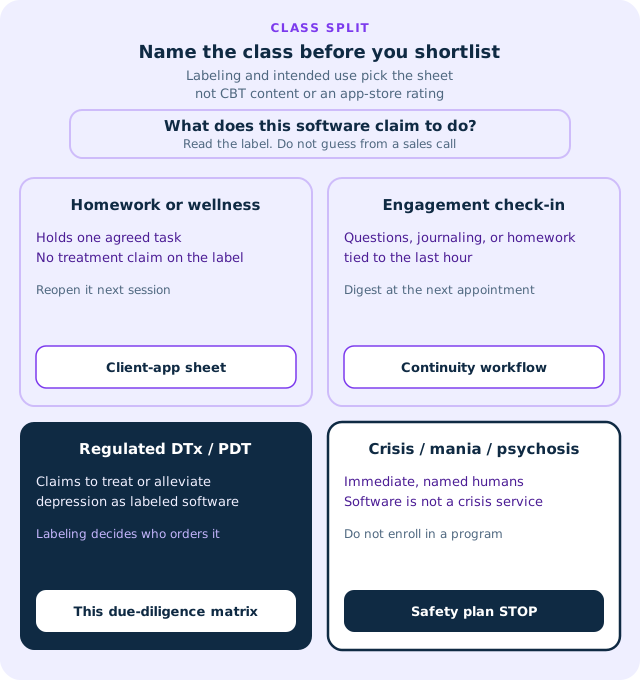
The Digital Therapeutics Alliance definition is software intended to treat or alleviate a disease or condition by delivering a medical intervention with a demonstrable therapeutic impact. Many jurisdictions treat that software as a medical device. A five-star app-store listing does not meet that bar.
APA Practice treats digital therapeutics as a distinct class from wellness and mobile-health tools, and notes that who may order a cleared product follows device labeling rather than a state medication-prescribing statute (digital therapeutics and mobile health). Check the current label. Do not guess from a sales call.
The digital therapeutics depression matrix
Walk these six rows from labeling, trial publications, and a privacy packet you actually opened. Date the check. Clearance and coverage move.
Evidence
Ask what trial design, comparator, population, endpoint, and duration sit behind the claim.
- RCT with an active or sham comparator, or a single-arm marketing quote
- Whether the endpoint is a named depression measure (for example MADRS or PHQ-9 scores the vendor reported), not “users felt better”
- Who the trial excluded: suicidality, bipolar, psychosis, age band, comorbid SUD
- Whether the published population matches this outpatient client
Blank or paywalled evidence is information. Do not fill it with a podcast endorsement.
Regulatory status
Separate wellness app, FDA-authorized software as a medical device or prescription digital therapeutic, unregulated chatbot, and hardware neuromodulation. Record:
- Who may order it, as written
- Adjunct versus stand-alone labeling
- Age band
- The as-of month and year you checked
Class example, not a ranking: Rejoyn received FDA 510(k) clearance K231209 on 30 March 2024 as a prescription digital therapeutic for MDD symptoms as an adjunct to clinician-managed outpatient care for adults aged 22 years and older who are on antidepressant medication (FDA 510(k) K231209). That labeling is specific. It does not make every depression app a medical device, and it does not make Emosapien one.
Workflow fit
Write down what you still do if this product sits beside therapy: introduction, consent, mid-program review, stop. Ask whether the product dumps alerts into your inbox, whether it expects you to replace a session, and whether missed modules wait until the next hour. A product that replaces the hour is a different clinical decision than a product that sits beside it.
Monitoring burden
Count hours, not slogans.
- Who watches (you, a vendor coach, nobody named)
- How often a dashboard is meant to be opened
- What is not monitored between sessions, including nights and weekends
- How a missed module is handled
- How risk language in the product is escalated, if at all
- What a blank week means in the next session
Do not generalize from a sales dashboard. Rejoyn’s FDA 510(k) K231209 states the device has no physician portal, does not monitor symptoms or clinical status, and cannot send alerts or warnings to the prescriber. Reopen the work yourself in the next session, as in tracking therapy progress between sessions, rather than relying on a promise that software is watching.
Access
Record the order or prescription path, payer coverage as of this month, device and language requirements, age band, caregiver involvement, and cash-pay cost if coverage is absent. Do not invent a coverage guarantee. CMS finalized Medicare payment for qualifying digital mental health treatment devices and three new HCPCS codes in the Calendar Year 2025 Physician Fee Schedule (CMS CY 2025 PFS final rule fact sheet). CMS names those codes G0552, G0553, and G0554 in Claims Processing transmittal 12975. A Medicare code is not the same as this client’s plan paying today.
Client selection and stop
Fit looks like: an outpatient client already in care, depression is the live problem, the client can complete the program on a device they already use, and consent is documented.
Stop when:
- active crisis, mania, or psychosis
- coercive partner or custody misuse of the device or data
- no BAA when HIPAA applies and PHI would move to a vendor acting as a business associate
- the actual job is a paper tracker or a PHQ-9
- the product claims to replace the therapist
- you cannot name what you will review next session
Each digital therapeutics depression row is a question you can answer from labeling and trial materials, not from a sales deck.
Monitoring burden and next-session reopen
Treat the week as complete, partial, abandoned, or alerting.
Complete. Name what changed in mood, function, or skill use. Decide continue, pause, or stop.
Partial. Shrink before you add a second program. Ask what blocked modules: time, literacy, shame, device, or the program itself.
Abandoned / blank. Blank use is information about burden and fit. It is not proof of resistance.
Alerting. If the product surfaced risk language, follow your existing safety path. Do not treat a push notification as a completed risk assessment.
Write one line in the note: class chosen, what will be reviewed, and what is not watched in real time.
Privacy and BAA
When HIPAA applies and a vendor creates, receives, maintains, or transmits PHI as a business associate for a covered entity, you need a signed business associate agreement on the plan that will handle that data before enrollment. Consumer apps the client holds alone are a different privacy problem; they still are not a free pass to put diagnoses into a chatbot.
Use the practice’s approved secure communication channel for PHI. Do not create ad hoc consumer email or SMS side channels for module summaries. HIPAA does not categorically ban provider-patient email: HHS FAQ 570 permits email, including unencrypted email, when reasonable safeguards and Security Rule requirements are applied. The safer workflow is still the approved channel, not a side inbox. No consumer AI tools as a side channel for module summaries. If the live job is the contract clauses, take that to your BAA review. The matrix decides whether the product belongs in care at all.
Where Emosapien fits
Emosapien keeps between-session check-ins, journaling, and modality-aligned homework visible at the next appointment. Engagement Agent auto-schedules measures. The client app holds measures, journaling, and check-ins. A Business Associate Agreement is available on Professional and Enterprise, not Free.
That is continuity work. It is not a regulated digital therapeutic, a PDT, software as a medical device, or an FDA-cleared depression treatment. Emosapien does not watch the week in real time, does not diagnose, and does not replace your safety plan.
Keep the week visible without a software treatment
Emosapien holds check-ins, journaling, and homework so the next hour starts with a picture. That is not a digital therapeutic.
client engagement between sessionsHow to use the printable matrix
Pages 1 to 2: six rows. Product name, vendor, as-of date, evidence, regulatory status, workflow fit, monitoring burden, access, client-selection decision (consider, trial with boundaries, do not enroll).
Page 3: clinician card. Four-line class split (homework app / engagement check-in / regulated DTx / crisis protocol). Documentation prompt: why this class, what will be reviewed, what is not watched in real time. Privacy prompt: BAA if PHI moves; no consumer AI; use the practice’s approved secure channel for PHI, not an ad hoc consumer email or SMS side channel. The card states that it is not a treatment, not a diagnosis, not a crisis service, not monitored in real time by Emosapien, and not an Emosapien DTx.
Print in grayscale. Leave blank fields blank until you have opened a source. The sheet is a decision record, not a vendor ranking.
Stop adding a digital therapeutics depression program when the live job is crisis, mania, psychosis, missing consent, or a paper task.
Email me the due-diligence matrix
Get the Digital Therapeutics Depression Due-Diligence Matrix: six evaluation rows plus a clinician card with class split, documentation and privacy prompts, and stop rules.
- Six evaluation rows: evidence, regulatory status, workflow fit, monitoring burden, access, and client selection
- Clinician card with class split, documentation prompt, privacy prompt, and stop rules
- Footer that this is not a treatment, diagnosis, crisis service, or an Emosapien DTx
Free. We'll email the PDF link right away and add you to the therapist toolkit, sent every two weeks. Unsubscribe any time.
Where should we send the link?
We'll email the PDF link right away. You'll also get the therapist toolkit every two weeks. Unsubscribe any time.
✓ Check your inbox
We've sent you the PDF
The download link is on its way to your inbox, usually within a minute or two. The email will come from Emosapien (hello@team.emosapien.com); check your spam folder if you don't see it.
You're also on the therapist toolkit list, sent every two weeks. Unsubscribe any time from the email footer.
References
- American Psychological Association. Digital therapeutics and mobile health. Practice overview of DTx versus wellness tools, ordering, and psychologist role. Checked August 2026.
- Centers for Medicare & Medicaid Services. Calendar Year (CY) 2025 Medicare Physician Fee Schedule Final Rule (1 November 2024). Medicare payment for qualifying digital mental health treatment devices and three new HCPCS codes; not a coverage guarantee for this client.
- Centers for Medicare & Medicaid Services. Claims Processing transmittal 12975 (21 November 2024). Names HCPCS G0552, G0553, and G0554 for digital mental health treatment devices; not a coverage guarantee for this client.
- Digital Therapeutics Alliance. What is a DTx?. DTx definition and core principles. Checked August 2026.
- U.S. Department of Health and Human Services. Does the HIPAA Privacy Rule permit health care providers to use e-mail to discuss health issues and treatment with their patients? (FAQ 570). Email, including unencrypted email, is permitted with reasonable safeguards and Security Rule compliance; it is not a categorical ban. Checked August 2026.
- U.S. Food and Drug Administration. 510(k) K231209, Rejoyn (decision date 30 March 2024). Class example of adjunct PDT labeling for MDD, including no physician portal and no alerts to the prescriber. Inclusion is not endorsement.
Closing
Keep the digital therapeutics depression decision in the chart as a class choice, a review date, and what you will not watch in real time. If you cannot name those three, do not enroll.