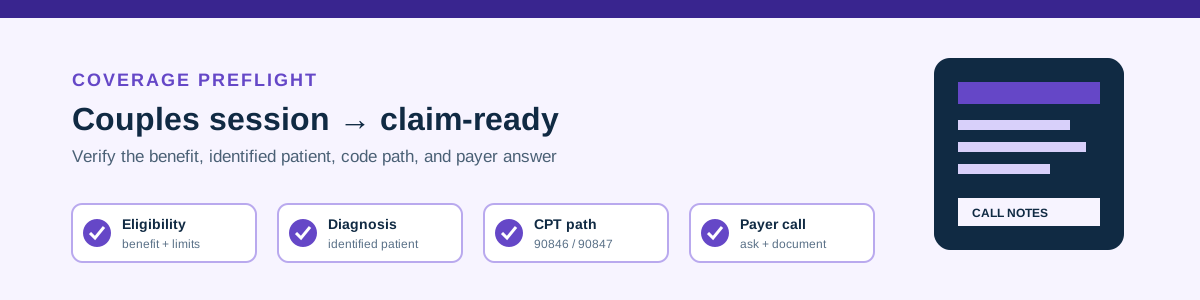
Does Insurance Cover Couples Therapy? A Clinician Preflight

Outline
Coverage preflight worksheet
| If the hour is | Code path to verify | Documentation fact to keep visible |
|---|---|---|
| Family or couple psychotherapy with the identified patient present | 90847 | Patient presence, participants, treatment target, intervention, and response |
| Family psychotherapy without the identified patient present | 90846 | Patient absence, participants, patient-centered purpose, intervention, and family response |
The short answer to “does insurance cover couples therapy?” is: sometimes, and never from the CPT number alone. Couples therapy insurance coverage needs a member-specific benefit answer, a covered patient and diagnosis, a service that matches the code description, and documentation that supports the treatment decision.
This guide is for licensed US clinicians and the billing staff who support them. It separates the clinical coding decision from the eligibility call. It does not guarantee reimbursement, select a diagnosis for you, or replace a payer contract, current policy, trained biller, or legal advice.
Verify the current descriptor, the service delivered, and the payer policy before you select a code. Then fill one couples therapy insurance worksheet per couple before you schedule a covered conjoint session. Copy it into the chart or print it, and keep one field per line.
Download the insurance billing preflight
Get the printable eligibility, authorization, pre-submit, and denial-handoff worksheet for your practice.
- Six-stage claim lifecycle map for therapy practices
- Eligibility, authorization, intake, and pre-submit checklists
- Denial ticket with owner, class, due dates, and root-cause fields
- Fifteen-minute weekly billing stand-up close sheet
Free. We'll email the PDF link right away and add you to the therapist toolkit, sent every two weeks. Unsubscribe any time.
Where should we send the link?
We'll email the PDF link right away. You'll also get the therapist toolkit every two weeks. Unsubscribe any time.
✓ Check your inbox
We've sent you the PDF
The download link is on its way to your inbox, usually within a minute or two. The email will come from Emosapien (hello@team.emosapien.com); check your spam folder if you don't see it.
You're also on the therapist toolkit list, sent every two weeks. Unsubscribe any time from the email footer.
What couples therapy insurance coverage actually asks
A payer is not deciding whether the relationship is important. The payer is applying the member’s benefit design and policy to a billed service for an identified patient. Your preflight therefore has six separate questions:
- Is the member eligible on the date of service?
- Does the plan include the relevant outpatient behavioral-health benefit?
- Is this clinician in network, or is out-of-network reimbursement available?
- Who is the identified patient, and what condition is being treated?
- Does the session match the family psychotherapy code descriptor and the payer’s policy?
- Is authorization, referral, a modifier, or a special claim field required?
Treat each answer as a fact to verify, not as an assumption to carry from a different plan. The insurance billing for therapists workflow has the broader eligibility, authorization, remittance, and denial loop. This page focuses on the two-adult or family psychotherapy decision inside that loop.
CPT 90846 and 90847 are service descriptors, not coverage promises
The AMA CPT overview is the primary reference point for current CPT terminology. Payer materials commonly describe 90846 as family psychotherapy without the patient present and 90847 as family psychotherapy with the patient present. For example, a current UnitedHealthcare public fee schedule lists those descriptors and lists 90847 as family/couple psychotherapy in that schedule (UnitedHealthcare 2026 behavioral-health fee schedule).
Use the descriptor that matches the service you actually delivered. Do not choose 90847 because two adults were in the room, or 90846 because a partner called in. First decide the clinical service, who was present, and who the identified patient is. Then verify the payer’s rules and the current CPT descriptor.
| If the hour is | Code path to verify | Documentation fact to keep visible |
|---|---|---|
| Family or couple psychotherapy with the identified patient present | 90847 | The patient was present, who else participated, the treatment target, intervention, and responses |
| Family psychotherapy without the identified patient present | 90846 | The patient was absent, who participated, the patient-centered treatment purpose, intervention, and family response |
| Individual psychotherapy with one partner | An individual psychotherapy code path, not automatically a family code | The individual service, time, diagnosis, and response |
| Relationship education or general communication coaching without treatment of a covered condition | Coverage is uncertain and may be excluded | The service was education or coaching, not a covered psychotherapy claim |
CMS’s Outpatient Psychotherapy billing and coding article states that 90846 and 90847 refer to family psychotherapy and are not history-taking or evaluation-and-management counseling services. It also describes the documentation expected for family psychotherapy without the patient present, including themes, interventions, participation, interaction, and changes or lack of changes in symptoms or behavior. Use that as a documentation check, not as a promise that every commercial plan follows Medicare rules.
Identify the patient before you talk about a diagnosis
“Couples counseling” describes the room. It does not by itself identify the patient on the claim. Before the first covered session, document:
- The person whose condition and treatment goals organize the episode of care
- Whether the relationship work is addressing that person’s condition
- The confidentiality and record-sharing frame for both partners
- Whether both partners consent to the conjoint work and understand the billing arrangement
- Whether one partner’s individual care is separate from the conjoint service
Do not invent a diagnosis to make a couples session payable. Do not submit a partner’s diagnosis simply because it is available in an old chart. The diagnosis must reflect the condition you are treating and the documentation you can support.
A relational diagnosis or contextual code may describe the presenting problem, but the payer may require a covered mental-health condition or may exclude relationship counseling. Ask the plan directly how it handles the identified patient, diagnosis, and family psychotherapy benefit. If the answer is unclear, route the question to your payer specialist or biller before scheduling the covered service.
Medical necessity: what the claim needs to connect
A defensible claim connects four things:
- The identified patient. Who is receiving treatment in the episode of care?
- The condition. What symptoms, functional impact, or diagnosed condition are you treating?
- The relational intervention. How did the partner’s participation help treat that patient’s condition?
- The response and plan. What changed, did not change, or needs to happen next?
CMS guidance for family psychotherapy says coverage is tied to treatment of the patient’s condition and distinguishes psychotherapy from taking a family history or providing general counseling. Its outpatient psychotherapy article is a useful public example of that medical-necessity frame.
Write what you observed and did. “Discussed communication” is too thin to connect the service to the patient’s care. “Used a structured turn-taking intervention to reduce the patient’s panic response during conflict; the patient practiced a pause and reported a lower urge to leave; partner followed the agreed cue” is a clinical record. Keep it accurate, concise, and attributable to the person who said or did it.
What named payers publish
Public payer pages show why a general internet answer is not enough. Policies and benefits vary by product, state, network, and date.
- Medicare. The CMS outpatient psychotherapy article describes family psychotherapy codes 90846 and 90847 and says family psychotherapy must be distinguished from history-taking or E/M counseling. It also describes patient-centered documentation for a session without the patient present. Start with the CMS billing and coding article, then check the applicable Medicare Administrative Contractor policy.
- UnitedHealthcare. A public 2026 Rocky Mountain Health Plans fee schedule lists 90846 as family psychotherapy without the patient present and 90847 as family/couple psychotherapy. That is a fee-schedule and product-specific publication, not a guarantee for every UnitedHealthcare plan. Read the UnitedHealthcare schedule and verify the member’s plan.
- Aetna. A public Aetna telemedicine payment policy lists family or group psychotherapy codes 90846, 90847, and 90853 among telemedicine services, with the applicable modifiers and policy conditions. It does not answer a member’s benefit or diagnosis question by itself.
The practical lesson is simple: cite the public policy you used, record the plan-specific answer, and do not turn one payer’s wording into a universal rule.
Eligibility call script for a couples session
Call the payer or use the provider portal before you promise that insurance will pay. Ask the questions in order so the answer maps to your claim fields.
An eligibility response is not a guarantee of payment. Save the date, source, reference number, benefit language, and any disclaimer in the billing record. If a portal gives only a generic “behavioral health covered” response, keep asking for the family or couple psychotherapy benefit and the plan-specific limitations.
Self-pay when insurance is not the right path
If the payer excludes couples counseling, the clinician is out of network, the identified patient or diagnosis does not fit the plan, or the client prefers not to use insurance, discuss self-pay before the session. Give the client a written estimate and financial policy. Do not describe a non-covered service as covered, and do not use a waiver to override a contract or law that restricts patient billing.
The self-pay conversation should state:
- The service being offered and the fee
- Whether the practice will submit a claim or leave it to the client
- What the client may owe if a claim is denied
- Whether a superbill is available and what it does not guarantee
- How the practice handles cancellations, balances, and changes in scope
The superbill template for therapy is the separate out-of-network document. It is not a payer claim and does not turn a non-covered couples session into a covered service.
Denial prevention and the handoff to billing
Before the session, hand billing the facts your future claim will need:
- Eligibility checked on the date and by whom
- Payer, plan, member ID, and subscriber relationship
- Identified patient and diagnosis carried consistently in the chart
- Participants and patient presence recorded
- Service delivered and time documented accurately
- Authorization number, units, or review date when applicable
- Payer call reference and the exact coverage limitation
- Client estimate or self-pay disclosure completed
After the remittance posts, compare the result with your preflight. If the payer denies the claim, classify the denial before changing anything. A wrong member ID is an intake fix. A missing authorization is a benefits workflow fix. A diagnosis or medical-necessity question needs clinician review. A code mismatch needs a documented correction, not a guess.
Never alter a signed note to make a denied claim look payable. If an addendum is allowed, label it with the actual date and follow the payer and practice policy. Keep the original record intact.
How this differs from couples therapy worksheets and progress notes
A couples therapy worksheet helps partners practice a skill. A couples therapy progress note template records the clinical hour. This guide answers a different operational question: whether the proposed service has a verified insurance path, what patient and diagnosis the claim is organized around, and what you need to ask before the session.
Do not put a coverage promise inside a worksheet. Do not turn a claim-preflight answer into a treatment-plan decision. Keep the clinical, billing, and client-financial records connected but distinct.
Download the insurance billing preflight worksheet
The Insurance Billing Preflight and Denial-Handoff Worksheet gives you a printable place to record the member and plan, eligibility response, authorization check, identified patient, pre-submit fields, denial class, owner, deadline, and weekly follow-up. Use it before a couples session and again when a claim needs a documented handoff.
Get the preflight and denial-handoff worksheet
Keep the eligibility answer, claim checks, and denial owner in one printable workflow.
- Six-stage claim lifecycle map for therapy practices
- Eligibility, authorization, intake, and pre-submit checklists
- Denial ticket with owner, class, due dates, and root-cause fields
- Fifteen-minute weekly billing stand-up close sheet
Free. We'll email the PDF link right away and add you to the therapist toolkit, sent every two weeks. Unsubscribe any time.
Where should we send the link?
We'll email the PDF link right away. You'll also get the therapist toolkit every two weeks. Unsubscribe any time.
✓ Check your inbox
We've sent you the PDF
The download link is on its way to your inbox, usually within a minute or two. The email will come from Emosapien (hello@team.emosapien.com); check your spam folder if you don't see it.
You're also on the therapist toolkit list, sent every two weeks. Unsubscribe any time from the email footer.
Closing checklist
- The member’s eligibility and behavioral-health benefit were checked for the date of service
- The clinician’s network status and the plan’s family or couple psychotherapy rules were verified
- The identified patient and treatment condition are documented
- The actual service and patient presence match the code path being verified
- Authorization, referral, modifiers, and visit limits were checked
- The payer source, call date, representative, and reference number are saved
- The client received an estimate or self-pay explanation before the session
- The signed note records participants, intervention, response, and plan without backdating
- The denial owner and appeal or correction deadline are clear if payment does not follow
Couples therapy insurance is a plan-and-service question, not a promise attached to a code. Insurance can support a couples session, but the coverage answer belongs to the member’s plan and the service you actually deliver. Run the couples therapy insurance preflight, document the uncertainty, and keep the clinician, biller, and client working from the same facts.
References
- American Medical Association. CPT overview and resources.
- Centers for Medicare & Medicaid Services. Billing and Coding: Outpatient Psychotherapy (A59723).
- UnitedHealthcare. Behavioral health value-based payments base fee schedule, effective January 2026.
- Aetna. Telemedicine and Direct Patient Contact Payment Policy.