
Activities for Drugs and Alcohol Awareness in Therapy Groups

Outline
Authored by Priya Mehta, Licensed Clinical Social Worker with eight years in addiction recovery and intensive outpatient programs.
A prevention hour can tilt fast. One member performs knowledge. Another gives advice. Silence reads as resistance. A mandated seat waits to be called on. The room is not asking for a scare talk, and it is not asking to become a recovery group tonight.
Activities for drugs and alcohol awareness are facilitator-led prevention and early-awareness psychoeducation for licensed therapists. They give the room shared language about risk before anyone is in treatment identity. They are not a recovery menu, not a Twelve-Step Facilitation protocol, and not a school kit.
The five in-room jobs are a risk continuum, trigger mapping, myths and facts, protective factors, and a referral debrief. Run those jobs in the circle. Download the facilitator pack when you want the sheets at the desk.
Email me the awareness facilitator pack
Get the continuum, trigger map, myths and facts, protective-factor sheet, and referral debrief. This is awareness psychoeducation, not a recovery program.
- Scope, risk continuum, pass option, and stop conditions
- Trigger map plus myths and facts with stigma checks
- Protective-factor map, referral debrief, and 60- and 90-minute time boxes
- Facilitation and documentation cues without a copied group paragraph
Free. We'll email the PDF link right away and add you to the therapist toolkit, sent every two weeks. Unsubscribe any time.
Where should we send the link?
We'll email the PDF link right away. You'll also get the therapist toolkit every two weeks. Unsubscribe any time.
✓ Check your inbox
We've sent you the PDF
The download link is on its way to your inbox, usually within a minute or two. The email will come from Emosapien (hello@team.emosapien.com); check your spam folder if you don't see it.
You're also on the therapist toolkit list, sent every two weeks. Unsubscribe any time from the email footer.
Educational resource for licensed mental-health clinicians facilitating outpatient, IOP, or psychoeducation groups. Awareness work does not diagnose, does not prevent substance use disorder by itself, and does not replace assessment, medical care, crisis protocols, or a treatment program. Adapt every activity to population, contract, risk, and culture.
Awareness versus recovery, RP, TSF, and psychoeducation
Name the job before you pick a tool. Use activities for drugs and alcohol awareness as a prevention hour. For the wider group directory, start with group therapy resources.
| Job in the room | Use |
|---|---|
| Shared language about risk before treatment identity | This awareness pack |
| Stage-matched treatment tasks | recovery group activities |
| Relapse-prevention exercises after the theme is locked | Relapse-prevention protocols, not this pack |
| Clinician-run Twelve-Step Facilitation | A TSF session plan, not awareness |
| Teach-practice-process arc across topics | psychoeducational groups |
| Individual motivational interviewing and personal planning | substance use counseling |
SAMHSA’s TIP 41 on group therapy keeps group work tied to structure, cohesion, and active facilitation. NIDA’s Principles of Drug Addiction Treatment keeps care individualized. SAMHSA recovery principles keep recovery person-driven and open to many pathways. This hour does not claim abstinence as the only valid goal.
When the hour fits
Use activities for drugs and alcohol awareness when the room needs shared language before anyone is wearing a treatment identity. Mixed outpatient or IOP rooms that include people who use, people who love someone who uses, and people who are not sure they have a problem are a common fit. A family-education adjunct inside a clinical contract can use the same hour if the contract is therapy, not a school assembly.
Mandated attendance is a dynamic, not consent to confess. Third-person and “someone I know” frames stay valid. A pass is data.
When to pause the hour
Stop, shrink, or switch when:
- Acute intoxication, withdrawal, or medical instability is in the room
- Someone is asking for treatment now and the circle starts to become an intake
- Coercion shows up: mandated confession, family pressure laundered into “honesty”
- Flooding, shame theater, or advice-giving that turns knowledge into a performance
- The room already needs relapse-prevention exercises, Twelve-Step Facilitation, or individual motivational interviewing. When the take-home is an integrated mood-and-use log rather than an awareness hour, use co-occurring disorders worksheets.
These are clinical holds. They are not a moral ranking of people who “are not ready.”
Five activities for drugs and alcohol awareness
Walk the five activities in order. Do not score anyone. Do not run a DARE script.
Scroll the visual sideways to view the full diagram
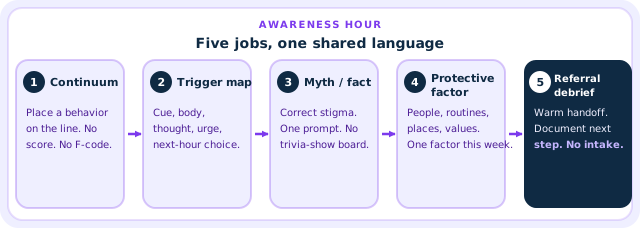
1. Risk continuum. Use a non-diagnostic continuum: no current use / experimental or situational / harmful pattern / dependent pattern. Members place a behavior, not a person, on the line. No scoring. No F-code. A pass or a third-person example is enough.
2. Trigger mapping. Cue, body, thought, urge, next-hour choice. Keep it awareness-sized. Do not restage a full relapse chain. The job is shared language, not a confession of last weekend.
3. Myths and facts. Eight to ten clinician-vetted items. Each item carries a myth, a plain fact, one discussion prompt, and one stigma check. Correct stigma around MAT and “hitting bottom.” Do not run a trivia-show board.
| Myth | Plain fact | Prompt | Stigma check |
|---|---|---|---|
| Tolerance means immunity | Higher tolerance often means higher dose and higher risk, not safety | What did “I can handle it” used to hide? | Do not praise high tolerance as strength |
| I can stop any time | Stopping once and staying stopped are different jobs | What made stopping last, when it lasted? | Curiosity beats a dare |
| Medication for addiction is substituting one drug | Medications are an important element of treatment for many patients, including medications for opioid and alcohol use disorders | What would change if medication counted as care? | Do not rank people who use MAT as less recovered |
| Real alcohol problems only count after hitting bottom | Waiting for collapse is not a clinical plan | Who taught the room that pain has to peak first? | Bottom stories are not the price of belonging |
| Young people bounce back from alcohol faster | Alcohol can interfere with brain development well into the 20s | What adult myth did you hear about “youth recovery”? | Do not minimize youth use as a phase |
| Overdose risk drops after a stretch without use | After quitting, a person can overdose on a previous opioid or other overdose-risk amount because the body is no longer adapted | What would you want a friend to know after a period without use? | A stretch without use is not a dare to test the old dose |
| Beer or wine is automatically safer than liquor | One US standard drink is about 14 g of pure alcohol: 12 oz regular beer at 5% ABV, 5 oz wine at 12% ABV, or 1.5 oz spirits at 40% ABV; a stronger 12 oz beer is not one drink | What does “it was only beer” protect in this room? | Do not let drink type become a moral rank |
| Talking about use makes people use | Silence is not prevention; interrogation is not teaching | What kind of talk actually shuts this room down? | Disclosure is material, not a trophy |
| One slip means the person failed treatment | A slip is information for the next step, not a verdict | What next step would you want named, not a speech? | Shame theater closes the hour |
| Asking for help means giving up | Help-seeking is a protective factor | Who is allowed to ask, and who gets mocked for it? | Do not treat help as weakness |
NIDA’s Principles of Drug Addiction Treatment names medications as an important element of treatment for many patients, including medications for opioid and alcohol use disorders. NIAAA’s underage drinking facts notes that alcohol can interfere with brain development well into the 20s. NIDA’s treatment and recovery guidance warns that after quitting, a person can overdose on a previous amount because the body is no longer adapted. NIAAA’s standard drink guidance defines one US standard drink as about 14 g (0.6 fl oz) of pure alcohol, shown as 12 oz regular beer at 5% ABV, 5 oz wine at 12% ABV, or 1.5 oz distilled spirits at 40% ABV. A 12 oz beer at 10% ABV is two standard drinks, so drink type is not a safety rank. Keep myths and facts clinician-vetted and process them as group discussion. Classroom Kahoot and school-assembly activities sit outside the clinical contract.
4. Protective factors. People, routines, places, values, help-seeking. Members name one factor they can actually use this week. Nobody has to perform recovery to belong in the map.
5. Referral debrief. What to do when someone discloses use, names a family member, or asks for treatment. Warm handoff language, not a lecture. Document the disclosure and the next step. Do not run a full intake in the circle.
How to run 60- and 90-minute rooms
Opening. One-word weather plus a loud pass option. Mandated seats get the same pass. Performing knowledge and advice-giving get named as dynamics, not as proof the hour is working.
Teach brief, practice once, process without interrogation, close with one next step or one referral path. Association for Specialists in Group Work best practice guidelines cover group-worker scope. SAMHSA prevention resources sit at the campaign and practitioner-training layer. This pack is session-level.
Time box. In 60 minutes: about 8 minutes open, 12 continuum, 12 trigger map, 12 myths and facts, 8 protective factors, 8 referral close. In 90 minutes: about 10 / 16 / 16 / 16 / 14 / 12, with more room to name silence, advice-giving, and mandated attendance without turning the hour into process group.
Open groups admit newcomers. Closed groups can finish the five jobs and stop. Either way, do not force a late member to catch up by disclosing their own use.
Third-person frames stay on the table. “Someone I know” is valid clinical talk in an awareness hour.
Privacy, documentation, and Part 2
Record the shared intervention once, then each member’s response, any risk or disclosure, and the next step. Do not copy one group paragraph across charts.
Note stem: shared intervention, member-specific response, any risk or disclosure, next step.
42 CFR Part 2 still applies when the program is a Part 2 program. Disclosure of use and family names can be more than a progress note needs. This pack is not a Part 2 manual. Use your program’s Part 2 workflow before you share those details outside the original team.
Nobody photographs anyone else’s page. A shared table does not make private writing communal.
How Emosapien carries the next step
Emosapien keeps the next-step or referral task the member named in group visible for the next hour, so the clinician reopens what actually happened instead of a copied awareness speech. Emosapien’s Engagement Agent carries between-session check-ins, journaling, and homework. The clinician signs off on every drafted note.
The therapist chooses whether the hour is awareness, recovery, relapse prevention, or individual work. Emosapien does not run prevention programming, does not monitor crisis, and does not replace the agreed safety plan.
After the pack, keep the named next step visible between sessions.
Use the printable facilitator pack
The Drug and Alcohol Awareness Facilitator Pack is four US Letter pages: scope, continuum, and stop; trigger mapping plus myths and facts; protective factors plus referral debrief with 60- and 90-minute boxes; and facilitation plus documentation cues. Each page carries a printed safety line: educational, not a diagnosis, not a crisis service, not monitored in real time, not a substitute for the agreed safety plan or a treatment program.
Do not treat the PDF as a school kit or a recovery program. It is a printable plan.
Email me the awareness facilitator pack
Get the continuum, trigger map, myths and facts, protective-factor sheet, and referral debrief. This is awareness psychoeducation, not a recovery program.
- Scope, risk continuum, pass option, and stop conditions
- Trigger map plus myths and facts with stigma checks
- Protective-factor map, referral debrief, and 60- and 90-minute time boxes
- Facilitation and documentation cues without a copied group paragraph
Free. We'll email the PDF link right away and add you to the therapist toolkit, sent every two weeks. Unsubscribe any time.
Where should we send the link?
We'll email the PDF link right away. You'll also get the therapist toolkit every two weeks. Unsubscribe any time.
✓ Check your inbox
We've sent you the PDF
The download link is on its way to your inbox, usually within a minute or two. The email will come from Emosapien (hello@team.emosapien.com); check your spam folder if you don't see it.
You're also on the therapist toolkit list, sent every two weeks. Unsubscribe any time from the email footer.
References
- Center for Substance Abuse Treatment. TIP 41: Substance Abuse Treatment: Group Therapy. SAMHSA.
- National Institute on Drug Abuse. Principles of Drug Addiction Treatment: A Research-Based Guide.
- Substance Abuse and Mental Health Services Administration. Recovery and recovery support.
- Substance Abuse and Mental Health Services Administration. Prevention of substance use and mental disorders.
- National Institute on Alcohol Abuse and Alcoholism. Underage drinking.
- Association for Specialists in Group Work. Guiding group work.
- National Institute on Drug Abuse. Treatment and recovery.
- National Institute on Alcohol Abuse and Alcoholism. What is a standard drink?.