
HIPAA for Solo Therapists: A One-Person Practice Checklist

Outline
It is 8:15pm. The last client left an hour ago. You still need to finish one note, answer a portal message, and decide whether tomorrow’s telehealth session stays on the laptop that also holds personal email. Nobody else will run the HIPAA review for you. That is the shape of HIPAA for solo therapists: one person holding clinical care and the compliance stack at the same time.
This guide is a one-person operating system. It covers role inventory, minimum necessary access, device and session workflow, vendor BAAs, annual review cadence, and what you can document without pretending a self-checklist equals legal clearance. It is educational guidance for US mental-health clinicians in solo private practice, not legal advice. High-risk questions go to healthcare counsel, your carrier, or a qualified privacy advisor.
Free PDF: Annual Solo-Practice HIPAA Checklist
A printable one-person HIPAA checklist for solo therapists: roles, devices, BAAs, risk analysis, and annual review fields.
- Owner, cadence, evidence, and escalation fields on every row
- Role inventory and Privacy Officer / Security Official designation
- Device, session workflow, and minimum-necessary access checks
- Vendor BAA inventory plus incident first-hour and annual close steps
Free. We'll email the PDF link right away and add you to the therapist toolkit, sent every two weeks. Unsubscribe any time.
Where should we send the link?
We'll email the PDF link right away. You'll also get the therapist toolkit every two weeks. Unsubscribe any time.
✓ Check your inbox
We've sent you the PDF
The download link is on its way to your inbox, usually within a minute or two. The email will come from Emosapien (hello@team.emosapien.com); check your spam folder if you don't see it.
You're also on the therapist toolkit list, sent every two weeks. Unsubscribe any time from the email footer.
Educational resource for licensed mental-health clinicians in US solo practice. HIPAA Privacy and Security Rule materials change over time. Verify current HHS OCR guidance before you rely on any workflow.
What HIPAA for solo therapists really means
HIPAA for solo therapists is not a wall poster of definitions. It is the set of decisions you make about notes, devices, vendors, and access when you are the only permanent staff.
If you are a covered entity, or you otherwise create, receive, maintain, or transmit protected health information (PHI) under HIPAA, the HIPAA Privacy Rule and the HIPAA Security Rule still apply. Solo size changes the staffing model. It does not erase the duties.
HHS designed the Security Rule to be scalable. A one-clinician practice is not expected to run a hospital security department. You are expected to choose reasonable and appropriate safeguards for your size, risks, and tools, then document what you chose and why. OCR’s Security Standards: Implementation for the Small Provider paper is still the practical federal companion for that scaling judgment.
Role inventory when you wear every hat
Write the roles first. In a solo practice you often hold several of them at once:
- Covered-entity owner who decides why PHI is collected and which systems hold it
- Treating clinician who creates the clinical record
- Privacy Officer who owns privacy policies, client rights requests, and complaint handling
- Security Official who owns technical and physical safeguards, risk analysis, and incident first response
- Billing or admin operator who sees payment data and sometimes clinical context
- Vendor relationship owner who signs BAAs and tracks software inventory
Create a one-page designation memo that names you (or another named person) as Privacy Officer and Security Official. Date it. File it where you can find it during an audit or after a laptop theft. When a biller, virtual assistant, supervisor, or locum enters the workflow later, update the memo and the access list the same week.
If the practice later grows past one clinician, move to the group-practice HIPAA guide for role-based access and incident ownership across people.
Minimum necessary access for a one-person shop
Minimum necessary still matters when you are alone. The question is not “who else is on payroll.” The question is “which accounts, devices, exports, and vendors can see PHI, and why.”
Practical solo controls:
- Unique logins for every system that holds ePHI. No shared passwords with a spouse, VA, or peer consultation buddy
- Separate clinical and personal email and cloud accounts
- MFA on EHR, email, telehealth, banking, and password manager
- Auto-lock on phone, tablet, and laptop; short idle timeout in the treatment room and home office
- Screen privacy when you work in shared spaces
- Limited calendar detail on any system a non-clinical helper can see
- Encrypted backups you control, with a tested restore path
- Export and deletion paths you can run without waiting on a vendor ticket for months
Minimum necessary is also a documentation habit. Progress notes should hold what another competent clinician needs for continuity and safety. Private process reflections that qualify as psychotherapy notes stay separate under HIPAA’s psychotherapy-notes rules. Use the HIPAA-compliant therapy notes workflow to keep psychotherapy notes separate from the rest of the medical record. Canadian clinicians naming the health information custodian and the statute that binds the chart should use Canada psychotherapy record keeping.
Device and session workflow
Most solo breaches start as ordinary work habits: an unlocked phone, a personal Dropbox folder, a “temporary” recording left on a laptop desktop, or an AI tool opened before a BAA exists.
Build a short session workflow you can repeat:
- Before session. Confirm the device is practice-managed, updated, encrypted, and signed into clinical accounts only. Close personal tabs. Confirm telehealth software is current.
- During session. Keep the screen angled away from household traffic. Mute notifications that show client names. If you record, use only the approved system with a signed BAA and a written retention rule.
- After session. Finish or securely park the note in the approved system. Clear downloads. Lock the device. Do not text clinical content through personal SMS.
- End of day. Check that backups ran, that portable media is locked away, and that any printed schedule is shredded or locked.
- Travel days. Prefer the practice laptop over a hotel business-center machine. Use a trusted network or phone hotspot. Do not leave paper charts in a car overnight.
That workflow is privacy-aware administration in plain clothes. It is where compliance lives between annual reviews.
Safeguards scaled to one clinician
Translate the Security Rule into solo language.
Administrative safeguards
- Written policies you can actually follow (privacy notice, access, retention, incident response, device use, telehealth)
- Risk analysis with a date, inventory of systems that hold ePHI, threats you considered, and mitigations
- Sanction language even if the only workforce member is you (it matters when a VA or student arrives)
- Contingency plan: how you reach clients and recover records if the laptop dies or the office floods
- Vendor inventory with BAA status and review dates
Physical safeguards
- Locked office or locked cabinet for paper and portable drives
- Visitor control in a home office (household members are still visitors to the clinical workspace)
- Screen placement and clean-desk habits between sessions
- Secure disposal for paper and retired drives
Technical safeguards
- Unique user IDs and MFA
- Encryption in transit and at rest for systems that store ePHI
- Automatic logoff
- Audit logs you can request from vendors
- Malware protection and timely patching
You do not need enterprise jargon. You need controls you can explain, evidence you can produce, and a review date on the calendar.
Vendors, BAAs, and the tools on your desk
Every notes platform, telehealth tool, cloud drive, email host, transcription service, AI draft tool, and virtual receptionist that can touch PHI belongs on the inventory. If the vendor is a business associate, get a signed Business Associate Agreement before PHI moves. Whether that inbox can hold clinical content is a separate yes-or-no. Run it on HIPAA-compliant email for therapists before you keep using the address you already have.
A BAA is necessary. It is not sufficient. Read how the vendor handles:
- Permitted uses and disclosures
- Safeguards and breach notice timing
- Subcontractors
- Termination, return, and destruction of PHI
- Whether client content trains public models
For clause-level review, use the business associate agreement guide for therapists. Put each signed BAA on your annual operating rhythm so vendor status is reviewed with the rest of the inventory.
Annual review: owner, cadence, evidence, escalation
A useful annual solo HIPAA review is a dated work session, not a vibe check. Put four fields on every row of the checklist:
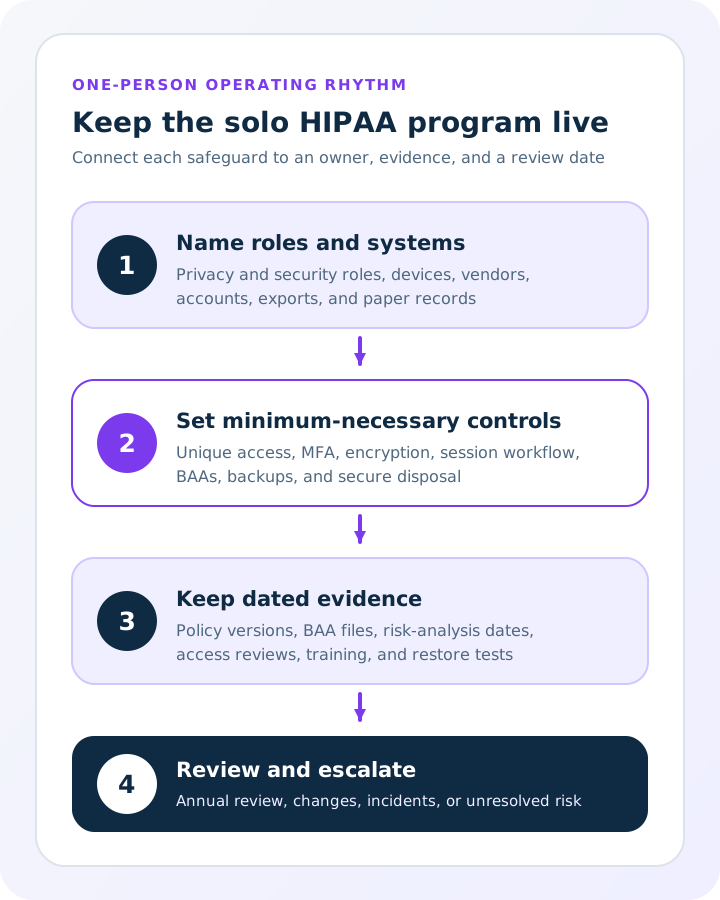
| Field | What to write |
|---|---|
| Owner | Usually you. Name a backup if a trusted colleague or counsel holds a sealed envelope or emergency role |
| Cadence | Annual baseline, plus trigger events (new vendor, stolen device, office move, new contractor) |
| Evidence | Policy version, BAA PDF, MFA screenshot log, training note, risk-analysis date, backup test result |
| Escalation | When the row leaves self-help: counsel, carrier, IT forensics, client notification workflow |
Walk the inventory once a year:
- Systems and devices that store or transmit ePHI
- Role designation memo still accurate
- Policies still match the tools you actually use
- BAAs current for every business associate
- Access list reviewed (helpers, supervisees, billing support)
- Backup restore tested
- Incident-response contacts and first-hour steps still current
- Privacy notice still matches processors and retention
- Telehealth and AI tools re-checked for training and subprocessor changes
- Next review date on the calendar
What a solo therapist can document without overclaiming
Document what you control:
- Roles you assigned
- Systems you approved
- Safeguards you turned on
- BAAs you hold
- Training you completed
- Risk analysis you dated
- Incidents you logged and how you responded
Do not document claims you cannot defend:
- “Fully HIPAA certified” as a blanket status for the whole practice
- “Compliant in every state” without checking licensure and state privacy overlays
- “The vendor is HIPAA compliant, so we are done”
- “Self-audit completed, therefore no residual risk”
Self-audit is evidence of a living program. Legal compliance is a conclusion only counsel can own in a live dispute. Keep that boundary visible in your policies and in client-facing language.
Download the annual solo-practice HIPAA checklist
The downloadable checklist puts owner, cadence, evidence, and escalation fields next to role inventory, device workflow, vendor BAAs, risk analysis, and incident first steps. Use it for the annual review or after a material change. It is an educational worksheet, not a certification.
Free PDF: Annual Solo-Practice HIPAA Checklist
A printable one-person HIPAA checklist for solo therapists: roles, devices, BAAs, risk analysis, and annual review fields.
- Owner, cadence, evidence, and escalation fields on every row
- Role inventory and Privacy Officer / Security Official designation
- Device, session workflow, and minimum-necessary access checks
- Vendor BAA inventory plus incident first-hour and annual close steps
Free. We'll email the PDF link right away and add you to the therapist toolkit, sent every two weeks. Unsubscribe any time.
Where should we send the link?
We'll email the PDF link right away. You'll also get the therapist toolkit every two weeks. Unsubscribe any time.
✓ Check your inbox
We've sent you the PDF
The download link is on its way to your inbox, usually within a minute or two. The email will come from Emosapien (hello@team.emosapien.com); check your spam folder if you don't see it.
You're also on the therapist toolkit list, sent every two weeks. Unsubscribe any time from the email footer.
How Emosapien fits a solo compliance stack
Emosapien is built for mental-health clinicians, not generic medical scribing. The Scribe Agent drafts structured notes for clinician review. Session content is not used to train public models. Security controls include encryption and audit-oriented safeguards described on the security page. Whether encryption is the right safeguard for a given system is the HIPAA encryption decision, not a product badge. BAA availability stays on the Professional and Enterprise plans that are appropriate for PHI. Emosapien is built for mental-health clinicians, not generic medical scribing. The Scribe Agent drafts structured notes for clinician review. Session content is not used to train public models. Security controls include encryption and audit-oriented safeguards described on the security page, with BAA availability on the Professional and Enterprise plans that are appropriate for PHI. The day-to-day pass for those safeguards is the practice HIPAA compliance checklist.
Software does not replace your Privacy Officer memo, risk analysis, or vendor inventory. It can reduce after-hours note load while you keep sign-off and policy ownership. If you want to test documentation support inside a review-first workflow, start a free trial.
If you need policies beyond a one-person stack, open the compliance resource hub. After you hire, assign access and incident ownership across people. Before a vendor receives PHI, sign and file a BAA.
Closing checklist
- Role designation memo names Privacy Officer and Security Official
- Device and session workflow is written and repeatable
- Minimum necessary access covers accounts, helpers, and exports
- Every PHI vendor is inventoried with BAA status
- Annual risk analysis has a date, evidence, and next review
- Self-audit rows escalate to counsel when risk is high
- AI and telehealth tools are re-checked when features change
That is the practical bar for HIPAA for solo therapists: a one-person system you can run after a full clinical day, with paper trails that still make sense when something goes wrong.
References
- U.S. Department of Health and Human Services. Summary of the HIPAA Privacy Rule.
- U.S. Department of Health and Human Services. Summary of the HIPAA Security Rule.
- U.S. Department of Health and Human Services, OCR. Security Standards: Implementation for the Small Provider.
- U.S. Department of Health and Human Services. Business Associate Contracts.
- U.S. Department of Health and Human Services. Security Risk Assessment resources.