
Mandatory Reporting Laws by State for Therapists

Outline
A parent describes bruises. An older adult client hints that a caregiver takes their card. A session turns and a client names a person they want to hurt. Three different facts. Three different legal stacks. Therapists get into trouble when they search for one national rule and invent a single threshold that does not exist.
This guide is a license-aware lookup for mandatory reporting laws by state. It separates child abuse and neglect, vulnerable-adult and elder abuse, and imminent-risk or duty-to-warn duties. It links each jurisdiction to a dated primary-source pathway and gives you a practice checklist for documentation. It is educational guidance for US mental-health clinicians. It is not legal advice, and it does not decide whether any live situation requires a report.
Free PDF: Mandatory Reporting Practice Checklist
A printable jurisdiction and duty-stack checklist for therapists: license match, child abuse, vulnerable-adult or elder APS, imminent-risk or duty-to-warn, and post-action documentation fields.
- Jurisdiction and license identity block with verification date
- Child-abuse stack checks for reporter category, knowledge standard, destination, and timing
- Vulnerable-adult or elder APS stack with protected-class and destination fields
- Imminent-risk or duty-to-warn stack plus factual post-action documentation fields
Free. We'll email the PDF link right away and add you to the therapist toolkit, sent every two weeks. Unsubscribe any time.
Where should we send the link?
We'll email the PDF link right away. You'll also get the therapist toolkit every two weeks. Unsubscribe any time.
✓ Check your inbox
We've sent you the PDF
The download link is on its way to your inbox, usually within a minute or two. The email will come from Emosapien (hello@team.emosapien.com); check your spam folder if you don't see it.
You're also on the therapist toolkit list, sent every two weeks. Unsubscribe any time from the email footer.
Educational resource for licensed mental-health clinicians. State statutes, board rules, and case law change. Matrix rows were verified July 2026 against public federal and multi-state summaries. Open the linked primary source and your board guidance before you rely on any row.
What these state reporting duties cover
State reporting duties are not a single code section. For outpatient therapists, three duty stacks show up again and again:
- Child abuse and neglect. Every state and the District of Columbia designate who must report suspected maltreatment of a minor, what standard of knowledge triggers the duty, where the report goes, and how quickly it must be made. The federal Child Welfare Information Gateway maintains the Mandatory Reporting of Child Abuse and Neglect State Statutes Series overview (May 2023) and per-jurisdiction summaries.
- Vulnerable-adult, dependent-adult, or elder abuse. Most states require certain professionals to report abuse, neglect, or exploitation of older adults or adults with disabilities through Adult Protective Services (APS). Definitions, age cutoffs, and reporter lists vary. National orientation lives with the National Center on Elder Abuse and NAPSA-linked briefs; the statute you follow is still the state APS code.
- Imminent harm to self or others, including duty to warn or protect. This stack is separate from child-protection reporting. Many states impose a statutory duty, a common-law duty, or a permissive disclosure path when a client presents a serious threat of violence. Multi-state orientation charts such as the NCSL mental health professionals duty-to-warn summary (updated March 2022) help you start research. They do not replace the statute or controlling case in your jurisdiction. Warning an identifiable third party and taking other protective steps are not the same duty. Sort that difference on duty to warn vs duty to protect. A duty-to-warn disclosure is not the same event as a licensing-board complaint. If the license is social work, keep the coverage reading on malpractice insurance for social workers separate from the statute you report under.
Scroll the visual sideways to view the full diagram
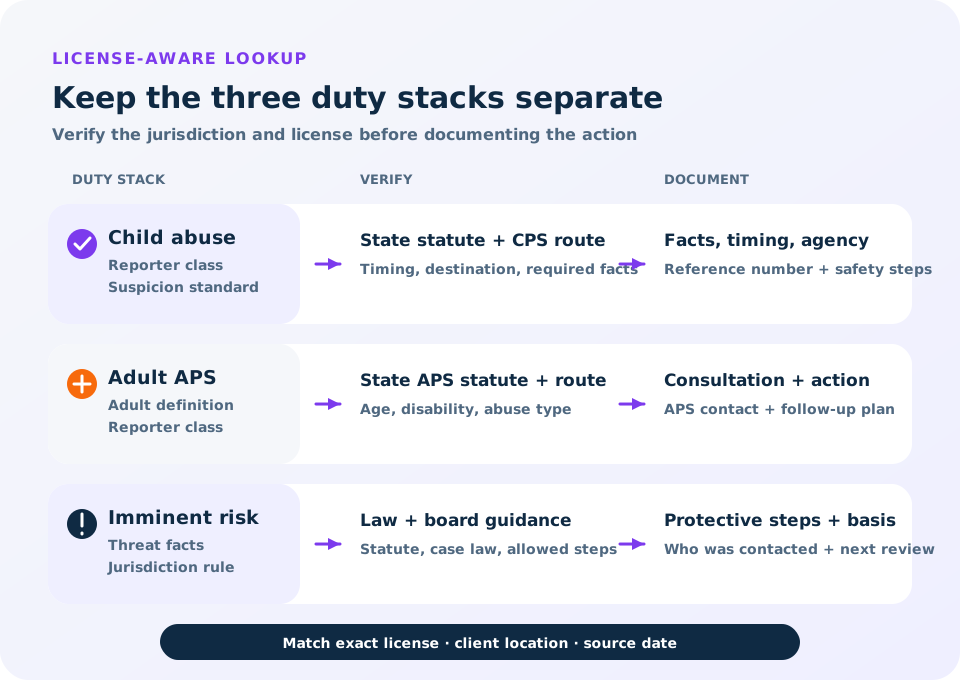
HIPAA sits underneath all three as a federal privacy floor. The Privacy Rule permits disclosures required by law and includes pathways for preventing serious and imminent harm when other law and standards support protective action. HIPAA does not invent a national reporter list, and it does not erase a valid state duty.
License-aware checks before you open the matrix
A statute that names “psychologists” does not automatically answer the question for an LPC associate, an LMFT, a clinical social worker, or a psychiatrist. Before you trust any row:
- Name the license on the wall and any supervised or temporary status.
- Name the client’s location and your own practice location if they differ.
- Open the child-abuse summary and the APS statute path for that geography.
- Open the duty-to-warn or protect orientation and then the actual code or case citation your board cites.
- Match reporter categories word for word. “Mental health professional,” “social worker,” “counselor,” “marriage and family therapist,” and “health practitioner” are not interchangeable labels.
- Note institutional dual-report rules if you work in a school, hospital, IOP, or group practice that also requires an internal report.
- Date the verification in your policy binder the same week you change states, add telehealth geography, or hire a new license type.
If your work is mostly adolescent or family systems, align the consent language on your adolescent therapy intake form and family therapy intake form with the stacks you actually practice under. Intake wording is not a substitute for the live decision, but vague limits-of-confidentiality text is how practices drift. When the license on the wall is marriage and family therapy, the practice checklist for those confidentiality limits is the MFT code of ethics checklist.
How to use mandatory reporting laws by state without inventing a national threshold
Use the table as a source map, not as a yes/no oracle.
- Open the child-abuse CWIG state summary first. Read the professionals required to report, the standard for making a report, and the procedures page linked from that series when timing and destination matter.
- Open your state APS or elder/dependent-adult page next. Confirm age, disability or dependent-adult definitions, and whether your license is named.
- Read the imminent-risk column as an orientation only. Categories compress multi-state research into one phrase so you know whether you are looking for a mandatory statute, a permissive statute, common-law duty, or thin guidance. Then open the NCSL chart and your state code.
- If client and clinician sit in different states, complete both lookups and your license-authority check. Pair this page with your interstate telehealth preflight workflow rather than assuming home-state rules travel with you.
- When facts are ambiguous and someone may be in danger, prioritize safety and consultation. Do not delay an emergency call because a PDF is still downloading.
The CSV export is the offline twin of this page’s mandatory reporting laws by state matrix:
50-state and DC source matrix
Accessible HTML table. Child-abuse links point to the HHS Child Welfare Information Gateway state statute summaries in the May 2023 series. Imminent-risk labels are research orientations from public multi-state charts, verified for this page in July 2026. Vulnerable-adult duties always need the state APS statute in addition to this row. Re-verify before clinical reliance.
| Jurisdiction | Child abuse primary source | Imminent-risk orientation | Matrix verified |
|---|---|---|---|
| Alabama | CWIG state summary | Common-law duty orientation | July 2026 |
| Alaska | CWIG state summary | Permissive disclosure orientation | July 2026 |
| Arizona | CWIG state summary | Statutory duty orientation | July 2026 |
| Arkansas | CWIG state summary | Limited guidance; verify | July 2026 |
| California | CWIG state summary | Statutory duty orientation | July 2026 |
| Colorado | CWIG state summary | Statutory duty orientation | July 2026 |
| Connecticut | CWIG state summary | Permissive disclosure orientation | July 2026 |
| Delaware | CWIG state summary | Statutory duty orientation: Del. Code tit. 16, § 5402 duty to take precautions / warn for named mental-health services providers; confirm license coverage and subsection (b) discharge steps | July 2026 |
| District of Columbia | CWIG state summary | Permissive disclosure orientation | July 2026 |
| Florida | CWIG state summary | Mixed statutory orientation: potential-victim warning remains a privilege waiver under Fla. Stat. §§ 491.0147(1)(c) / 490.0147(1)(c); law-enforcement disclosure is mandatory under §§ 491.0147(2) / 490.0147(2) when the statutory threat threshold is met | July 2026 |
| Georgia | CWIG state summary | Common-law duty orientation | July 2026 |
| Hawaii | CWIG state summary | Common-law duty orientation | July 2026 |
| Idaho | CWIG state summary | Statutory duty orientation | July 2026 |
| Illinois | CWIG state summary | Permissive disclosure orientation | July 2026 |
| Indiana | CWIG state summary | Statutory duty orientation | July 2026 |
| Iowa | CWIG state summary | Common-law duty orientation | July 2026 |
| Kansas | CWIG state summary | Limited guidance; verify | July 2026 |
| Kentucky | CWIG state summary | Statutory duty orientation | July 2026 |
| Louisiana | CWIG state summary | Statutory duty orientation | July 2026 |
| Maine | CWIG state summary | Limited guidance; verify | July 2026 |
| Maryland | CWIG state summary | Statutory duty orientation | July 2026 |
| Massachusetts | CWIG state summary | Statutory duty orientation | July 2026 |
| Michigan | CWIG state summary | Statutory duty orientation | July 2026 |
| Minnesota | CWIG state summary | Statutory duty orientation | July 2026 |
| Mississippi | CWIG state summary | Statutory duty orientation | July 2026 |
| Missouri | CWIG state summary | Statutory duty orientation | July 2026 |
| Montana | CWIG state summary | Statutory duty orientation | July 2026 |
| Nebraska | CWIG state summary | Statutory duty orientation | July 2026 |
| Nevada | CWIG state summary | Limited guidance; verify | July 2026 |
| New Hampshire | CWIG state summary | Statutory duty orientation | July 2026 |
| New Jersey | CWIG state summary | Statutory duty orientation | July 2026 |
| New Mexico | CWIG state summary | Limited guidance; verify | July 2026 |
| New York | CWIG state summary | Statutory duty orientation (MHL §9.46) | July 2026 |
| North Carolina | CWIG state summary | Common-law duty orientation | July 2026 |
| North Dakota | CWIG state summary | Limited guidance; verify | July 2026 |
| Ohio | CWIG state summary | Statutory duty orientation | July 2026 |
| Oklahoma | CWIG state summary | Statutory duty orientation | July 2026 |
| Oregon | CWIG state summary | Permissive disclosure orientation | July 2026 |
| Pennsylvania | CWIG state summary | Common-law duty orientation | July 2026 |
| Rhode Island | CWIG state summary | Permissive disclosure orientation | July 2026 |
| South Carolina | CWIG state summary | Common-law duty orientation | July 2026 |
| South Dakota | CWIG state summary | Common-law duty orientation | July 2026 |
| Tennessee | CWIG state summary | Statutory duty orientation | July 2026 |
| Texas | CWIG state summary | Permissive disclosure orientation | July 2026 |
| Utah | CWIG state summary | Statutory duty orientation | July 2026 |
| Vermont | CWIG state summary | Common-law duty orientation | July 2026 |
| Virginia | CWIG state summary | Statutory duty orientation | July 2026 |
| Washington | CWIG state summary | Statutory duty orientation | July 2026 |
| West Virginia | CWIG state summary | Permissive disclosure orientation | July 2026 |
| Wisconsin | CWIG state summary | Common-law duty orientation | July 2026 |
| Wyoming | CWIG state summary | Permissive disclosure orientation | July 2026 |
Vulnerable-adult / elder column lives in the CSV with APS routing notes. New York and other jurisdictions can differ sharply on who is a mandated reporter for adult mistreatment. Do not infer adult duties from the child-abuse column alone. New York’s imminent-risk duty under Mental Hygiene Law §9.46 is a mandatory report to the director of community services / state system, not a classic third-party Tarasoff warning path. Re-verify the current statute text.
Documentation that holds when a board or court asks
Defensible charting is factual and narrow.
When you report
- Date and time of the decision
- Observable facts that raised the concern
- Statute or policy basis you relied on, in plain language
- Agency, hotline, or law-enforcement path used
- Reference or confirmation number if issued
- Immediate safety steps taken
- What the client was told about limits of confidentiality, when that conversation was appropriate
When you decide a report is not indicated
- Facts considered
- Why the legal threshold was not met, without arguing a case you are not litigating
- Consultation obtained (supervisor, counsel, carrier)
- Follow-up plan and next review point
Keep psychotherapy process notes that are not needed for the protective action out of the report narrative. Progress notes should still support continuity. For intake structure that already holds risk language, pair this page with the biopsychosocial assessment example and with your risk templates rather than inventing a second charting system. Scan the PHI identifiers list before the narrative carries a name, a date of birth, or a device ID the statute did not ask for.
Practice checklist and common failure modes
Use the downloadable checklist when you onboard a new state, update consent forms, or debrief a difficult case.
Common failure modes:
- One-threshold thinking. Collapsing child, adult APS, and Tarasoff-style duties into a single sentence on the consent form
- License mismatch. Reading a “psychologist” rule while practicing on a counseling or social-work license
- Geography mismatch. Applying home-state habits to a telehealth client sitting elsewhere
- Delay for certainty. Waiting for a perfect memo while a child remains in danger
- Over-disclosure. Sending the entire chart to a hotline when the statute asks for the facts of the suspicion
- Under-documentation. Filing a report and leaving no dated trace of what was said or to whom
- Policy drift. Never reopening sources after a statute change (for example, state bills that alter reporter lists or timing)
Sibling compliance pages: keep solo operating controls on the solo-practice HIPAA checklist and role access on the group-practice HIPAA guide.
References
- Child Welfare Information Gateway. Mandatory Reporting of Child Abuse and Neglect (State Statutes Series overview, May 2023).
- Child Welfare Information Gateway. Mandated reporting topic hub and State Statutes Search.
- Child Welfare Information Gateway. How to report child abuse and neglect (national routing context).
- National Conference of State Legislatures. Mental Health Professionals’ Duty to Warn (page updated March 16, 2022).
- Gorshkalova O, Munakomi S. Duty to Warn. StatPearls. NCBI Bookshelf.
- National Center on Elder Abuse (ACL). NCEA home and reporting resources.
- NCEA and NAPSA. Mandated Reporting of Abuse of Older Adults and Adults with Disabilities brief.
- U.S. Department of Health and Human Services, Office for Civil Rights. HIPAA Privacy Rule (disclosures required by law; preventing serious and imminent harm pathways).
Keep the chart current without turning every session into a legal clinic
These duties reward a boring system: dated sources, license-matched consent language, a short decision checklist, and notes that stick to facts. Build that system once. Re-verify when geography or statutes move. When the room is hot, you will not be inventing the process under adrenaline. Keep mandatory reporting laws by state next to your intake templates, not buried in a shared drive nobody opens.
Emosapien helps therapy practices keep risk language, session context, and follow-up continuity in one clinician-controlled workspace so the protective decision and the clinical story stay connected. It does not replace your legal duty, your board, or counsel.
Start a free trial when you want that continuity layer beside your compliance binder.