Ontario Psychotherapy Progress Notes: CRPO Guide

Outline
Authored by Dr. Sofia Reyes, a clinical psychologist with a forensic and healthcare-compliance specialty and over a decade of practice across the US and Canada.
It is 6:10pm in a Toronto consulting room. Maya, RP, still has two charts open. Tomorrow a client asked for their file. Tonight’s session was useful. The record still has to show what the client said, what Maya observed, and what she plans next, in language another RP could pick up on Monday.
That is the working problem behind Ontario psychotherapy progress notes: not producing a transcript, and not hiding behind a one-line “supportive session.” CRPO Standard 5.1 wants an accurate, complete, legible clinical record. The progress note is the session layer of that file.
This page is a desk-side map for Registered Psychotherapists, qualifying registrants, and supervisors in Ontario. It covers what belongs in the session entry, how that entry sits beside the rest of the clinical record, language and joint-file rules, PHIPA access, amendments, and retention. It is educational guidance, not College, legal, or privacy advice. Follow the live CRPO Standard 5.1: Clinical Records and your custodian policy when they differ from any example here.
Educational resource for Registered Psychotherapists and other regulated mental-health clinicians practicing in Ontario. CRPO standards and PHIPA processes change. Verify current requirements against official sources before you rely on any workflow.
What a CRPO progress note is for
Ontario psychotherapy progress notes exist so you, a covering colleague, or a later reader can see what happened in this contact and why you responded as you did. They are not a diary of everything disclosed, and they are not a substitute for the therapy plan.
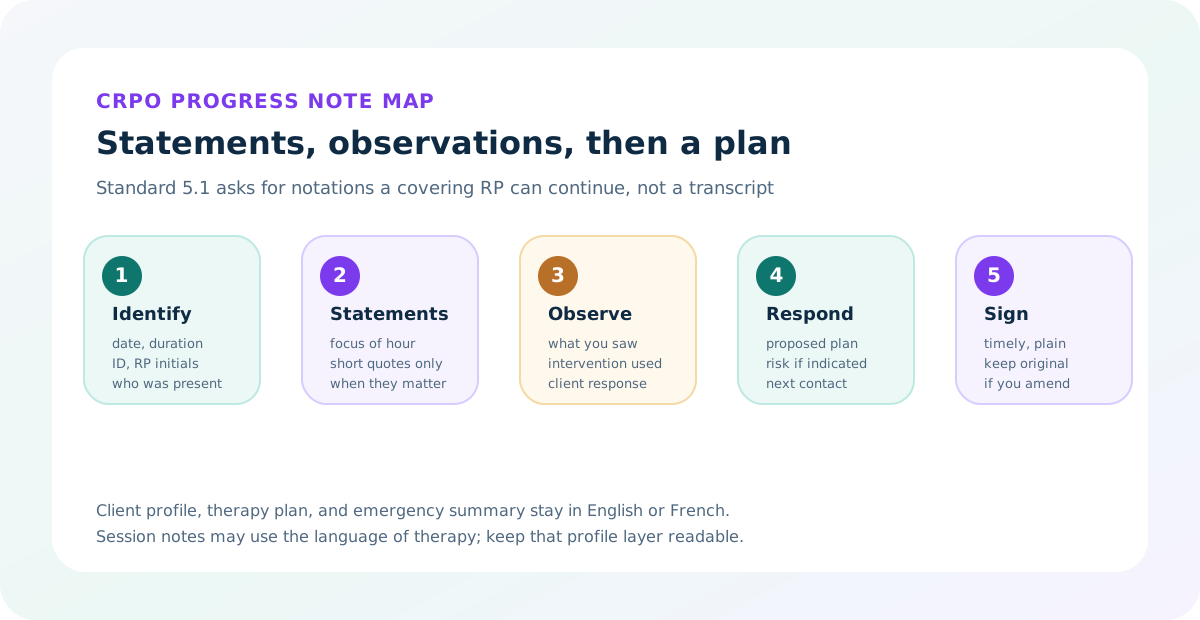
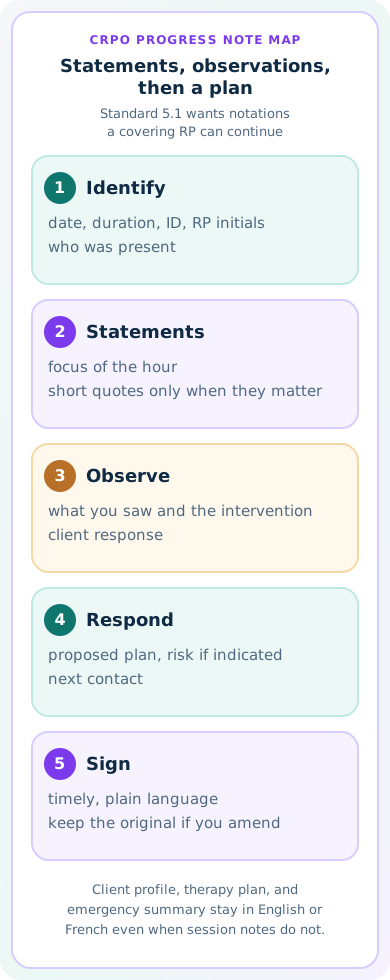
CRPO’s own wording is short on purpose. Progress notes are notations of:
- the client’s statements
- the therapist’s observations and impressions
- proposed plans in response
If a line does not serve care, clinical reasoning, or a live safety issue, it probably does not belong. Over-writing creates its own risk: extra third-party detail, speculative language, and notes the client will reasonably object to when they read them.
SOAP, DAP, or BIRP can hold the same content if your setting wants a format spine. Map the fields; do not import a foreign payer template. For format options that stay format-neutral, use the progress note templates and examples.
The session note is not the whole file
A complete clinical record is larger than tonight’s entry. Keep the session note in its lane.
| Record part | What it holds | What tonight’s note should not try to do |
|---|---|---|
| Client profile | Full name, address, phone, date of birth, unique identifier, substitute decision-maker, referral source | Rebuild demographics every session |
| Assessment | Methods, results, conclusions, problem formulation, professional opinion of status | Rewrite the formulation unless status actually changed |
| Therapy plan and consents | Direction of therapy, modality, initial and later consents, test reports, plan changes | Invent a new plan in the progress note without logging the change |
| Progress notes | Statements, observations, impressions, proposed plans | Carry the entire history |
| Work product | Photos, copies, or descriptions of objects such as artwork | Dump every image if a short description will do |
| Consultations and referrals | Date and relevant details of consults given or received, plus referrals you make | Hide a consult in an impression line |
| Reports sent or received | List and copy | Treat a GP letter as a session note |
| Incident and mandatory reports | Unexpected negative outcomes, and copies or summaries of mandatory reports | Soften a reportable event into vague wording |
| Closing | Reasons for ending, outcomes, referrals, follow-up | Skip a closing note because the last progress note felt complete |
Appointment records (date, time, duration, missed or canceled contacts) and financial records sit with the client record even when you store them in a diary or billing system. Standard 5.4 still expects an attendance history you can retrieve.
Fields that earn their place
Write enough that a covering RP can continue. Do not write a screenplay. These fields are the practical minimum for Ontario psychotherapy progress notes in an individual hour.
| Field | What to write | What to leave out | Why it belongs |
|---|---|---|---|
| Identity | Client name or unique identifier, date, your name or initials | A note with no author and no date | Standard 5.1 expects each entry to show who wrote it and when |
| Contact facts | Duration, modality (in person, video, phone), who was present | A scheduled slot that did not happen, written as if it did | Appointment records and the clinical note have to match the contact |
| Focus | The problem or target of this hour | The entire intake history | Continuity needs this session, not a recap of the file |
| Client statements | Paraphrase plus a short quote only when the wording itself matters | Verbatim dialogue, gossip about third parties | CRPO names client statements as a required element |
| Observations | What you saw, heard, or measured | Mind-reading (“manipulative,” “in denial”) | Observations are reviewable; labels are not |
| Impressions | A brief clinical read tied to those observations | A new diagnosis dumped without assessment support | Impressions show reasoning, not a second chart |
| Intervention | Named action (for example, CBT thought record on a work prediction) | “Provided support” with no action | Another RP needs to know what you actually did |
| Response | How the client used, refused, or was unchanged by that action | A hope that they “seemed better” | Progress is a change you can point to |
| Risk | What you assessed, current level, actions, follow-up, when risk is indicated | A ritual risk paragraph on a quiet hour, or a blank when risk was live | Defensibility lives in assessment plus response |
| Plan | Next step, between-session task, consult, or plan change | Homework with no link to the hour | CRPO asks for proposed plans in response |
| Consent change | New or revised consent if the work shifted | Repeating the original consent paragraph every week | Later consents belong in the record when they happen |
Unique identifiers are allowed. If you use a code instead of a name, keep the linking key as securely as the chart itself.
Copy-ready Ontario session scaffold
Adapt this into your approved record system as a starting structure for Ontario psychotherapy progress notes. Remove fields your setting does not use. Add any field your custodian, employer, or program requires.
Worked example (fictional)
Maya sees A.L., 34, in private practice for worry that has started to cost workdays. Video session, 50 minutes. No third party on the call. This is not a real client. A completed hour of Ontario psychotherapy progress notes can look like this.
That note is long enough for a covering RP. It is short enough that A.L. could read it without wading through Maya’s private reactions. Those reactions, if Maya needs them, belong in a developmental note for supervision that does not identify the client. Looking at that reaction without putting it in A.L.’s chart is reflective practice for therapists. For how supervision notes stay separate from the official chart, see clinical supervision documentation. If the hour was mentoring or consultation rather than evaluation, it is not this binder; see clinical supervision vs mentoring vs consultation.
Language, joint files, and who may read the note
Write Ontario psychotherapy progress notes as if the client may request them. Under PHIPA they usually can.
CRPO now draws a language split:
- Progress notes may be in the language in which therapy is taking place.
- Key information that another provider might need in an emergency, including the client profile and a usable summary, stays in English or French.
If you work in a third language, do not leave the emergency layer only in that language.
Joint records need an explanation at the start of couple, family, or group work.
| Situation | How CRPO frames the file | What one person can access |
|---|---|---|
| Couple or family always attends in the same combination | One joint file is allowed | The whole file if all participants consent or make a joint request |
| Same pair, but one person later attends alone | Keep a separate file or sub-file for the individual hour | The individual hour is not automatically part of the joint chart |
| Group | Separate files per member, or one group file | One member does not receive another member’s attributable material |
| One participant asks, others have not consented | Do not release the whole joint file | Information about that person, plus communal themes not tied to someone else |
Tell joint clients how you keep records before the work starts. Do not wait for the access request.
PHIPA access is time-bounded. The Information and Privacy Commissioner of Ontario states that a custodian must respond as soon as possible and no later than 30 days, with a documented extension of up to 30 more days in limited circumstances. CRPO Standard 5.2 uses the same 30-day window for reports and certificates that are not a copy of the record itself. Put a diary reminder the day the request arrives.
Fees may recover cost. They may not block access. CRPO notes that a fee on the order of $30 for the first 20 pages and 25 cents a page after that has been treated as reasonable. If cost would stop the client, adjust.
Amendments, rough notes, and how long you keep the file
Every entry shows who wrote it and when. If you need to change a signed note, add an amendment that states what changed, when, by whom, and why. The original stays legible. A system that silently replaces text does not meet Standard 5.1 or 5.6.
Rough notes can stay in the record or not. If they will not stay, finish the clinical entry and destroy them the same day. Do not leave a second, messier version in email, a phone notes app, or an AI draft folder. Those copies are still personal health information.
When you are the health information custodian, retain the clinical record for at least 10 years from the last interaction, or 10 years from the client’s 18th birthday, whichever is later. Appointment and financial records follow the same clock. Employer or group-practice policies can be longer. They cannot be shorter if you are the custodian.
Standard 5.6 still sits under the note: lock paper, shield screens, control who can open the electronic file, keep an audit trail, have a fallback if the system fails, and transmit with tracking or encryption. If you use an AI draft, you still sign the clinical entry. The draft is not the record until you accept it.
Sign-off check before you close the chart
Ask these in order before you file Ontario psychotherapy progress notes. If any answer is no, fix the entry before you leave the desk.
- Would another RP know the focus, what you did, how the client responded, and the next step?
- Are statements, observations, and the proposed plan all present, even if each is two lines?
- If risk was live, did you write assessment, action, and follow-up rather than a feeling?
- Could the client read this without unnecessary third-party detail or insulting labels?
- If this is an amendment, is the original still visible?
- Are profile and emergency summary still usable in English or French?
- If the hour was joint work, does this file match the combination who attended?
If yes, you are in the range CRPO actually describes. Longer is not more professional.
Ontario psychotherapy progress notes fail more often from missing identity, missing plans, or overwritten amendments than from imperfect prose. Write the session you had. Sign it while the hour is still in working memory.
If you want structured drafting with clinician review before anything is signed, start a free trial of Emosapien. You still own College standards, PHIPA duties, and the signature. Software does not take that over. See Emosapien features for how draft review sits next to the signed chart.
References
- College of Registered Psychotherapists of Ontario. Standard 5.1: Clinical Records.
- College of Registered Psychotherapists of Ontario. Record-Keeping and Documentation (Section 5).
- College of Registered Psychotherapists of Ontario. Clinical Records Checklist (October 2024).
- College of Registered Psychotherapists of Ontario. Language of records and access to joint therapy records.
- College of Registered Psychotherapists of Ontario. Standard 5.2: Requests for Reports.
- College of Registered Psychotherapists of Ontario. Standard 5.4: Appointment Records.
- Information and Privacy Commissioner of Ontario. Access and correction under PHIPA.
- Government of Ontario. Personal Health Information Protection Act, 2004.