
REBT Worksheet You Assign After a Must

Outline
Authored by Dr. Hannah Lin, counseling psychologist trained in CBT, ACT, and IFS, with over a decade of clinical practice in anxiety and complex trauma.
Jordan has nine minutes left. The thought record already came back filled from the silent standup, with “I should have known the numbers” in the thought column and a full list of evidence against. Anxiety is still 8, and the rest of the hour is turning into a debate about whether they should have known.
The argument in the room is not that sentence. It is the demand under it: I must not look incompetent, and if I do I am a fraud.
Stop collecting more evidence for a passing thought. Get the must into B in their own words, walk A and C, model one dispute, and send a single REBT worksheet home only after they can say B out loud.
If the job is still testing an automatic thought with evidence for and against, stay on the CBT thought record worksheet. When the demand is a mode that is running the room rather than a single must, use schema therapy basics for therapists.
Use the pack when you want the assignment card, client cover sheet, and next-session review beside the row you walk in the room.
Email me the worksheet assignment pack
Get the clinician assignment card, client cover sheet, and next-session review for therapist-led homework. Pair it with the ABCDE fields you walk in session.
- Clinician assignment card for fit, dose, privacy, and stop rules
- Client cover sheet for one assigned worksheet
- Adulthood and engagement worksheet menu by clinical job
- Next-session review card for complete, partial, or blank work
Free. We'll email the PDF link right away. We may also send the occasional therapist toolkit. Unsubscribe any time.
Where should we send the link?
We'll email the PDF link right away. You'll also get the occasional therapist toolkit. Unsubscribe any time.
✓ Check your inbox
We've sent you the PDF
The download link is on its way to your inbox, usually within a minute or two. The email will come from Emosapien (hello@team.emosapien.com); check your spam folder if you don't see it.
You're also on the weekly therapist toolkit list. Unsubscribe any time from the email footer.
Format selection sits inside formulation, consent, and window of tolerance. ABCDE homework is not an Albert Ellis Institute protocol and it is not a crisis service.
Walk A, B, and C before anyone writes at home
Do not send a blank grid after a two-minute explanation. The columns look simple. Catching a must in writing is not.
Walk one complete A-B-C in session, in the client’s language, before you ask for D.
| Column | Client writes | You watch for |
|---|---|---|
| A. Activating event | Where, when, with whom. Observable facts. | Story, mind-reading, or a belief smuggled in as “what happened” |
| B. Belief | The evaluative thought in the client’s words | Paraphrase (“I felt like a failure”) instead of the must |
| C. Consequence | Emotion, intensity, and what they did | Mixing C back into B, or listing every feeling in the week |
| D. Dispute | Empirical, logical, and pragmatic challenges | Therapist argument, reassurance, or a pep talk |
| E. Effective new philosophy | A belief they could live by, plus a healthier emotion or action | A nicer sentence that would collapse at the next A |
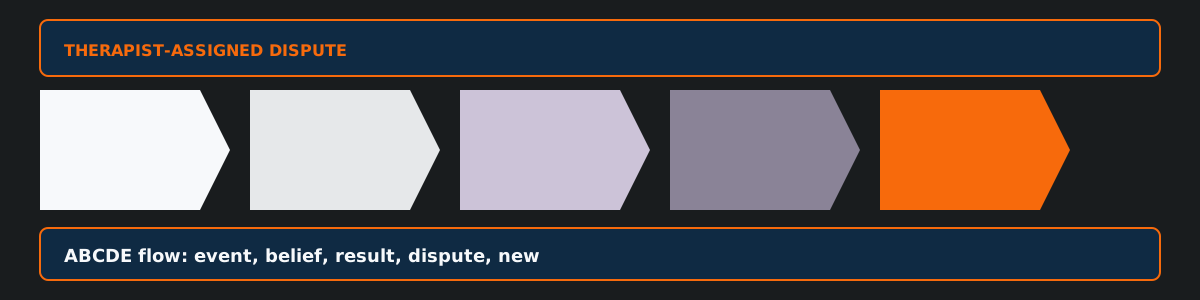
A is not the problem to fix. A is the cue. B is the clinical target. C tells you whether B is still running. D is the intervention. E is what you review next hour, not what you applaud and file.
If they cannot yet separate A from B, stop there. That session was an awareness task. Homework can be a three-column log of A, B, and C only.
When they can name B as a must, model one dispute out loud. Keep your voice curious. “Where is it written that you must not be rejected?” is a classic Ellis move. It fails when it sounds like mockery. If the client’s shoulders go up, you are arguing, not disputing.
Jordan does this in the last eight minutes. She writes the client’s must in B, reads it back, asks “is that the demand, or a paraphrase?”, then models one pragmatic dispute. What leaves the room is one expected A, the B already spoken, a stop rule if D turns into self-attack, and an REBT worksheet only after that B has been said out loud.
Albert Ellis developed REBT in 1955 as an action-oriented cognitive therapy. The Albert Ellis Institute still teaches the same core move: it is largely thinking about events, not the events alone, that produces unhealthy emotion and self-defeating behavior. Paper makes that move visible.
DiGiuseppe, Doyle, Dryden, and Backx describe this sequence in A Practitioner’s Guide to Rational Emotive Behavior Therapy as philosophical work, not a contest over facts. If the client already has plenty of evidence and still holds the must, a thought record will stall. ABCDE is built for that stall.
The four beliefs that belong in B
REBT does not need a long distortion taxonomy in B. Four evaluative processes cover most of what belongs there.
| Process | Sounds like | What you dispute |
|---|---|---|
| Demandingness | Must, should, have to, ought | The law. Leave the preference standing. |
| Awfulizing | This is 100% bad, unbearable, the end of a livable life | The rating of the outcome, not that the outcome is unwanted |
| Low frustration tolerance | I cannot stand this | The demand that discomfort be absent |
| Global rating | I am a failure. He is a jerk. Life is worthless. | The total. Keep the behavior ratable. |
“I want their approval” can be painful and still be rational. “I must have it” is the clinical target. Awfulizing often rides along with a must. The client can usually stand a great deal. What they cannot stand is the demand that discomfort be absent.
Pick one B per row. A sheet that lists four musts, two awfuls, and a global rating in a single box will produce a dispute that never lands. If several beliefs are live, rank them with the client and work the one that is driving C today.
Why a thought record stalls on a must
A thought record is the right tool when the client can catch an automatic thought in the moment and test it. ABCDE is the right tool when the distress sits in an evaluation of that thought: it must not be, it is awful, I cannot stand it, or I (or they) are wholly bad.
Three differences show up in supervision more than any others.
The B column is not “the thought.” It is the demand or rating. “She didn’t text back” is A. “She thinks I’m needy” may be an inference. “I must not be ignored, and if I am I am unlovable” is B.
The D column is not evidence-against. You can ask whether the belief is true, whether it logically follows, and whether holding it helps the client move toward what they care about. All three questions can be useful. None of them is “convince the client they are wrong to feel this.”
The E column is not a balanced thought. A balanced thought can still keep the must (“I should have known better, but nobody is perfect”). An effective new philosophy drops the demand: “I prefer to handle this well, and I can stand getting it wrong without becoming a failure.”
If you have not yet decided whether any form belongs in the room, start with choosing therapy worksheets.
Send one REBT worksheet row, not a week of blanks
Then send a single between-session row, not a week’s worth. One activating event they already expect. One B they have already said in the room. D and E attempted once. Bring the page back.
When you need other assignment formats for a different presenting concern, use the therapy worksheets hub.
Print the ABCDE fields below for the in-session walkthrough. The pack holds the cover sheet and the review prompts so you are not inventing them after the last client.
When the form does not go home
Fit is a formulation call, not a default homework move. Do not send an REBT worksheet home from panic, crisis, or OCD just because the hour ran long.
| Presentation | ABCDE fits? | Notes |
|---|---|---|
| Performance anxiety with “I must not fail” | Yes | B is usually demandingness plus a global self-rating |
| Anger at “they must treat me fairly” | Yes | Dispute the must; do not debate whether the other person was unfair |
| Guilt with “I should have known” | Yes | Separate preference, responsibility, and rating of the whole self |
| Mild-to-moderate depression with self-downing | Often | Pair with behavioral work if energy is too low for written dispute |
| Panic in the moment | No | Body-led skill first; ABCDE only after arousal drops |
| Trauma stuck points (“it was my fault”) | Use a trauma-calibrated frame | Generic disputation can land as invalidation |
| OCD | No | Dispute can become a ritual; exposure and response prevention leads |
| Active crisis or dissociation | No | Safety and orientation first |
A second stop rule is relational. Some clients hear D as “my therapist thinks I am stupid for feeling this.” That is not a reason to abandon REBT forever. It is a reason to slow down, name the alliance, and sometimes switch to a thought record, defusion, or parts work until the room can hold a dispute.
Fields you can copy into the chart
Keep the printable row to one page. Extra coaching notes belong in your session plan, not on the client’s kitchen table.
Documentation language
Your note can carry the clinical reasoning without redrawing the grid.
That note is readable to a covering clinician. It names the belief type, the dispute, and the next look, which is what utilization review can actually use.
Read B and E first at the next hour, not the story in A. Ask whether the new philosophy showed up in a real moment, whether C shifted, and whether D was a genuine dispute or a pep talk. Keep, adapt, or retire that REBT worksheet from that data.
Use the pack again if you still need the cover sheet and the review prompts on paper.
Email me the worksheet assignment pack
Get the clinician assignment card, client cover sheet, and next-session review for therapist-led homework.
- Clinician assignment card for fit, dose, privacy, and stop rules
- Client cover sheet for one assigned worksheet
- Adulthood and engagement worksheet menu by clinical job
- Next-session review card for complete, partial, or blank work
Free. We'll email the PDF link right away. We may also send the occasional therapist toolkit. Unsubscribe any time.
Where should we send the link?
We'll email the PDF link right away. You'll also get the occasional therapist toolkit. Unsubscribe any time.
✓ Check your inbox
We've sent you the PDF
The download link is on its way to your inbox, usually within a minute or two. The email will come from Emosapien (hello@team.emosapien.com); check your spam folder if you don't see it.
You're also on the weekly therapist toolkit list. Unsubscribe any time from the email footer.
Where Emosapien fits
ABCDE moves fast once B is on the table: the must surfaces, you dispute it, the client tries a preference, and you still have to write the note. Emosapien’s Scribe Agent can keep the activating event, the belief in the client’s words, the dispute you ran, and the E you assigned in the intervention section so you are not reconstructing the sequence from memory at 7pm.
You still choose whether ABCDE is the right form, whether D is landing as work or as shame, and whether the next hour keeps the sheet or retires it. The product holds the thread between this row and the next review. See the AI clinical notes overview for modality-aware documentation, or start a trial if you want that sequence in your own chart.
References
- Albert Ellis Institute. Rational Emotive Behavior Therapy.
- DiGiuseppe, R. A., Doyle, K. A., Dryden, W., & Backx, W. (2014). A Practitioner’s Guide to Rational Emotive Behavior Therapy (3rd ed.). Oxford University Press.
- Ellis, A. (1994). Reason and Emotion in Psychotherapy (rev. ed.). Citadel Press.