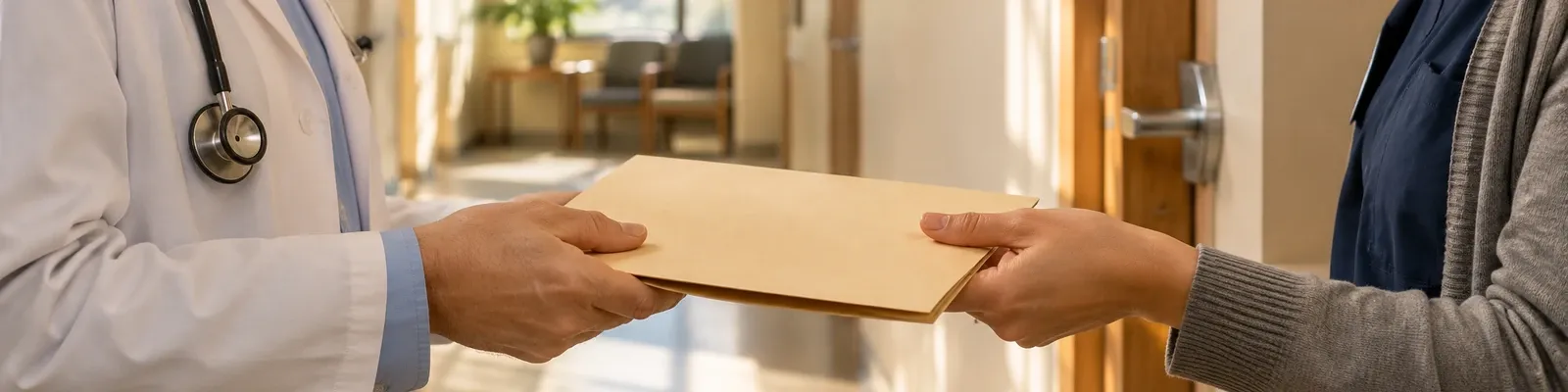
ChatGPT for Clinicians: Can I Draft a Psych Referral?

Outline
A fictional referral, checked against its source
You are Dr. Avery Lane, an invented outpatient psychiatrist. Your entirely fictional patient, Morgan Ellis, reports sleep disruption and asks for an evaluation by a sleep specialist. Your signed source note records sleep disruption and the request; it does not state a diagnosis or medication trial.
You open the account switcher and move from your personal workspace to your individually verified Clinicians workspace. For this fictional test, your individual agreement, workspace, feature, and practice policy have already been checked. You enter only invented facts and ask for a concise referral for your review, preserving the consultant question and adding nothing unsupported.
You compare it with the source note and find both the symptom and the question supported. If the draft instead says a medication failed or names a diagnosis, you remove that claim unless the record supports it. The result is ready for your review, not automatically verified or sent. Your individual enrollment does not cover your colleagues or authorize a referral on the patient’s behalf.
Check your referral before sign-off
Use the sheet this week to record the workspace, source facts, and reviewer for a referral draft.
Free. We'll email the PDF link right away and add you to the therapist toolkit, sent every two weeks. Unsubscribe any time.
Where should we send the link?
We'll email the PDF link right away. You'll also get the therapist toolkit every two weeks. Unsubscribe any time.
✓ Check your inbox
We've sent you the PDF
The download link is on its way to your inbox, usually within a minute or two. The email will come from Emosapien (hello@team.emosapien.com); check your spam folder if you don't see it.
You're also on the therapist toolkit list, sent every two weeks. Unsubscribe any time from the email footer.
Check the individual workspace before PHI
If you are a U.S. physician, nurse practitioner, physician assistant, or pharmacist, check your eligibility using OpenAI’s “ChatGPT for Clinicians” help article, checked November 2026. You need a valid NPI and a license verifiable through a third-party provider to sign up. If you are eligible and authorized to sign, review and sign the individual BAA under Settings > Agreements. For centralized deployment or an agreement covering multiple users, assess the separate Healthcare offering described in that help article.
Before you enter patient information, check that the signed agreement names the service, the account switcher shows the individual Clinicians workspace, and the feature you intend to use is eligible and enabled. Review OpenAI’s “HIPAA eligible products and functionality,” checked November 2026, alongside the agreement and your practice’s policy. Do not assume an agreement carries to a personal workspace, a colleague’s account, a connected app, or the referral destination. For the wider account-tier and agreement distinction, read is ChatGPT HIPAA compliant.
Your content shared in the Clinicians plan is not used to train OpenAI’s models, according to OpenAI’s “ChatGPT for Clinicians” plan page, checked November 2026. Still check where copies are retained and whether your specific use is permitted. For generic wording that contains no patient information, a general assistant may be enough. Test it with an invented case, not a real note with the name removed.
Your own workspace verification is an individual step, not approval for an entire practice. If a colleague wants to use the same workflow, ask the practice owner or privacy lead to establish that person’s approved account and agreement rather than sharing your login. If the clinician workspace or agreement cannot be verified, stop before entering patient information. You can still practice the mechanics with a case you invented entirely, or write the referral yourself. Keep the source note in its designated record and assess the recipient’s delivery method separately from the drafting tool.
You can also see how Emosapien works for the clinical note behind a referral.
Decide what enters and leaves the workspace
Name the receiving clinician and the clinical question first. Then identify the smallest set of source facts needed to answer it, the assistant workspace receiving those facts, and the separate route by which the finished letter would reach the consultant. A signed BAA is not itself patient authorization to send a letter, and it does not establish that a destination or connected tool is covered. Check applicable permissions and agreements for each step.
Discuss the purpose, recipient, proposed data flow, retention risks, and your review with the patient. Explain any choices, including a non-AI drafting alternative, and document a refusal under your practice policy. A patient can agree to a referral while declining the proposed AI step. Consent cannot legalize a prohibited use. Apply your own jurisdiction’s rules and obtain legal advice when the use is uncertain.
Use the AMA’s Ethical AI Use in Medicine toolkit, checked November 2026, to guide your oversight, transparency, and accountability. Consider disclosure when your AI use raises privacy, accuracy, or data-handling questions. Keep responsibility for the facts and clinical decisions with you; this professional guidance is not a federal statute.
Review the source and retained copies
Read the draft against your signed source note, not merely against the prompt. Check symptom history, relevant uncertainties, current information, and the consultant’s precise question. Remove invented diagnoses, claims about treatment, or other unsupported detail. If a material fact is missing from the source, resolve it yourself rather than asking the model to fill the gap. For your documentation workflow, see how notes are drafted and reviewed.
Plan for regular and archived chats to remain saved until you delete them or an applicable workspace policy removes them. After deletion, removal from OpenAI’s systems is scheduled within 30 days, subject to de-identification, security, and legal exceptions. Check separately saved Library or Space files too: they survive chat deletion (OpenAI, “Chat and file retention in ChatGPT,” checked November 2026). Verify your own retention settings; we could not find a published Clinicians-only deletion schedule, checked November 2026. Track the working letter, downloaded copies, and recipient copies separately; deleting a chat does not remove those copies.
Removing a name is not HIPAA de-identification. Under HHS de-identification guidance, checked November 2026, Safe Harbor removes 18 categories of identifiers concerning the individual and relatives, employers, or household members, and requires no actual knowledge that the remaining information can identify the individual alone or in combination. Review free text and unusual combinations too. Expert Determination is a separate route. An eligible product and signed BAA do not by themselves satisfy HIPAA, professional duties, or state law. This is not legal advice.
What to keep on file
Keep the agreement and account identity, workspace and feature checked, the approved task, the reviewer, and the date of review. Record the applicable retention settings and where the draft and any copies are held. Document the patient’s discussion and choices in the appropriate record, including any refusal, in line with practice policy.
Before a letter leaves your control, verify the recipient and permitted delivery method, check any required patient authorization, and compare every clinical statement and the consultant question with the source. The referral is your responsibility. If the agreement, patient choice, recipient, or a material fact remains uncertain, pause and resolve it or prepare the letter without the assistant.
Keep the clinical note under a signed BAA
Emosapien’s Scribe Agent drafts a progress note from the session in formats including SOAP. You review, edit, and sign it, then use the signed note to check the symptoms and other facts you choose to include in a referral. You still write, authorize, and send the letter separately. A signed BAA is included on every plan, including Free. Before entering PHI, confirm it is signed and covers your intended use.
Prepare a signed visit note for the psychiatric referral
Create an account to review and sign your session note before writing the referral separately.
Create account- Free plan
- No credit card
Session detail
The patient discussed the next step in care.
Draft for review
Progress and next step ready for review.
References
- OpenAI, “ChatGPT for Clinicians,” help article, checked November 2026.
- OpenAI, “ChatGPT for Clinicians,” plan page, checked November 2026.
- OpenAI, “HIPAA eligible products and functionality,” help article, checked November 2026.
- OpenAI, “Chat and file retention in ChatGPT,” help article, checked November 2026.
- HHS, “Guidance Regarding Methods for De-identification of Protected Health Information”, checked November 2026.
- American Medical Association, “Ethical AI Use in Medicine: A Clinical Practice Toolkit”, checked November 2026.
Related reading
Best AI Scribe for Psychiatry: Meds, Risk, and the Trial
Score the best AI scribe for psychiatry on medication notes, mental status, EHR fit, consent, a BAA, and price before you trial.
Read article →Behavioral Health SEO Company Comparison
Compare services, HIPAA tracking, price, contracts, and reporting before you call a behavioral health SEO company. First-call questions included.
Read article →Free PDF: AI Assistant Workspace Approval Cards
Printable decision sheets for checking assistant accounts, features, copies, retention and clinician review before a workflow is approved.
- Claude Referral Approval Card and Gemini Referral Desk Card
- Copilot-to-chart worksheet and Psychiatric Referral Check
- Research-session attachment and deletion worksheet and Chart Proofreading Field and Extension Checklist
- Document workspace versus session-note trial scorecard
Free. We'll email the PDF link right away and add you to the therapist toolkit, sent every two weeks. Unsubscribe any time.
Where should we send the link?
We'll email the PDF link right away. You'll also get the therapist toolkit every two weeks. Unsubscribe any time.
✓ Check your inbox
We've sent you the PDF
The download link is on its way to your inbox, usually within a minute or two. The email will come from Emosapien (hello@team.emosapien.com); check your spam folder if you don't see it.
You're also on the therapist toolkit list, sent every two weeks. Unsubscribe any time from the email footer.