
Art Therapy Worksheets You Can Use This Hour

Outline
Authored by Dr. Hannah Lin, counseling psychologist trained in CBT, ACT, and IFS, with over a decade of clinical practice in anxiety and complex trauma.
A client says they do not have words for what is in the room. You do not need a scored drawing, a mandala pack, or a credential you do not hold. Art therapy worksheets are image-safe prompts a licensed talk therapist can assign for emotion mapping, identity, resources, or closure. The therapist debriefs in the client’s words and does not read the picture as a diagnosis.
The American Art Therapy Association defines art therapy as a profession facilitated by a professional art therapist. This pack is not that profession. It is a contained drawing or collage offer inside talk therapy, with stop rules. I am not an ATR, and this pack does not confer art-therapy credentials.
Clinical guidance below is available without email. Email the printable pack when you want the four jobs, debrief notes, and documentation stem beside the session plan.
Email me the printable image-prompt pack
Get four prompt families plus therapist debrief notes, materials, decline language, and stop flags.
- Four prompt families: emotion mapping, identity, resources, and closure
- Materials, time box, decline language, and debrief questions that stay with the client title
- Therapist notes for fit, stop flags, documentation, and what carries between sessions
Free. We'll email the PDF link right away and add you to the therapist toolkit, sent every two weeks. Unsubscribe any time.
Where should we send the link?
We'll email the PDF link right away. You'll also get the therapist toolkit every two weeks. Unsubscribe any time.
✓ Check your inbox
We've sent you the PDF
The download link is on its way to your inbox, usually within a minute or two. The email will come from Emosapien (hello@team.emosapien.com); check your spam folder if you don't see it.
You're also on the therapist toolkit list, sent every two weeks. Unsubscribe any time from the email footer.
Educational content for licensed therapists, not clinical, legal, or emergency advice. Prompt selection sits inside formulation, consent, and window of tolerance. These pages are not an art-therapy evaluation, a projective test, or a crisis service.
What this pack is and is not
Use the parent library of therapy worksheets when you are choosing forms across modalities. Use these art therapy worksheets when the job is one image-safe prompt in the hour.
| This pack is | This pack is not |
|---|---|
| Four jobs: emotion, identity, resources, closure | A House-Tree-Person or Draw-a-Person key |
| Materials, a time box, and a decline option | A kids mandala or classroom SEL bundle |
| Debrief that repeats the client’s title | A symbol dictionary or art critique |
| A stop when the picture floods the window | A safety-plan replacement |
| Adult talk-therapy first | ATR training or AATA credentialing |
If the job is values as direction versus goals, use the values clarification worksheet. If the job is a non-image experiment, log, window check, or trigger sheet, use mental health activity sheets. If the job is mapping a part, hand that to IFS worksheets. If the hour already met one part and you need a time-boxed noticing page, use parts work therapy worksheets. Drawing a part is IFS work, not this pack.
Teen adaptations require developmentally appropriate language and explicit consent. These sheets are written for outpatient clinical work, not for a school counseling curriculum.
When art therapy worksheets belong in the hour
They fit when three conditions hold.
The client can mark, glue, write, or watch without a demand to be good at art. The clinical job is mapping a feeling, naming an identity edge, locating a resource, or closing the hour. You can debrief without interpreting. If the job is one identity writing stem rather than an image prompt, assign journal prompts for self discovery.
A compact example: a client can say “tight” and “hot” but not name the affect. You offer color or shape for what is here, not “draw your trauma.” They mark a dense red block and title it “the lid.” You repeat “the lid.” That is the intervention. The page is only the place the mark landed.
Cathy Malchiodi’s Handbook of Art Therapy is written for mental health professionals who use art in treatment, including settings outside a credentialed art-therapy program. The no-decode rule here is clinical, not a handbook claim: stay with the client’s title, not a symbol dictionary.
When to pause the prompt
Pause when the offer costs more than it gives.
Flooding or dissociation: the image outruns language and the window. Put the page down. Return to range. SAMHSA’s trauma-informed principles include Safety and Empowerment, Voice and Choice among six key principles. An image prompt does not override those. I pause for pacing rather than pushing content.
Shame about skill: handwriting shrinks, they apologize for “bad art,” or they perform for you. Name the performance demand and offer write-only or observe.
A request to interpret: “Tell me what this means.” Decline the interpreter role. Ask what they would title it.
Active risk: a picture is not a safety plan. Pair any resource image with a verbal plan if risk is live. Do not send graphic trauma or suicide-method images home.
Wrong tool: the hour needed a parts map, values paper, or talk only. Switch. Do not force a drawing onto a different job.
Four jobs, one sample each
Walk one job. The PDF holds the remaining prompts, materials lists, and stop flags.
Scroll the visual sideways to view the full diagram
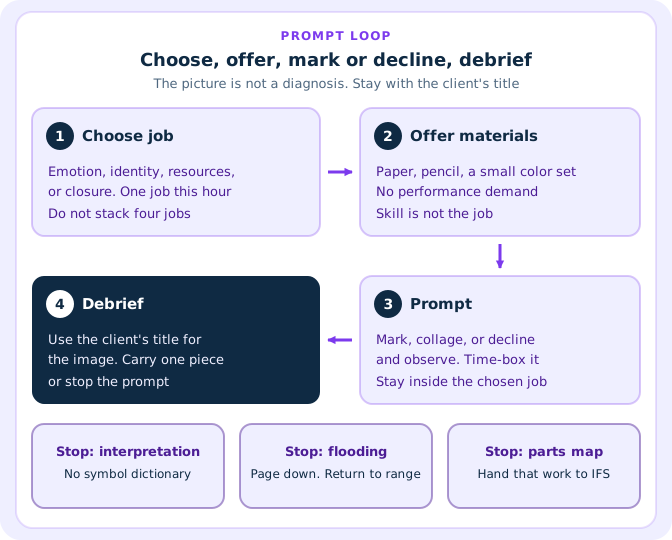
Emotion mapping
Job. Color, shape, or a simple mark for a feeling that is already in the room.
Materials. One sheet, a pencil, two or three colors. Time box: six minutes.
Decline. “You can mark, write a word, or watch while I keep the page.”
Sample. “If this feeling had a color or a shape, what would land on the page?” A client fills the lower third with gray and leaves the top blank. Title they give: “fog under the ceiling.” Debrief: “You called it fog under the ceiling. What do you notice in your body as you look at that?”
Stop. This is not an emotion-wheel diagnosis. It is not “draw your trauma.” If they start illustrating an index event, close the prompt.
Identity
Job. Inside/outside, roles, or what I show / what I keep.
Materials. One sheet, a line down the middle, pencil. Time box: eight minutes.
Decline. Write-only on either side is enough.
Sample. Left: “what I show.” Right: “what I keep.” A client writes “fine” on the left and draws a closed box on the right. Debrief: “You titled the right side a closed box. What does that box protect, in your words?”
Stop. This is not a scored mask. It is not a parts map. If managers, firefighters, or exiles are the useful language, stop this page.
Resources
Job. A safe-enough place, a helpful object, or a support map in image form.
Materials. Paper plus optional collage scraps already in the room. Time box: eight minutes.
Decline. They can name the place out loud and skip the image.
Sample. “Draw or glue one place or object that is safe enough right now, not perfect, not forever.” A client pencils a kitchen stool. Title: “the corner with the kettle.” Debrief: “You called it the corner with the kettle. What makes that corner usable today?”
Stop. This does not replace a safety plan. If risk is active, the verbal plan comes first. The picture is optional.
Closure
Job. One mark or image that closes the hour or the week.
Materials. The same sheet or a fresh corner. Time box: three minutes.
Decline. A spoken sentence is a valid close.
Sample. “Leave one mark that says we are stopping here.” A client adds a small line under the fog and says “enough for today.” Debrief: “You said enough for today. What, if anything, do you want this page to do between now and next time?”
Stop. This is not a crystal-ball future self. It is not a goal worksheet.
These four families are the clinical job of art therapy worksheets. The emailed pack repeats them with therapist notes.
Image safety, materials, and the no-interpretation rule
Materials stay simple on purpose. Paper, pencil, a small color set. Nothing that requires a studio or a talent story. Keep them in the room so the client is not carrying an unfinished trauma image through a waiting room.
Offer three exits before anyone marks: mark, write only, or observe. Consent is the first material.
Treat the no-interpretation rule as a core clinical boundary. You do not score form, color, or missing people. You do not translate houses, trees, or masks. You do not tell the client what the picture “really” shows. If you hear yourself reaching for a symbol, you have left the prompt.
Image safety also means what you will not assign: House-Tree-Person, Draw-a-Person, mandala affirmation coloring, kids grief-tree pages, suicide-method images, or graphic trauma illustration.
Debrief and what carries forward
Stay with the client’s title. Two questions are usually enough: what they would call it, and what they notice now. Repeat their words. Do not upgrade them into your formulation out loud.
What carries, if anything, is one agreed piece: the title, the decline, or a choice to leave the page in the room. Do not send a packet. Do not ask them to finish a drawing alone after flooding. Between-session use is optional and secondary.
Next hour, reopen the title or the decline, not an art critique you reconstructed from memory.
Privacy, documentation, and safety
Agree storage before private material hits paper. The working page may stay with the client or enter the file under practice policy. The progress note records the prompt used, the response (marked, wrote, declined), and affect or window. It does not paste the image, score it, or diagnose from it.
Each client-facing page in the pack carries a printed safety line: not a crisis service, not monitored in real time, not a diagnosis, not a substitute for the agreed safety plan, not an art-therapy evaluation.
Where Emosapien fits
You choose the prompt, the materials, and whether an image belongs in the hour. Emosapien keeps the prompt the client agreed to retry visible for the next session, so you can reopen the image or the decline instead of reconstructing a critique. The clinician still sets the stop rule. Nothing here scores a picture or watches a crisis feed.
Keep the agreed prompt visible for the next hour, including a decline.
References
- American Art Therapy Association. About art therapy.
- Malchiodi, C. A. (Ed.). (2012). Handbook of art therapy (2nd ed.). Guilford Press.
- Substance Abuse and Mental Health Services Administration. (2014). SAMHSA’s Concept of Trauma and Guidance for a Trauma-Informed Approach. HHS Publication No. (SMA) 14-4884.