Depression Worksheets for Teens in Therapy

Outline
Authored by Dr. Elena Vasquez, licensed psychologist (PsyD), play-therapy and child-and-family-therapy trained, with a family-systems lens across home, school, and clinic.
The backpack is still on the hallway floor. Maya, fifteen, has not come out since school. A parent wants a mood tracker. The school wants proof she is trying. Nobody has asked her what one small thing she might actually do before Thursday.
Depression worksheets for teens belong in a licensed session after withdrawal, a narrowed week, or unsupported days are already in view. The therapist chooses one short pack, says what it is for, names who will see it, and keeps the result inside treatment. This is not a parent shop pack, a classroom assignment, or a consumer teen workbook.
The pack below names a small-action sheet, a support map, a short thought check, and a clinician debrief card with a worked example. Download it, and keep naming the clinical purpose in session so the form does not become a test of whether she is depressed enough.
Email me the teen depression pack
Get the small-action sheet, support map, short thought check, and a clinician debrief card for purpose, cadence, stop conditions, and next-session reopen.
- One small next action with obstacle, helper, and a short after line
- Support map plus who must not see the page
- Two- or three-line thought check, not a seven-column record
- Clinician debrief card for purpose, cadence, stop conditions, and next-session reopen
Free. We'll email the PDF link right away and add you to the therapist toolkit, sent every two weeks. Unsubscribe any time.
Where should we send the link?
We'll email the PDF link right away. You'll also get the therapist toolkit every two weeks. Unsubscribe any time.
✓ Check your inbox
We've sent you the PDF
The download link is on its way to your inbox, usually within a minute or two. The email will come from Emosapien (hello@team.emosapien.com); check your spam folder if you don't see it.
You're also on the therapist toolkit list, sent every two weeks. Unsubscribe any time from the email footer.
Educational content for licensed therapists, not clinical, legal, or emergency advice. Worksheet selection sits inside formulation, consent, developmental fit, and risk review. These sheets do not replace supervision, a safety plan, a PHQ-9, or crisis protocol.
What depression worksheets for teens are and are not
This is one pack for outpatient adolescent and family talk therapy, roughly ages 13 to 19, with developmental level taking precedence over birthday. One named next action. Who can help, and who must not see the page. Two or three lines on a thought that showed up. Caregivers can support without prosecuting the referred teen.
The wider library of therapy worksheets in clinical practice covers choosing forms by clinical task. Use this printable pack when the next days need one try and one support map, not a new accusation. When the job is naming 1-3 skills the teen will actually try, use a coping skills checklist for teens.
| This pack is | This pack is not |
|---|---|
| One small scheduled action the teen can finish | A seven-day adult behavioral activation worksheet |
| A support map, including who must not see the page | A parent shop gallery or school counseling curriculum |
| A two- or three-line thought check | A seven-column CBT thought record |
| A therapist-chosen take-home | A PHQ-9, a suicide-risk template, or a depression test |
| A pass the teen can use without a lecture | Self esteem worksheets for teens |
AACAP’s clinical practice guideline for depression in children and adolescents treats assessment, formulation, and a treatment plan as the frame around any homework. These sheets sit inside that frame. They are not the assessment.
When one small try already fits
Assign depression worksheets for teens when formulation already points to withdrawal, narrowed activity, or unsupported days, and the teen can contribute or pass. “Fill the water bottle and sit on the hallway console for ten minutes” is a try. “Be less depressed” is not.
They are useful across a home and school gap when the next days need one action and one support map, not a new accusation. A younger teen can draw, point, dictate, or pass. An older teen can keep a private line that is not read aloud in the first minute.
Agree on a purpose before the page leaves. “Notice one try you can actually finish” is a purpose. “Prove you are working on your depression” is a character test, and a character test will find a guilty teen.
The assignment is optional in the sense that refusal, a skipped line, or a blank return still belongs in the next hour. Completion is not proof of alliance. Non-completion is not proof that the family will not do the work.
Home or a private enough place has to exist for one small try. If the only place to write is a backpack that a sibling opens, keep the work in the room.
When to pause the work
Pause this pack when the paper would cost the teen, the alliance, or safety.
Stop, shrink, or switch tasks when:
- Active suicide or self-harm risk. Safety planning and direct assessment take the hour. A small-action sheet does not sit on top of that. The worked example in this pack is deliberately non-graphic, and the pack is not a suicide-risk template.
- Unsafe record access. If a parent portal, group chat, or school shared drive will see the page, the private line does not belong on paper.
- Coercive control, custody, or school-discipline misuse. If the page will travel into a contested file or a principal’s meeting, it stays in the drawer.
- Flooding or freeze. The teen cannot name a try because the body has already left the room.
- Medical or sleep drivers that need referral. A behavioral try does not stand in for apnea, medication, or a medical evaluation.
- The indicated work is different. Administer a PHQ-9 through its own administration protocol. Use a behavioral activation schedule for adult weekly activity-mood logging, a thought record for situation-thought-feeling-behavior recording, and self esteem worksheets for teens for harsh worth beliefs. When the take-home is an ABCDE dispute rather than a seven-column record, use the rebt worksheet.
Parent shop packs, classroom mood meters, token boards, and unguided teen quizzes are out of audience. Do not teach those as the intervention.
SAMHSA’s trauma-informed principles put safety, trustworthiness, and choice ahead of any exercise. If last week’s review felt like a grade on mood, this week’s page will stay in the bag. Repair that first.
Dimidjian and colleagues’ adult behavioral activation trial is the related adult method. Name it when you assign a weekly activity log. Do not claim this teen pack was that trial intervention.
Walk the three teen sheets
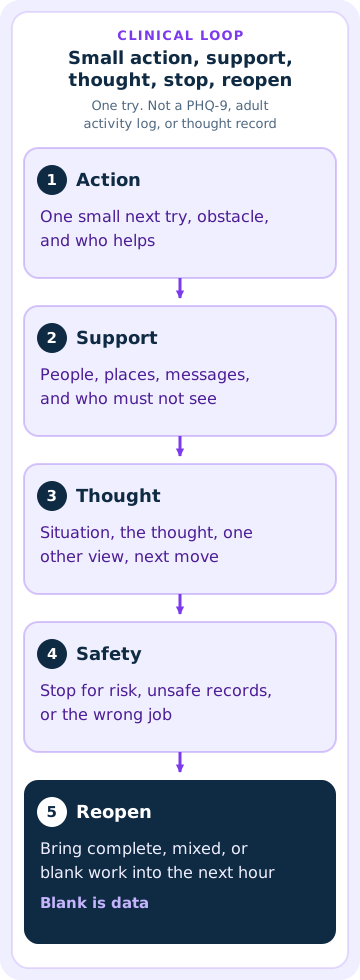
The printable pack exposes the same fields the family will see. Walk one try in session before the page goes home.
Small-action sheet
One named next action for the coming days, small enough to finish. Expected obstacle. Who or what would make it more likely. A short after line: tried, partly, or not yet. Developmental light: draw, point, or dictate is allowed. The teen may pass.
Introduce. “We are picking one try you can actually finish, not a new personality.”
Stop the page. A seven-day adult activity-mood grid. A symptom checklist. “Just go outside.”
Support map
People, places, and messages that help. One line for who should not see this page: peer group chat, parent portal, school counselor shared drive, sibling. The caregiver line is optional and must not prosecute the teen.
Introduce. “We are naming help, and we are naming who does not get this page.”
Stop the page. A forced family contact list. A school sharing default. Using the map to prove the teen has no friends.
Short thought check
One situation, the thought that showed up, one other way to see it, one next move. Two or three lines. Not a seven-column record and not a distortions gallery.
Introduce. “Three lines. You can pass on any of them.”
Stop the page. The therapist supplies the better thought and waits for the teen to agree. A lecture about thinking positive.
Worked example (debrief card)
This fictional, de-identified teen-and-family example shows how a therapist might complete the sheets, with no graphic self-harm content.
Reopen complete, mixed, or blank sheets
Name the pack at the start of the next hour. Keep more than one person’s account visible in family work without collapsing the teen’s privacy contract. If only the referred teen’s row is full, that is data about the assignment, not proof about the teen.
| Return state | First clinical move |
|---|---|
| Complete | Ask what the page missed, including anyone who was in the scene and is not on the paper |
| Mixed | Find which setting produced a usable try and which one became a complaint list |
| Thought line skipped | Thank the pass. Do not fill it in for them |
| Blank | Ask what happened around the form before you interpret motivation |
| Identified-patient collapse | Name the collapse without shaming it. Put the referred teen back in a try, not in the dock |
A useful reopen is specific: “You wrote that the bottle made it to the console, and you left the thought line blank. Where should we begin?” If the teen wants a different starting point, follow that.
Blank work is information. It can mean the try was too large, the home was not private, last week’s review felt like a grade, or the school week needed the whole hour. None of those possibilities should be scored from the page.
The APA Ethics Code keeps informed consent and competence in view when you send work home. Say what the sheet is for, who will see it, when you will read it, and that it is not monitored between sessions.
Privacy, documentation, and safety
Agree on delivery, storage, and sharing before anyone writes private material.
Delivery. Deliver it on paper, through a portal the practice already uses, or complete it together in session. Do not send clinical content through ordinary consumer email or SMS.
Storage. The working copy may stay with the teen or enter the file under practice policy. Portal copies belong in the approved record system. Do not send a completed sheet home in a backpack if the home is not private.
Sharing. Home and school sharing rules belong in the consent conversation. A teacher may hear a short, agreed next step. A teacher does not receive the teen’s private writing unless a specific, consented clinical reason exists.
Documentation. Record the clinically relevant signal, the intervention, the response, and the next step. Do not paste the sheet verbatim into the note unless there is a specific clinical reason.
A concise entry might read:
Reviewed between-session teen depression pack for one hallway try. Youth sat at the console for six minutes and left the thought line blank. Explored the blank line as a pass, not as noncompliance. Agreed to keep the sheet for one action only and to pause any sharing with school this week.
Safety boundaries. This sheet is not a crisis service, is not monitored in real time, and does not replace the agreed safety plan. It is not a school disciplinary record. It is not a depression test. It is not a PHQ-9. If the family needs urgent support, they use the crisis path you already set.
If risk language, marked deterioration, or a safety concern appears, leave worksheet mode. Follow the practice’s risk, consultation, and emergency procedures.
How Emosapien carries the thread
Emosapien keeps the small action and support map the teen agreed to try visible for the next appointment so you can reopen what actually happened, not a reconstructed story about the week. You choose the action, the cadence, and the response plan. Emosapien does not pick the try, score mood, monitor crisis risk, or contact emergency services.
See how that layer supports client engagement between sessions while clinical judgment stays with you.
Download the pack
The printable pack fits three teen sheets, a worked example, and one clinician debrief card onto 3 to 4 US Letter pages with selectable text:
- Small-action sheet
- Support map
- Short thought check
- Clinician debrief card: purpose and cadence; delivery and storage; fit and stop; next-session reopen for complete, mixed, or blank work; documentation prompt; worked example
Each teen page carries a printed safety line: not a crisis service, not monitored in real time, not a substitute for the agreed safety plan, not a school disciplinary record, not a depression test, not a PHQ-9.
Assign one try at a time. A second page belongs only after the first one came back without turning low mood into a character defect. Keep depression worksheets for teens as one pack, not a homework stack.
Email me the teen depression pack
Get the small-action sheet, support map, short thought check, and a clinician debrief card for purpose, cadence, stop conditions, and next-session reopen.
- One small next action with obstacle, helper, and a short after line
- Support map plus who must not see the page
- Two- or three-line thought check, not a seven-column record
- Clinician debrief card for purpose, cadence, stop conditions, and next-session reopen
Free. We'll email the PDF link right away and add you to the therapist toolkit, sent every two weeks. Unsubscribe any time.
Where should we send the link?
We'll email the PDF link right away. You'll also get the therapist toolkit every two weeks. Unsubscribe any time.
✓ Check your inbox
We've sent you the PDF
The download link is on its way to your inbox, usually within a minute or two. The email will come from Emosapien (hello@team.emosapien.com); check your spam folder if you don't see it.
You're also on the therapist toolkit list, sent every two weeks. Unsubscribe any time from the email footer.
References
- Walter, H. J., Abright, A. R., Bukstein, O. G., Diamond, J., Keable, H., Ripperger-Suhler, J., & Rockhill, C. (2023). Clinical practice guideline for the assessment and treatment of children and adolescents with major and persistent depressive disorders. Journal of the American Academy of Child and Adolescent Psychiatry, 62(5), 479-502.
- Substance Abuse and Mental Health Services Administration. (2014). SAMHSA’s Concept of Trauma and Guidance for a Trauma-Informed Approach. HHS Publication No. (SMA) 14-4884.
- American Psychological Association. Ethical Principles of Psychologists and Code of Conduct.
- Dimidjian, S., Hollon, S. D., Dobson, K. S., Schmaling, K. B., Kohlenberg, R. J., Addis, M. E., Gallop, R., McGlinchey, J. B., Markley, D. K., Gollan, J. K., Atkins, D. C., Dunner, D. L., & Jacobson, N. S. (2006). Randomized trial of behavioral activation, cognitive therapy, and antidepressant medication in the acute treatment of adults with major depression. Journal of Consulting and Clinical Psychology, 74(4), 658-670.