

Group Therapy Attendance Tracker: Roster, Not Chart

Outline
Authored by Dr. Hannah Lin, counseling psychologist trained in CBT, ACT, and IFS, with over a decade of clinical practice across anxiety and complex trauma.
Jordan opens the shared drive ten minutes before IOP. The roster already has a sentence in the notes column: “tearful, SI last week.” A co-facilitator typed it so nobody would forget. Two interns can see the file. So can the program assistant who prints the sign-in.
That sentence does not belong there. Presence belongs there. The clinical story belongs in the chart.
A group therapy attendance tracker is a facilitator roster for a shared file: member codes, present / late / absent, and a behavioral engagement mark. It is not a progress note. It is not a party list. It is not a place to store quotes so the next person “has context.”
If more than one person can open the sheet, write as if they will.
Educational resource for licensed mental-health clinicians facilitating therapy groups. Adapt every mark to consent, setting policy, risk procedure, and applicable privacy law. This is not legal advice and not a substitute for the chart.
Email me the facilitation pack
Get the stage and risk card, roster-only attendance tracker, activity menu, and termination planner as a printable US Letter PDF.
- Stage, risk, and trauma-informed keep-out card before you pick an activity
- Attendance and engagement tracker that stays out of the chart
- Activity menu for family, adult topics, experiential work, and recovery groups
- Termination planner with a transferable next step and after-group note stems
Free. We'll email the PDF link right away. We may also send the occasional therapist toolkit. Unsubscribe any time.
Where should we send the link?
We'll email the PDF link right away. You'll also get the occasional therapist toolkit. Unsubscribe any time.
✓ Check your inbox
We've sent you the PDF
The download link is on its way to your inbox, usually within a minute or two. The email will come from Emosapien (hello@team.emosapien.com); check your spam folder if you don't see it.
You're also on the weekly therapist toolkit list. Unsubscribe any time from the email footer.
What belongs on the roster
The group therapy resource hub covers the wider cluster. Come back here for the shared file you mark after the hour, when a co-facilitator or intern can still see it.
Keep the columns boring on purpose.
Scroll the table sideways to view every column
| Field | Allowed on the shared tracker | Put this in the chart instead |
|---|---|---|
| Identity | Initials or a standing code | Full name, date of birth, or a printable sign-in list |
| Presence | Present, late, or absent | Why they missed, who called, or the excuse they gave |
| Engagement | O, P, or F from the key below | What they said, which part spoke, or a skill they named |
| Follow-up | Y or N, codes only | Risk, quotes, diagnosis, or the outreach script |
| Pattern | A scan box for repeating late or a second absence | The clinical meaning of the pattern over weeks |
The Group Facilitation and Recovery Pack prints this split on page 2. After-group stems sit on page 1 and page 4 so you are not tempted to park them on the roster. A group therapy attendance tracker only earns its keep if those five fields stay boring.
Engagement marks without clinical detail
O, P, and F are behavioral, not interpretive.
- O: observed only. The member stayed in the room and did not take the task.
- P: partial. They spoke once, completed part of the task, or used a pass.
- F: full. They stayed with the hour’s job.
Do not upgrade a mark because the content was “deep.” A member who discloses trauma and then leaves the room is not F. A member who passes twice and still completes the written backup can be P. The mark answers how they took the job, not how important the material felt.
Jordan’s Tuesday group ran a low-disclosure round. Member C spoke once and asked to pass on the second prompt. That is P. The urge they named goes in C’s chart, not in a cell a printer can spit into the hallway.
If you need language for the record, use group therapy notes examples and keep one shared frame beside each member’s participation, response, risk, and plan.
When a group therapy attendance tracker fits
Fit is a privacy and facilitation judgment, not a spreadsheet habit.
Use the shared roster when:
- more than one clinician, intern, or program staff can see the file;
- the group is open or closed and you need a running presence count;
- you want a same-night scan for repeating lateness or a second absence this cycle;
- engagement needs a one-letter mark so the next facilitator is not guessing from memory;
- the chart still exists as the only place for clinical content.
CBT skills groups often need to know who rehearsed the task. ACT groups often need to know who stayed with the hour under discomfort. IFS-informed groups may watch blending in the room without turning parts language into a shared cell. The tracker only helps if those marks stay behavioral.
Live judgment in the hour still sits in how to facilitate a group therapy session. This file is what you mark after people leave.
When to keep clinical content out of the shared file
Pause the shared roster, or shrink it to presence only, when writing would become a second chart that the wrong people can open.
Stop or do not assign when:
- risk is active and the safety protocol, not another column, is required;
- a partner, parent, or custody process could coerce the sheet;
- the setting forbids shared PHI files, including unsanctioned cloud drives;
- the group is SUD care and attendance itself is sensitive under 42 CFR Part 2;
- the real job is a member-specific note, a billing ledger, or a practice-wide missed-appointment workflow.
Standard 4.01 of the APA Ethics Code requires psychologists to take reasonable precautions to protect confidential information. A shared drive with quotes is not a reasonable precaution. The HIPAA minimum necessary standard points the same way: if an intern only needs to know who came, they do not need last week’s suicidal ideation in the notes column.
The Association for Specialists in Group Work keeps group work tied to purpose, preparation, and active facilitation. A roster is preparation and aftercare. It is not the clinical hour.
Mark the file, then leave it
Scroll the visual sideways to view the full diagram
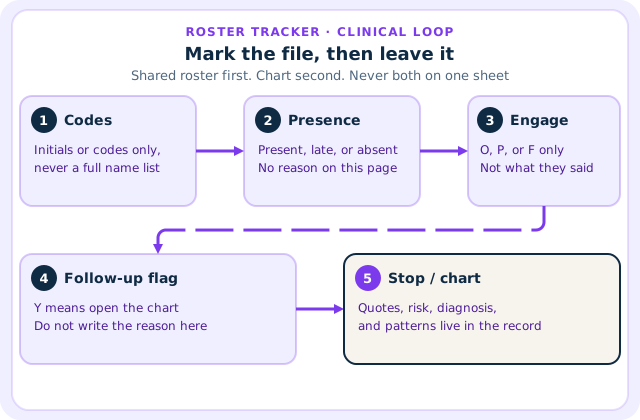
Run one session as a short facilitator sequence.
- Before the room arrives, confirm the file is roster-only. Codes, not a printed name list on the table.
- State the pass option aloud. Engagement marks assume people may sit out without a public reason.
- After close, mark present, late, or absent. Do not write why.
- Add O, P, or F from what you observed, not from how moving the hour felt.
- Set follow-up to Y only when you will open that member’s chart the same day.
- Complete the facilitator scan: new member or guest, repeating late, more than one absence this cycle, ending window named aloud.
- Write intervention, participation, response, and next step in the record. Leave the roster alone.
A late arrival is still a presence mark, not a story. If someone walks in at minute 18, mark late, offer the current task or the backup, and restate the pass. The reason they were late waits for the chart, a hallway check, or individual follow-up.
A follow-up flag is a hinge, not a story. Y means you have a job in the chart. It does not mean “document the reason here so I remember.” If you will not open the chart tonight, do not tick Y as a sticky note.
After-group scan without a second chart
The pack’s scan boxes are still roster language.
New member or guest present tells you consent and orientation may still be thin. Repeating lateness is a pattern cue, not a character label. More than one absence this cycle is a continuity cue. An ending window is a reminder to name remaining sessions aloud, not to dump unfinished work into the last hour.
Who needs individual follow-up stays in codes. What you will write in the chart has a prompt line so you do not park that sentence on the shared page.
If the same names keep showing Y, the tracker is doing its job. The meaning of that pattern still belongs in formulation, supervision, and the member record.
Software can hold the split between a shared hour and member continuity. That is a different artifact from this paper roster. For the product path, see group therapy software. If you want that split inside Emosapien, start a trial and keep clinical content in the record, not in a shared sheet.
Keep the pack honest
This group therapy attendance tracker does not replace a treatment plan, a safety protocol, or clinical judgment. Do not photocopy a filled roster into the chart. Do not put chart content into a shared tracker. One job per hour. One primary activity. One backup. One written next step, in the record.
If you came here looking for a hallway sign-in, a no-show fee script, or a diagnostic log, you are in the wrong file. The sheet in the pack is a facilitator roster. Use it that way.
Get the roster page with the rest of the pack
Stage and risk, roster-only attendance, activity menu, and a termination planner. Chart stems stay off the shared file.
Free. We'll email the PDF link right away. We may also send the occasional therapist toolkit. Unsubscribe any time.
Where should we send the link?
We'll email the PDF link right away. You'll also get the occasional therapist toolkit. Unsubscribe any time.
✓ Check your inbox
We've sent you the PDF
The download link is on its way to your inbox, usually within a minute or two. The email will come from Emosapien (hello@team.emosapien.com); check your spam folder if you don't see it.
You're also on the weekly therapist toolkit list. Unsubscribe any time from the email footer.