
Mental Health Tracker for Weekly Review

Outline
Authored by Dr. Hannah Lin, counseling psychologist trained in CBT, ACT, and IFS, with over a decade of clinical practice across anxiety and complex trauma.
A mental health tracker is a clinician-assigned weekly log of symptoms, functioning, skills, context, and next-session questions the pair already agreed to watch. Licensed therapists use it in outpatient talk therapy when the next hour keeps getting spent reconstructing the week, and a scored instrument is not the job.
The pack is short on purpose: one client week, an optional second week or summary strip, and a clinician review panel. Blank is allowed on every field. The sheet is not a diagnosis, not a quiz, and not watched between sessions.
Download the weekly tracker pack
Get the client week, optional second week, and clinician review panel as a printable US Letter PDF.
- One-week client sheet with agreed marks and a non-monitoring footer
- Optional second week and one-line weekly summary strip
- Clinician panel for purpose, cadence, delivery, fit, stop, and reopen
- Worked outpatient example and documentation prompt
Free. We'll email the PDF link right away and add you to the therapist toolkit, sent every two weeks. Unsubscribe any time.
Where should we send the link?
We'll email the PDF link right away. You'll also get the therapist toolkit every two weeks. Unsubscribe any time.
✓ Check your inbox
We've sent you the PDF
The download link is on its way to your inbox, usually within a minute or two. The email will come from Emosapien (hello@team.emosapien.com); check your spam folder if you don't see it.
You're also on the therapist toolkit list, sent every two weeks. Unsubscribe any time from the email footer.
Educational content for licensed therapists, not clinical, legal, or emergency advice. Adapt the sheet to formulation, consent, risk, culture, accessibility, setting, and applicable practice requirements.
What this pack is and is not
This is an idiographic review worksheet. The therapist names the marks. The client can finish a week in a few minutes. The next session reopens what returned, including a blank page.
| This pack is | This pack is not |
|---|---|
| A weekly symptoms, functioning, skills, and context log | A diagnostic interview or “you have X if” quiz |
| Therapist-chosen labels for a named watch window | PHQ-9, GAD-7, or another validated total |
| A place for skills used, partly used, or not this week | A named-instrument score log |
| Next-session questions the client wants to bring back | A mental health check-in worksheet pulse |
| A clinician review panel with a stop rule | An app, consumer diary, or real-time monitor |
For app-container decisions, use apps to recommend to therapy clients. Use the measurement based care guide for validated-measure cadence, scoring, and review.
When a mental health tracker fits
Fit is a modality judgment, not a productivity habit.
Useful presentations:
- the client is already in outpatient care, not googling a self-test;
- the pair can name two or three marks worth watching this month (a body cue, a rumination loop, a missed meal with family), not a DSM checklist;
- functioning at work or school, home, or relationships keeps disappearing from the hour unless someone writes it down;
- a skill was rehearsed in session and you need to know whether it was used, partly used, or not;
- the client can mark a week in under a few minutes, on paper, in an approved portal, or with you at the start of the hour.
CBT often wants a concrete cue and a skill trial. ACT often wants functioning in a valued domain plus whether the skill showed up under discomfort. IFS-informed work may watch blending or unblending without turning parts language into a scored trait. The sheet only helps if those marks are already in the formulation.
For the wider between-session question, tracking therapy progress between sessions stays the essay. This pack is the printable weekly artifact. When the take-home is a name-peak-move stem rather than a weekly tracker, assign journal for emotional regulation.
When to pause
Pause the sheet when writing would become surveillance, a fake diagnosis, or a substitute for the actual clinical job.
Stop or do not assign when:
- risk is active and the practice safety plan, not another row, is required;
- the client uses the page as proof they are “fine” or “failing”;
- tracking itself feeds rumination or compulsive checking;
- a partner, parent, or custody process could coerce or misuse the page;
- the job is PHQ-9, GAD-7, a testing battery, or another validated measure;
- a daily polarity chart or a short qualitative pulse is enough;
- there is no consent, or home privacy is not workable.
SAMHSA’s trauma-informed approach centers safety, trust, collaboration, and empowerment. Handing over a weekly log without an agreed purpose, stop date, and review window fails that frame. Standard 10.01 of the APA Ethics Code requires psychologists, when obtaining informed consent to therapy, to inform clients as early as feasible about the nature and anticipated course of therapy. Name the tracker’s purpose, watch window, and stop rule before the sheet leaves the room, and treat the assignment as optional homework the client can decline.
Walk the five client fields
Set up the mental health tracker with five fields, not a 90-day research diary. Agree the labels before the page leaves the room.
Scroll the visual sideways to view the full diagram
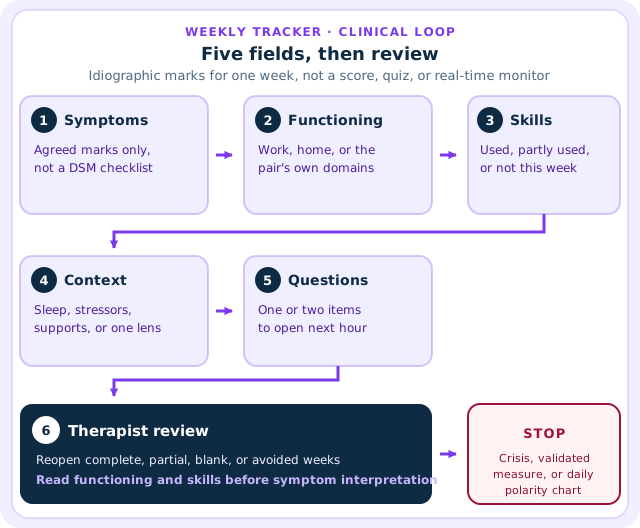
Week dates
A start and end keep the page attached to one interval. A client-chosen identifier can stay optional on paper when the practice can match the sheet another way. Do not load extra identifiers onto a page that may travel outside the chart.
Symptoms
Write the marks you already agreed to watch, in the client’s language. “Tight chest after the afternoon email” is a mark. A photocopied DSM list is not. Leave unused rows blank. Intensity, if used at all, is a conversation prompt, not a diagnostic band.
Functioning
Pick the domains that matter for this course: work or school, home, relationships, or one pair-specific domain. Ask what the client did, skipped, or half-did. Functioning often tells you more than the loudest symptom line.
Skills
Used, partly used, or not this week. “Not this week” is a valid mark. It keeps the field from becoming a hidden adherence score and gives the next hour a place to look at access, burden, timing, and fit.
Context
One agreed lens is enough: sleep, stressors, supports, or another lens the pair named. Context explains why the same cue landed differently. It is not a second diary.
Next-session questions
One or two questions the client wants to open. A question can be more useful than a severity number. If the client leaves it blank, that is still a return state.
Debrief the week in session
Review the mental health tracker from functioning and skills before you interpret symptoms. Complete, partial, blank, and avoided weeks all count as information.
| Return state | First clinical move |
|---|---|
| Complete | Name one functioning or skill mark, then ask what the page missed |
| Partial | Find where burden, privacy, activation, or uncertainty changed the task |
| Blank | Ask what happened around the sheet before you interpret motivation |
| Avoided | Check coercion, shame, or a sheet that started to feel like a grade |
A useful reopen is specific: “You made two meetings and skipped the defusion practice after Tuesday. Where should we start?” If the client wants a different starting point, follow that. The sheet serves the hour only when the client can still redirect the room.
Shrink, complete it together, or stop when the page becomes repetitive, secret, or a performance.
Privacy, documentation, and safety
Agree delivery before the first send: paper the client keeps, an approved secure portal, or completion in session. Do not send PHI through consumer email or SMS.
This sheet is not monitored in real time. Say that out loud. If the client would have to wait for you to read a row before seeking help, the assignment is unsafe.
Chart the clinically relevant signal: a functioning drop, an unused skill, new context, or a question the client wants to open. Do not paste the sheet into the record unless setting or policy requires it.
A concise note might read:
Reviewed weekly log for 3-9 March. Client reported tight chest after work email on two days, attended two of four team meetings, and skipped the planned defusion practice after a late night. Agreed to keep the sheet for two more weeks, complete it in session if home privacy stays limited, and reopen the skipped-practice barrier next hour.
If risk language appears, leave worksheet mode. Use the practice safety plan. Do not add another tracking row and call that monitoring.
How Emosapien carries the thread
Emosapien keeps the weekly symptoms, functioning, and skills marks the therapist asked for visible at the next appointment, so the clinician can reopen what actually happened rather than a reconstructed week. The therapist chooses the fields, cadence, and stop rule. The Engagement Agent can run guided check-ins and auto-schedule validated measures; this paper tracker is not that automated measure. Emosapien does not diagnose, score the sheet, watch crisis risk, or contact emergency services.
See how Emosapien supports client engagement between sessions while the review stays with the therapist.
Download the printable pack
The PDF includes three US Letter pages:
- one-week client sheet with symptoms, functioning, skills, context, next-session questions, and a non-monitoring footer;
- an optional second week plus a one-line weekly summary strip;
- a clinician review panel with purpose, cadence, delivery, fit and stop, reopen paths, documentation, a crisis caveat, and one worked outpatient example.
Download and print the pack before the first watch window, not after the week has already vanished.
Download the weekly tracker pack
Get the client week, optional second week, and clinician review panel as a printable US Letter PDF.
- One-week client sheet with agreed marks and a non-monitoring footer
- Optional second week and one-line weekly summary strip
- Clinician panel for purpose, cadence, delivery, fit, stop, and reopen
- Worked outpatient example and documentation prompt
Free. We'll email the PDF link right away and add you to the therapist toolkit, sent every two weeks. Unsubscribe any time.
Where should we send the link?
We'll email the PDF link right away. You'll also get the therapist toolkit every two weeks. Unsubscribe any time.
✓ Check your inbox
We've sent you the PDF
The download link is on its way to your inbox, usually within a minute or two. The email will come from Emosapien (hello@team.emosapien.com); check your spam folder if you don't see it.
You're also on the therapist toolkit list, sent every two weeks. Unsubscribe any time from the email footer.
References
- American Psychological Association. Ethical Principles of Psychologists and Code of Conduct.
- Substance Abuse and Mental Health Services Administration. Trauma-informed approaches.