
Best HIPAA Compliant Note App for Therapists in 2026

Outline
Friday evening, three unsigned notes, and a vendor site that only says “HIPAA compliant” on the homepage. That is not a buying criterion. It is a slogan.
The best HIPAA compliant note app for a therapy practice is the one that survives a boring operations test: signed BAA on the plan you buy, therapy formats you already write, psychotherapy-note separation when you use process notes, role access that matches who sees which chart, clinician review before anything becomes the record, and export you can leave with. Feature tours skip those tests. A usable shortlist does not.
For therapists and mental-health practices comparing note tools across vendors, keep the shortlist below as operations guidance, not a legal opinion and not the Emosapien product landing. For the product-category workflow and psychotherapy-notes split inside one vendor, use the HIPAA-compliant therapy notes page. For a wider notes-software peer set beyond privacy filters, use the best therapy notes software roundup.
Quick picks by practice shape
| Practice need | Shortlist start | Why it clears the HIPAA-and-ops filter |
|---|---|---|
| Best overall therapy workflow + notes | Emosapien | Multi-format drafts, optional clinician-controlled in-session support, BAA on Professional and Enterprise, separate psychotherapy-note vault |
| Mature post-session AI notes | Mentalyc | Long therapy track record, strong format coverage, BAA on paid plans, major US EHR path |
| AI notes plus wider EHR functions | Upheal | Capture, therapy notes, treatment planning, and practice ops under one vendor |
| Measurement-led chart with AI docs | Blueprint | Outcomes sit first; notes and plans wrap scores and goals |
| Lean solo AI notes | Supanote or Quill | Narrow documentation focus, lower overhead, faster solo evaluation |
| EHR-with-notes, not AI-first | TherapyNotes or ICANotes | System of record with therapy charting and established BAA posture |
Vendor facts are based on public US pages checked July 2026. Functionality, pricing, and terms can change after publication.
Non-negotiables before demos
Judge the live product, not the homepage. Even a strong best HIPAA compliant note app shortlist fails if any check below is fuzzy on the plan you will buy.
1. Signed BAA on your tier. Ask for the agreement before you put ePHI in a trial that becomes production. Some vendors gate the BAA to higher plans. HHS explains why business associates need this relationship in the first place (HHS business associates).
2. Psychotherapy notes vs progress notes. Progress notes are the clinical record. Psychotherapy notes can receive extra protection when they meet the HIPAA definition and stay separate from the designated record set (HHS psychotherapy notes FAQ). If the app mixes process material into every export, that is an operations problem, not a branding detail.
3. Therapy formats. SOAP alone is not enough for many caseloads. DAP, BIRP, and GIRP still show up in private practice, IOP, and SUD work. A medical SOAP default forces rewrite time every day.
4. Role access and minimum necessary. Solo is simple. Groups need clinician, supervisor, owner, and admin paths that do not dump every chart into a shared inbox.
5. Clinician review and sign-off. AI can draft. It cannot own the record. Require human review before the note is final.
6. Retention, deletion, and export. You need a way out: chart export, deletion on request, and a retention story that matches your board and payer rules. A lock-in archive is a future migration bill.
7. Therapy continuity. Homework, measures, and treatment-plan goals are clinical work. A note that never reconnects to them is only half a system.
Comparison table
| Tool | Best fit | BAA posture | Therapy note fit | Main tradeoff |
|---|---|---|---|---|
| Emosapien | Therapy workflow + multi-format notes | BAA on Professional and Enterprise | SOAP, DAP, BIRP, GIRP, PIE; separate psychotherapy-note vault | Broader platform if you only want a scribe |
| Mentalyc | Proven post-session AI notes | BAA on paid plans | SOAP, DAP, BIRP, GIRP | Cross-targets non-therapy audiences |
| Upheal | AI notes with EHR-style ops | HIPAA-oriented US posture with BAA path | SOAP, DAP, EMDR packs | Between-session continuity is lighter |
| Blueprint | MBC-led practices | HIPAA-oriented with BAA path | Outcomes-anchored notes and plans | Broader stack than a notes-only buy |
| Supanote | Lean solo notes | HIPAA-oriented; confirm BAA on your plan | Common therapy formats | Thin integrations and continuity |
| Quill | Structured export into EHR fields | BAA available | SOAP, DAP, BIRP | Smaller brand footprint; tiered pricing |
| TherapyNotes | Insurance-heavy US chart | Established EHR BAA posture | Strong clinical templates | Not an AI-first documentation layer |
| ICANotes | Behavioral health EHR notes | EHR BAA posture | SOAP, DAP, BIRP, GIRP + templates | Full EHR commitment, not a bolt-on |
1. Emosapien
Best for: therapists who want optional, clinician-controlled in-session support plus therapy-shaped notes, not a passive transcript dump.
Emosapien drafts SOAP, DAP, BIRP, GIRP, and PIE notes from session context. Clinician review stays mandatory before sign-off. Security and product controls include encryption in transit and at rest, SOC 2 Type II and ISO 27001 infrastructure claims, a BAA on Professional and Enterprise, no training of foundation models on session content, and a separate vault for psychotherapy notes so process material is not auto-bundled into routine exports.
What clears the ops filter:
- Multi-format therapy notes with modality-aware Assessment language.
- Separate psychotherapy-note handling rather than one mixed export.
- Role-aware access patterns for solo and small-group caseloads.
- Free tier (10 AI-generated sessions per month, no credit card, no BAA) for simulated or fictional data only. Identifiable PHI only after a signed BAA on Professional or Enterprise, with settings complete and consent confirmed. Consent alone does not make Free-tier PHI use acceptable.
Watch-outs:
- Newer integration list than the longest-running EHRs.
- Not a full practice-management system. Keep billing and portal on your EHR if they already work.
- Broader workflow than a post-session-only scribe.
Best fit: solo psychologists, counselors, and small groups that want documentation plus continuity without buying a hospital stack.
2. Mentalyc
Best for: US therapy practices that want a mature post-session AI note generator with EHR write-back paths.
Mentalyc has a long therapy documentation track record. It generates SOAP, DAP, BIRP, and GIRP notes and integrates with major US therapy EHRs. Paid plans include a signed BAA and HIPAA-aligned security controls.
What clears the ops filter:
- Strong format coverage with sensible defaults.
- Mature US-market integrations.
- Clear paid-plan BAA path.
Watch-outs:
- Cross-targets ABA, OT, and related audiences, so the roadmap is not therapy-only.
- Post-session only. No clinician-controlled in-session support layer.
- Confirm psychotherapy-note separation if process notes leave your designated record set.
Best fit: US solo or small-group talk therapy practices already on a major therapy EHR.
3. Upheal
Best for: therapists who want AI capture and notes alongside treatment planning and wider practice operations.
Upheal combines therapy-focused AI notes with treatment planning, an AI assistant, and broader EHR-style functions. Real-time capture is a core strength. Note packs cover common therapy formats, including SOAP, DAP, and EMDR-oriented documentation.
What clears the ops filter:
- Dependable session capture for telehealth and in-room work.
- One-vendor path when notes and ops need to move together.
- HIPAA-oriented US posture with a BAA path to verify on your plan.
Watch-outs:
- Between-session continuity is thinner than tools with a dedicated engagement layer.
- Verify current session caps, plan features, and BAA tier before annual billing.
- If you only need a documentation layer on a stable EHR, a full stack can be more product than you need.
Best fit: practices that want AI notes and practice operations under one vendor.
4. Blueprint
Best for: measurement-based-care practices that want notes tied to scores and goals.
Blueprint leads with outcomes. AI progress notes and treatment plans sit inside that stack rather than as a thin bolt-on. Blueprint offers HIPAA-oriented controls and a BAA path for covered entities.
What clears the ops filter:
- Notes and plans anchored to measures and goals.
- Useful when audit conversations start with outcomes, not narrative alone.
- Free EHR base options for practices that want chart and AI docs together.
Watch-outs:
- Format breadth and modality-specific Assessment language can feel thinner than documentation-first tools.
- Usage-priced AI on top of an EHR path can overshoot a notes-only buy.
- Confirm export and psychotherapy-note handling before you move process notes in.
Best fit: group practices and outcome-focused clinics that already want measurement in the center of the chart.
5. Supanote
Best for: solo clinicians who want a lean notes tool with minimal admin surface.
Supanote stays narrow on purpose: generate a clean therapy note and stop. Pricing is simple and per-clinician. There is little practice-management weight and no deep continuity layer.
What clears the ops filter:
- Fast solo evaluation path.
- Therapy formats without medical EHR overhead.
- Low monthly overhead for cash-pay and light-insurance solos.
Watch-outs:
- Confirm the BAA on the exact plan you will buy.
- Smaller integration and export ecosystem.
- Little between-session or treatment-plan continuity beyond what you wire by hand.
Best fit: one-person practices that want documentation savings without a platform migration.
6. Quill
Best for: practices that want structured AI notes that map toward EHR fields.
Quill is therapy-focused and leans into structured output. Quill covers SOAP, DAP, and BIRP with treatment-plan linkage and a BAA path. That makes it a middle layer when the EHR stays put and documentation quality is the gap.
What clears the ops filter:
- Structured output that is easier to place into chart fields.
- Therapy-first framing rather than hospital scribe defaults.
- BAA available on paid plans.
Watch-outs:
- Smaller brand footprint and social proof than Mentalyc or Upheal.
- Tiered pricing can move solos upward sooner than expected.
- Still a post-session draft tool, not an in-session workflow.
Best fit: small groups and solos that keep their EHR and want cleaner structured notes on top.
7. TherapyNotes
Best for: US practices whose primary risk is chart quality and insurance audit readiness, not AI typing speed.
TherapyNotes is an EHR, not an AI-first note app. It still belongs on a HIPAA note-app shortlist because many buyers are really choosing where the record lives. Templates, treatment planning, and claims depth are the product. The BAA posture is the standard EHR pattern: signed agreement with the system of record.
Practices that want the record to stay put while adding therapy-specific AI can compare TherapyNotes alternatives for therapy practices before changing EHRs.
What clears the ops filter:
- Mature US behavioral health charting.
- Strong structure for measurable goals and audit-ready notes.
- One system for chart, claims, and templates.
Watch-outs:
- AI drafting depth is not the center of the product.
- Front-office polish trails portal-first competitors.
- Buying TherapyNotes is an EHR decision, not a bolt-on scribe trial.
Best fit: insurance-heavy US practices that want the chart and notes in one established system.
8. ICANotes
Best for: behavioral health practices ready to standardize on a mental health EHR with broad note templates.
ICANotes is built for behavioral health charting. SOAP, DAP, BIRP, GIRP, group notes, and case-management templates sit inside an ONC-certified environment with billing and telehealth options. AI-assisted and menu-driven templates speed charting, but the identity is system of record.
What clears the ops filter:
- Purpose-built mental health charting rather than a general medical EHR adapted later.
- Broad template coverage, including group and case management.
- Established EHR BAA and access-control model.
Watch-outs:
- Migration cost is higher than layering a scribe on your current EHR.
- AI drafting is secondary to template-driven charting.
- Wrong buy if you only need documentation on top of a stable record.
Best fit: clinics ready to make the behavioral health EHR the center of operations.
What we excluded on purpose
Generic AI medical scribes. Heidi, Nuance DAX, Suki, Abridge, Nabla, and Freed are strong products for primary care and hospital medicine. Their default note shape, coding logic, and privacy models are not built around talk-therapy formats or psychotherapy-note separation. For replacement intent on those medical tools, use the therapy-specific alternative pages on the alternatives hub, including the DAX and Abridge therapist pages when you are leaving a medical ambient tool.
Hospital and multi-specialty EHRs. Epic, Cerner, athenahealth, and eClinicalWorks serve a different buyer. Most solo psychologists and small group practices do not need that overhead for progress notes.
Consumer AI chat tools. No signed BAA, no clinical audit trail, and often model-training terms that conflict with ePHI handling. They are not a note app for a covered entity.
Practice-size decision path
Use this path before you book demos. It is how operators actually shortlist the best HIPAA compliant note app without drowning in feature matrices.
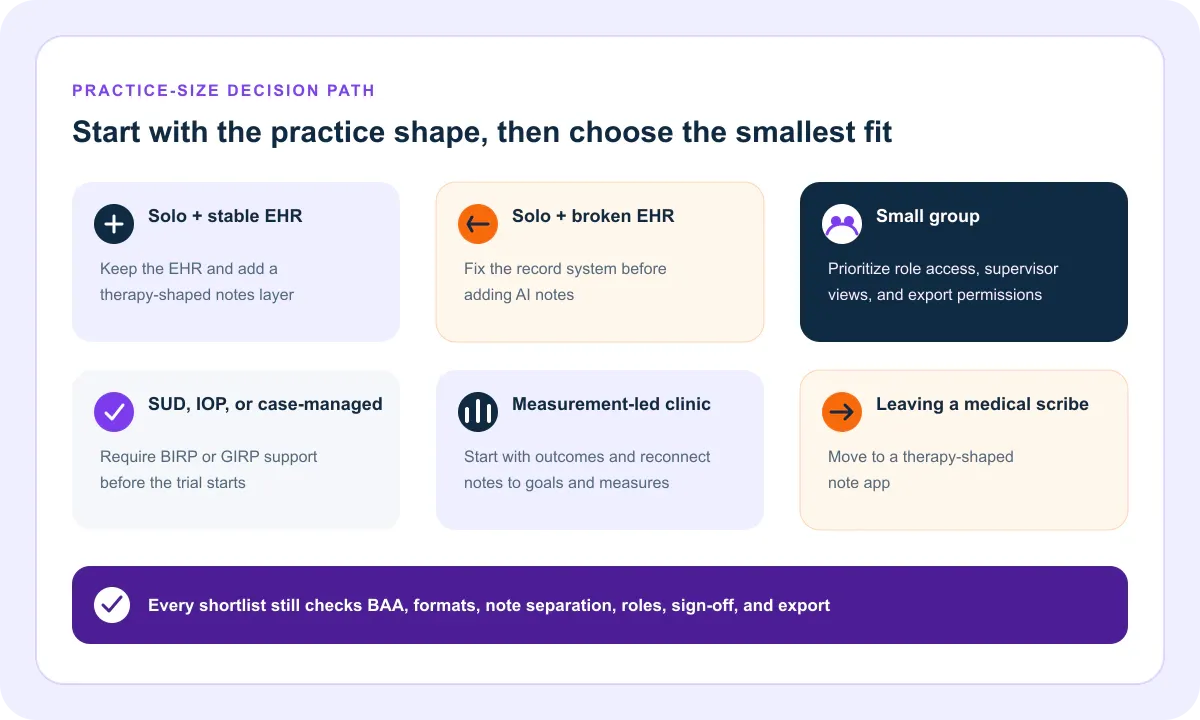
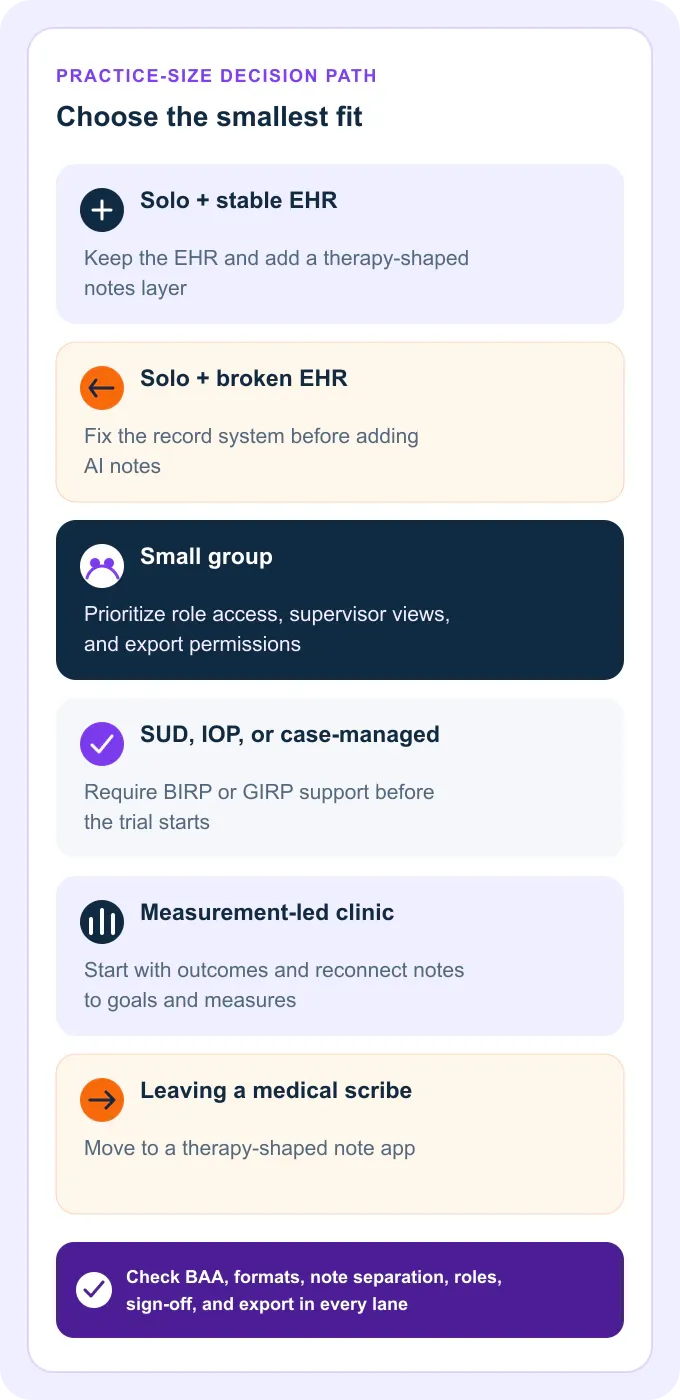
Solo, stable EHR, notes are the pain. Keep the EHR. Shortlist Emosapien, Mentalyc, Supanote, or Quill. Require BAA on your tier, your formats, and export back into the chart. Trial on simulated data first, then three consented real sessions only after the BAA is live. If you are deciding whether those drafts should be a native add-on or a second layer, run the ehr ai notes vs standalone gates before you migrate the chart.
Solo, broken EHR plus notes pain. Do not buy two half-systems in one week. Fix the record first with a therapy EHR shortlist, then layer AI notes if typing time remains the bottleneck.
Small group, shared admin, supervision in the mix. Prioritize role access, supervisor views, and who can export. Emosapien, Upheal, Blueprint, TherapyNotes, and ICANotes are the realistic lane. Ask who can open whose caseload on day one.
SUD, IOP, or case-managed care. BIRP or GIRP support is non-negotiable. SOAP-only tools drop off immediately.
Measurement-led clinic. Start with Blueprint if scores already run the treatment conversation. Everyone else must show how notes reconnect to goals and measures.
Leaving a medical ambient scribe. Do not force a hospital tool to pretend it is therapy software. Move to a therapy-shaped note app and keep medical scribes for medical settings.
How to trial without creating a mess
- Get the BAA path in writing for the plan you will buy.
- Turn on only the formats you write this month.
- Evaluate first with simulated session data on free or uncontracted tiers.
- Execute the BAA, finish settings and consent, then run three to five consented real sessions across your caseload mix.
- Time clinician edit-to-sign-off, not demo wow-time.
- Export one finished note into your EHR the way you will on a Tuesday.
- Check psychotherapy-note separation if you keep process notes.
- Price twelve months of seats, not the launch discount.
If a vendor fails export, BAA, or edit time on your caseload, end the trial. Charm is not a control.
Practices that record or upload session audio should run the HIPAA-compliant AI transcription checklist before the first real recording. Keep this page for the multi-vendor note-app shortlist; use that guide for the full audio-to-note data path.
Choosing the best HIPAA compliant note app without overbuying
“Best” still means fit. The best HIPAA compliant note app for one caseload is a poor buy for the next. Buy the smallest system that clears BAA, formats, separation, roles, sign-off, and export. Keep the EHR when the chart already works. Add AI notes when typing time is the bottleneck, not when a homepage scares you into a migration.
If optional clinician-controlled in-session support and multi-format therapy notes match how you work, create a free Emosapien account and evaluate only with simulated or fictional data on Free. Move identifiable client sessions only after the Professional or Enterprise BAA is executed and settings plus consent are complete. If a leaner post-session tool or an EHR-with-notes platform fits better, pick that. Choose against your Friday afternoon caseload, not against a vendor script.
References
This review is current as of July 2026. Pricing, features, and integrations move quickly. Confirm current capabilities with each vendor before purchasing. Educational content for licensed mental health practitioners; not legal, clinical, or compliance advice.